



Climbing stairs shouldn’t leave you breathless. Chasing after your kids at the park shouldn’t require a recovery break. Yet for millions of people, these everyday activities highlight a concerning reality: poor aerobic fitness has become the norm rather than the exception.
Your aerobic capacity—your body’s ability to efficiently deliver and utilize oxygen during sustained activity—serves as the foundation for virtually every aspect of physical performance. Whether you’re an elite athlete pursuing a personal record, a weekend warrior training for your first 5K, or someone who wants to feel energized throughout the day, your aerobic fitness determines how well your body performs under demand.
Individuals with higher aerobic fitness tend to have lower risks of heart disease and overall mortality. Cardiorespiratory fitness is a powerful indicator of long-term health—more important than body weight—making it one of the best ways to invest in your future well-being.
Improving aerobic fitness isn’t about grinding through endless hours of monotonous cardio or pushing yourself to exhaustion every workout. The most effective approach combines strategic training methods, precise heart rate zones, and objective measurement to optimize your body’s oxygen-processing capabilities.
Understanding Aerobic Fitness
Aerobic fitness represents your body’s ability to take in, transport, and utilize oxygen efficiently during sustained physical activity. Think of it as your cardiovascular system’s engine capacity—the better your aerobic fitness, the more powerfully and efficiently your heart, lungs, and muscles work together to fuel your movement.
At its core, aerobic fitness reflects how well your body performs the process of cellular respiration. When you exercise, your muscles demand oxygen to convert stored energy into usable fuel. Your heart pumps oxygen-rich blood to working muscles, while your lungs extract oxygen from the air you breathe. The more efficiently this system operates, the longer and harder you can sustain activity before fatigue sets in.
This efficiency is what VO2 Max measures—your maximum rate of oxygen consumption during intense exercise. Expressed as milliliters of oxygen consumed per kilogram of body weight per minute, VO2 Max is the standard indicator of aerobic fitness and cardiovascular endurance. A higher VO2 Max means your body can process more oxygen, delivering greater energy to your muscles and enabling superior performance across all activities.
While elite athletes certainly benefit from exceptional aerobic fitness, this capacity matters equally for everyone else. Whether you’re carrying groceries up three flights of stairs, playing with grandchildren, or maintaining energy throughout a busy workday, your aerobic fitness determines how easily your body meets these oxygen demands. Individuals with higher aerobic fitness experience better quality of life, increased longevity, and reduced risk of chronic diseases, making it one of the most powerful predictors of overall health and vitality.
The Zone 2 Foundation
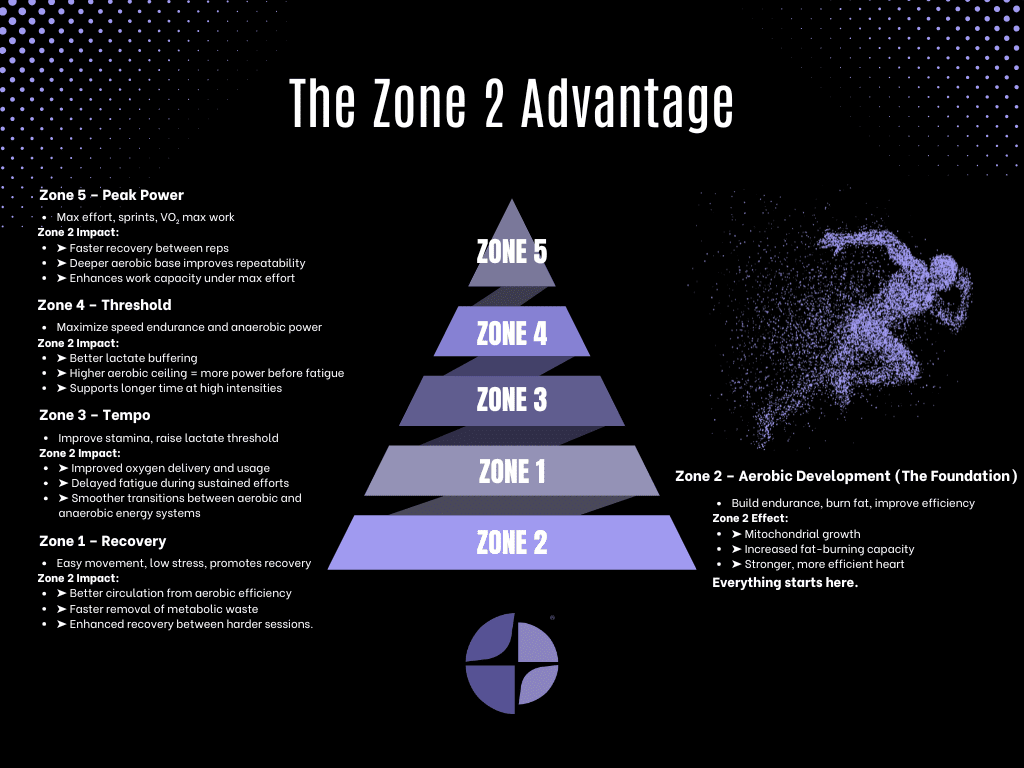
Zone 2 training has become the cornerstone of modern endurance and fitness programming—and for good reason. This heart rate zone shows the sweet spot where your body maximizes aerobic development while building the metabolic foundation that enhances every other aspect of your training.
What Makes Zone 2 Special?
Zone 2 occurs below your aerobic threshold—the exercise at which the body transitions from primarily using fat to a greater reliance on carbohydrates for fuel, while still maintaining a steady state of oxygen supply.. At this intensity, you’re working hard enough to stimulate meaningful adaptations without crossing into the anaerobic realm where lactate begins accumulating faster than your body can process it.
During Zone 2 training, your body undergoes remarkable adaptations:
- Mitochondria (your cellular powerhouses) multiply and become more efficient
- Capillary density increases, improving oxygen delivery to muscles
- Your heart becomes stronger and more efficient at pumping blood
- Fat oxidation pathways become highly developed and efficient
How Zone 2 Enhances All Training Zones
Think of Zone 2 as the foundation of a fitness pyramid. When you strengthen this aerobic base, you enhance your performance across all intensity zones:
- Zone 1 (Recovery): Better aerobic efficiency means faster recovery between sessions
- Zone 3-4 (Tempo/Threshold): Improved oxygen delivery supports higher sustainable intensities
- Zone 5 (Neuromuscular Power): Enhanced lactate clearance allows for better recovery between high-intensity intervals
This effect explains why elite endurance athletes spend 80% of their training time in Zone 2—it amplifies the benefits of every other training zone.
The Metabolic Advantage
Zone 2 training transforms your body into a fat-burning machine. At this intensity, your muscles preferentially burn fat for fuel, which offers several advantages:
- Sustained Energy: Fat provides a virtually unlimited fuel source compared to limited carbohydrate stores
- Metabolic Flexibility: Your body becomes efficient at switching between fuel sources as needed
- Improved Body Composition: Enhanced fat oxidation supports healthy weight management
- Fewer Metabolic Byproducts: Fat metabolism produces fewer reactive byproducts and less metabolic stress than carbohydrate burning
Why Generic Formulas Fall Short
Your Zone 2 heart rate can’t be accurately determined through age-based formulas or fitness trackers. These generic calculations can be off by 20-30 beats per minute, leading to ineffective training that either undershoots or overshoots your prime zone.
Only a VO2 Max test can identify your precise aerobic threshold and corresponding Zone 2 heart rate. This testing measures your actual oxygen consumption and carbon dioxide production, revealing the exact point where your body maximizes fat burning while maintaining aerobic efficiency. Without this data, you’re training blind, potentially missing the benefits that properly executed Zone 2 training provides.
Four Strategies to Transform Aerobic Fitness
Strategy 1: Build Your Aerobic Base with Zone 2 Training
The Protocol That Works: Start with 30-45 minute Zone 2 sessions, 2-3 times per week. Your pace should feel “conversational”—you should be able to speak in full sentences without gasping for air. As your fitness improves, gradually extend these sessions to 60-90 minutes while maintaining the same heart rate zone.
Progressive Overload Made Simple:
- Week 1-2: 30 minutes at Zone 2 intensity
- Week 3-4: Increase to 40 minutes
- Week 5-6: Progress to 45-50 minutes
- Week 7+: Gradually work toward 60+ minute sessions
The key is consistency and duration. Your body adapts to the sustained aerobic demand, building the mitochondrial density and capillary networks that form your aerobic foundation.
Strategy 2: Add Strategic High-Intensity Work
The Research-Backed Approach: Training even in lower-intensity zones improves aerobic capacity. However, high-intensity interval training achieves similar adaptations with lower training volumes than low-intensity continuous exercise.
Smart Integration:
- Maintain 80% of your training in Zone 2
- Add 1-2 high-intensity sessions per week
- Use intervals like 4×4 minutes at 85-95% max heart rate with 3-minute recoveries
- Allow 48-72 hours between high-intensity sessions
Think of high-intensity work as the “sharpening” phase that maximizes the aerobic base you’ve built through Zone 2 training.
Strategy 3: Consistency Trumps Perfection Every Time
The Sustainable Mindset: Missing a workout won’t derail your progress, but inconsistent training patterns will. Your cardiovascular system responds to regular, repeated stimuli, not sporadic bursts of motivation followed by weeks of inactivity.
Building Unbreakable Habits: Start Small: Three 30-minute sessions beat one 90-minute “hero” workout.
Schedule Non-Negotiables: Treat training appointments like important meetings.
Embrace Flexibility: A 20-minute walk counts when life gets busy.
Track Streaks: Celebrate consecutive weeks of consistent training
Individuals who exercise regularly for 6 months can improve their VO2 Max by 15-20%—but only if they maintain consistency throughout the training period.
Strategy 4: Monitor and Measure for Maximum Results
Why Heart Rate Training Works: Your heart rate provides real-time feedback about training intensity, ensuring you’re working in the correct zone for your intended adaptation. Unlike perceived exertion, which varies with fatigue, stress, and mood, heart rate offers data you can trust.
The Testing Advantage: Generic age-based formulas (220 minus age) can miss your training zones by 20-30 beats per minute. This margin of error means you might be training too easily to stimulate adaptation or too hard to maintain aerobic benefits.
Objective Testing vs. Guesswork:
| Generic Formula | VO2 Max Testing |
| One-size-fits-all calculations | Personalized heart rate zones |
| 20-30 BPM margin of error | Precise aerobic threshold identification |
| Estimates fat-burning zone | Measures actual fat oxidation rates |
| Static recommendations | Tracks fitness improvements over time |
Professional VO2 Max testing reveals your exact aerobic threshold, anaerobic threshold, and peak oxygen consumption—providing the precise heart rate targets that transform guesswork into strategic training.
The Science Behind Effective Training
Improvements in VO₂ Max aren’t solely dependent on how intense your workouts are. Whether training at moderate or very high intensities, the cardiovascular benefits can be surprisingly similar.
The key difference? Higher-intensity training can deliver those same results with much less total workout time. This reinforces what elite coaches have known for years—success isn’t about pushing harder, but about training smarter with focused, efficient effort.
The Individual Variation Reality
Consider this scenario: Two 35-year-old athletes with identical fitness backgrounds begin the same training program. Using the standard “220 minus age” formula, both would target the same heart rate zones. Yet their actual aerobic thresholds could differ by 30+ beats per minute.
Real-World Example:
- Athlete A: Aerobic threshold at 135 BPM
- Athlete B: Aerobic threshold at 155 BPM
- Generic Formula: Both target 148 BPM (80% of estimated max)
Result? Athlete A trains above their aerobic threshold (developing different adaptations), while Athlete B trains well below optimal intensity (missing key adaptations). Same program, completely different outcomes.
This individual variation stems from:
- Genetic factors affecting heart size and stroke volume
- Training history influencing cardiac efficiency
- Metabolic differences in oxygen utilization
- Physiological adaptations unique to each person
The difference between estimation and measurement becomes critical when you consider that effective Zone 2 training often occurs within a narrow 10-15 beat range. Generic formulas can’t provide this level of precision.
The Mixing Chamber Advantage
Mixing chamber technology is the pinnacle of metabolic measurement accuracy. Unlike breath-by-breath systems that analyze each individual exhale (creating inconsistent data), mixing chambers collect and average expired air over time, providing stable, reliable measurements even during high-intensity exercise.
Key Advantages:
- Consistent Readings: No fluctuation from breathing patterns or movement
- Environmental Stability: Unaffected by air currents or temperature changes
- Complete Data: Captures both oxygen consumption AND carbon dioxide production
The Fat Burn Revelation Here’s what sets comprehensive testing apart: while competitors focus solely on oxygen measurement, advanced systems analyze the complete respiratory exchange. This reveals your respiratory exchange ratio (RER)—the precise point where your body transitions from fat to carbohydrate burning.
Why does this matter? Knowing your exact fat-burning zone allows you to target the intensity that maximizes metabolic efficiency, body composition improvements, and sustainable energy production. Without measuring oxygen and carbon dioxide, you’re missing half the metabolic picture. Training based on assumptions limits your potential. Training based on precise metabolic data unlocks it.
Transform Your Potential into Performance
Your aerobic fitness is far more than a number on a test—it’s the foundation of your energy, vitality, and long-term health. Every flight of stairs you climb effortlessly, every training session where you push new boundaries, and every day you feel energized from morning to night reflects the power of a well-conditioned cardiovascular system.
The strategies outlined here are proven pathways to transformation. Zone 2 training builds your aerobic engine. Strategic high-intensity work sharpens your performance edge. Consistent execution creates lasting change. But without precise measurement, you’re navigating this journey without a compass.
Generic formulas and fitness tracker estimates rob you of your full potential. They keep you training in approximations when your body deserves precision. They leave metabolic insights undiscovered when those insights could revolutionize your approach to fitness and health.
KORR’s advanced VO2 Max testing with mixing chamber technology doesn’t just measure your current fitness—it reveals your pathway to optimization. Discover your true Zone 2 heart rate. Identify exactly where your body burns fat most efficiently. See precisely how your cardiovascular system responds to different intensities.
Ready to discover what precision-guided training can do for your performance and health? Experience the KORR difference and unlock your aerobic potential today.