



Two runners line up at the starting line of a marathon. Both have logged thousands of training miles over the past year. Both follow structured training plans, maintain disciplined nutrition, and prioritize recovery. Yet when they cross the finish line, one runner completes the race a full 20 minutes ahead of the other. What made the difference?
The answer isn’t found in their training logs or weekly mileage totals. Instead, it lies in three physiological markers that determine endurance performance at the highest levels. While many athletes focus on training volume and intensity, elite performers understand that success comes from identifying and optimizing specific metabolic capabilities that can’t be improved through willpower alone.
Cardiovascular fitness is one of the strongest predictors of not just athletic performance, but overall health and longevity. The secret lies in understanding three physiological factors that act as the foundation of elite endurance performance: your maximum oxygen uptake capacity (VO2 Max), your anaerobic threshold, and your aerobic threshold. These markers work together to create your metabolic fingerprint—a blueprint that reveals how your body processes energy during exercise and where your greatest opportunities for improvement exist.
Unlike generic training formulas or one-size-fits-all approaches, these physiological markers are as individual as your DNA. They determine your training zones, your race-day strategy, and ultimately, your performance ceiling. Understanding and optimizing these three factors is what separates athletes who simply train hard from those who train smart—and achieve extraordinary results.
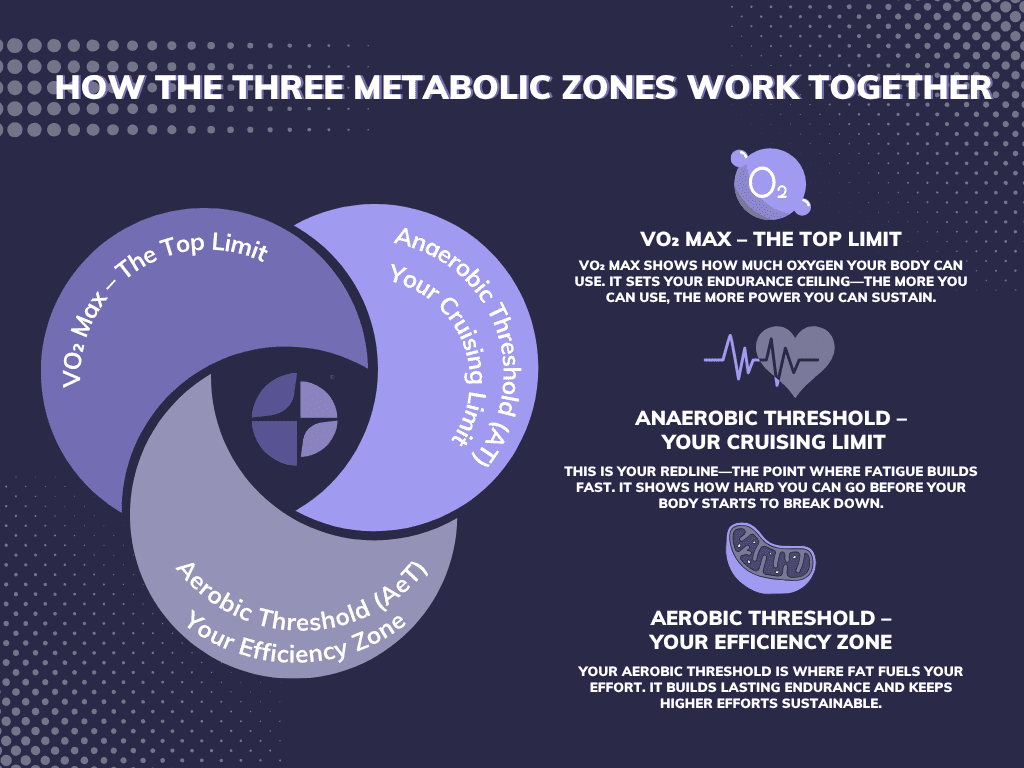
The Three Pillars of Elite Endurance Performance
1. VO2 Max: Your Cardiovascular Ceiling
What if your body came with a horsepower rating?
It does. It’s called VO2 Max, and it’s the single most revealing number about your endurance potential. This measurement, expressed as milliliters of oxygen consumed per kilogram of body weight per minute—tells you exactly how much fuel your cardiovascular engine can process at maximum capacity.
When exercise physiologists measure VO2 Max, they’re stress-testing your entire cardiovascular system. During a graded exercise test, you’ll exercise at progressively increasing intensities while breathing into an oxygen consumption analyzer. As the intensity climbs, your oxygen consumption rises in a linear relationship—until it doesn’t. That plateau, where oxygen consumption levels off despite increasing exercise intensity, represents your VO2 Max.
Here’s why VO2 Max has earned its status as the “gold standard” for cardiovascular fitness:
- Oxygen = Performance Power: Every heartbeat, every breath, every muscle contraction depends on oxygen delivery
- Predictive Precision: VO2 Max accurately forecasts endurance performance across a range of sports
- Universal Currency: Whether you’re running, cycling, or swimming, VO2 Max translates directly to sustainable speed
- Health Predictor: VO2 Max is one of the strongest predictors of cardiovascular disease and all-cause mortality
That difference isn’t just academic—it’s the gap between a 4-hour marathon and a 2:30 finish time. Consider that elite marathoners can sustain approximately 75-85% of their VO2 Max for the entire 26.2-mile distance. A recreational runner with a VO2 Max of 45 ml/kg/min running at 85% capacity produces roughly 38 ml/kg/min of oxygen consumption. An elite athlete with a VO2 Max of 75 ml/kg/min running at the same percentage produces 64 ml/kg/min—enabling faster sustainable speeds.
Even modest improvements in VO₂ Max can create big performance gains. Exercise training across various intensities helps increase maximal oxygen uptake in young, healthy adults. These improvements translate to real-world health benefits. Every 3.5 ml/kg/min increase in VO₂ Max (equivalent to one metabolic equivalent) can enhance endurance and cardiovascular efficiency. For athletes, that means maintaining faster paces with less perceived effort—the holy grail of endurance performance.
The Testing Reality: Accurate VO2 Max testing requires precise measurement of oxygen consumption during maximal exercise. The test involves collecting and analyzing all expired air during a graded exercise protocol, typically lasting 10-15 minutes. This process requires equipment capable of measuring air flow volume and oxygen concentration with extreme precision—factors that separate clinical-grade testing from consumer approximations.
2. Anaerobic Threshold (AT): The Breaking Point That Matters
Your anaerobic threshold marks the point past which your body creates lactate faster than it can be cleared. This threshold is a physiological “red line”—crossing it leads to faster fatigue, making it a key factor in endurance and performance.
The Metabolic Mechanics:
Below your AT, your body operates like a well-tuned hybrid vehicle. Oxygen-dependent aerobic metabolism efficiently converts fats and carbohydrates into energy through the Krebs cycle, producing carbon dioxide and water as clean byproducts. This process can continue for hours because oxygen supply meets demand, and metabolic waste products clear faster than they accumulate.
Cross your AT, and everything changes. Your muscles begin recruiting anaerobic pathways that produce energy without oxygen—but at a cost. These pathways generate lactate and hydrogen ions (H+), which lower the pH within muscle cells, creating a more acidic intracellular environment. This drop in pH is associated with that familiar burning sensation during intense exercise that forces you to slow down or stop.
Training Adaptations That Move the Threshold:
Athletes push their AT higher through specific physiological adaptations:
- Enhanced Oxygen Delivery: Increased cardiac output, capillary density, and red blood cell count improve oxygen transport to working muscles
- Improved Lactate Clearance: Better ability to shuttle lactate from working muscles to other places it can be utilized (e.g., heart, liver, slow-twitch muscle fibers)
- Mitochondrial Efficiency: More and larger mitochondria increase aerobic energy production capacity
- Buffering Capacity: Enhanced ability to neutralize acid buildup in muscle tissue
Previously sedentary individuals can improve their anaerobic threshold by 15–25% through structured training programs lasting 3–6 months. For already-trained athletes, even a 5–10% improvement can lead to noticeable performance gains.
Race Day Strategy Revolution:
Understanding your AT transforms strategy from guesswork into precision engineering. Instead of relying on perceived exertion or generic pace charts, you can:
- Pace Optimization: Sustain the highest possible intensity without crossing into unsustainable anaerobic metabolism
- Energy Management: Preserve glycogen stores by maximizing aerobic metabolism throughout the race
- Tactical Positioning: Know exactly when surges or climbs will push you beyond sustainable effort
- Recovery Planning: Understand how long you need to clear lactate after threshold efforts
Imagine two marathoners with identical VO2 Max values but different AT percentages. Runner A reaches AT at 80% of VO2 Max, while Runner B maintains aerobic metabolism until 88% of VO2 Max. Runner B can sustain faster pace throughout the marathon while operating in the same metabolic comfort zone.
The Precision Problem: Generic heart rate formulas (like 220 minus age) can’t accurately identify individual AT. Your threshold is determined by complex interactions between genetics, environment, training history, and current fitness level. Precise identification requires metabolic testing that measures oxygen consumption and lactate accumulation during progressive exercise intensity.
3. Aerobic Threshold (AeT): The Fat-Burning Sweet Spot
Your Aerobic Threshold is the metabolic foundation that makes everything else possible. This often-overlooked physiological marker has revolutionized endurance training methodology, transforming how elite athletes build the aerobic base that supports peak performance.
The Metabolic Sweet Spot Explained:
Your AeT shows the exercise intensity where fat oxidation predominates. Below this point, your body operates like a perfectly calibrated hybrid engine, extracting maximum energy from fat stores while relying less on carbohydrate reserves.
The physiological magic happens through a complex orchestration of metabolic pathways:
- Lipolysis Optimization: Fat cells release fatty acids at high and sustainable rates
- Oxygen Efficiency: Mitochondria preferentially use oxygen to break down fats through beta-oxidation
- Glycogen Preservation: Carbohydrate stores remain largely untouched and are saved for higher-intensity efforts
- Lactate Clearance: The body efficiently processes minimal lactate production without accumulation
The Zone 2 Revolution:
Modern endurance training places strong emphasis on Zone 2 because of its role in building aerobic capacity and metabolic efficiency. Zone 2 training usually occurs at or just below your aerobic threshold (AeT) and is characterized by:
- Heart Rate: Around 60–70% of your maximum heart rate (with significant individual variation)
- Power Output: Roughly 55–75% of your functional threshold power (FTP)
- Pace: A conversational effort—you should be able to speak in full sentences without gasping
- Respiratory Exchange Ratio (RER): Typically 0.85 or lower, indicating your body is primarily using fat for fuel
This training zone supports long-term endurance and helps build the physiological base needed for higher-intensity efforts.
The Unlimited Fuel Advantage:
Training below your AeT unlocks access to your body’s most abundant energy source. Consider the math:
✓ Fat Stores: Even lean athletes carry 50,000-100,000+ calories in fat reserves
✓ Carbohydrate Stores: Muscle and liver glycogen provide only 1,500-2,000 calories
✓ Utilization Rate: Efficient fat oxidation can fuel 3-4+ hour efforts without external fuel
✓ Performance Sustainability: Reduced reliance on limited glycogen extends endurance capacity
How Zone 2 Enhances All Training Zones
Here’s the truth that separates smart athletes from hard-working ones: Zone 2 training enhances every other training zone. The physiological adaptations create a cascade of performance benefits:
Zone 1 (Active Recovery) Benefits:
- Enhanced fat oxidation makes easy efforts feel effortless
- Improved circulation accelerates recovery between sessions
- Better lactate clearance speeds metabolic waste removal
Zone 3 (Tempo/Threshold) Benefits:
- Stronger aerobic base delays the onset of anaerobic metabolism
- Improved oxygen delivery sustains higher intensities longer
- Enhanced lactate processing allows longer threshold efforts
Zone 4 (Lactate Threshold) Benefits:
- Greater aerobic contribution reduces anaerobic demand
- Improved buffering capacity tolerates higher lactate levels
- Faster lactate clearance enables shorter recovery intervals
Zone 5 (Neuromuscular Power) Benefits:
- Accelerated recovery between high-intensity intervals
- Maintained form and coordination when fatigue sets in
- Greater total work capacity in interval sessions
Elite Training Distribution:
A well-structured endurance training approach emphasizes spending the majority of time in lower-intensity zones, like Zone 1 and Zone 2, with a smaller portion dedicated to higher-intensity efforts. This distribution helps build a strong aerobic foundation, which supports performance across all training zones. Focusing on aerobic threshold development enhances efficiency, endurance, and long-term progress more effectively than training at moderate intensities.
Physiological Adaptations from Zone 2 Training:
Consistent AeT training triggers adaptations that reshape your metabolic profile:
- Mitochondrial Biogenesis: Increases the number and size of cellular powerhouses
- Capillary Density: Enhances oxygen and nutrient delivery to working muscles
- Enzyme Activity: Upregulates fat-oxidizing enzymes while improving lactate processing
- Cardiac Efficiency: Increases stroke volume and cardiac output at submaximal intensities
- Respiratory Efficiency: Improves oxygen extraction and carbon dioxide removal
These adaptations create a snowball effect. As your aerobic engine becomes more powerful and efficient, previously challenging intensities feel easier, allowing you to train at higher absolute intensities while remaining in Zone 2.
The Precision Problem and Testing Requirements:
Generic heart rate formulas can’t identify your personal AeT. Your metabolic fingerprint depends on:
- Genetics and muscle fiber composition
- Training history and current fitness level
- Age, body composition, and hormonal status
- Environmental factors and nutritional state
Accurate AeT identification requires sophisticated metabolic testing that measures:
- Oxygen Consumption (VO2): How much oxygen your body uses at each intensity
- Carbon Dioxide Production (VCO2): Metabolic byproduct of energy extraction
- Respiratory Exchange Ratio (RER): The ratio of VCO2 to VO2 indicating fat vs. carbohydrate oxidation
- Heart Rate Response: Individual cardiovascular response to increasing intensity
The Technology Distinction:
Accurate metabolic testing is best accomplished with mixing chamber technology that provides precise, stable measurements across all exercise intensities. This approach differs greatly from breath-by-breath systems that can be influenced by environmental factors and provide noisy data requiring extensive algorithmic smoothing.
Mixing chamber technology collects all expired air in a mixing chamber before analysis, providing consistent, reliable measurements that accurately identify your unique metabolic transition points. This precision allows coaches and athletes to prescribe training zones based on individual physiology rather than population averages.
Training Application and Periodization:
Understanding your precise AeT enables scientific training periodization:
- Base Building Phases: 90% of training at or below AeT intensity
- Build Phases: 70-80% Zone 2 training with progressive intensity additions
- Peak Phases: Maintain Zone 2 volume while adding race-specific intensities
- Recovery Phases: Return to AeT-focused training for physiological restoration
Elite athletes regularly assess their Aerobic Threshold (AeT) every 6–12 weeks to track progress and recalibrate training zones as fitness evolves. This approach guarantees they continue training at the right intensity—challenging enough to promote adaptation without falling into the trap of stagnant progress caused by outdated training zones.
Your Aerobic Threshold forms the cornerstone of endurance performance. Prioritizing Zone 2 training strengthens this foundation, enhancing all other aspects of your endurance. Overlooking it, no matter how hard you train at higher intensities, can lead to frustration and incomplete development.
The Difference Between Guessing and Knowing
Would you trust your marathon pace to a bathroom scale?
That’s essentially what happens when athletes rely on generic formulas to determine their training zones. The popular “220 minus your age” heart rate formula—still used by countless fitness apps and gym equipment—was developed from a small study of sedentary individuals decades ago. Yet millions of athletes base their entire training strategy on this outdated approximation.
The Generic Formula Fallacy
Here’s the uncomfortable truth about one-size-fits-all approaches: they fit almost no one accurately.
Generic formulas make three fatal assumptions:
- Heart rate correlates identically across all individuals (it doesn’t)
- Metabolic transitions occur at predictable percentages (they don’t)
- Training zones can be estimated without measuring actual fuel utilization (they can’t)
Standard equations for predicting resting metabolic rate often fail to provide accurate results, showing that direct measurement of energy expenditure is essential. This same concept applies to exercise metabolism—individual differences make relying on population averages ineffective for precise training.
The KORR Difference
KORR’s mixing chamber technology highlights the evolution of metabolic testing from research laboratory to real-world application. While competitors rely on breath-by-breath analysis, KORR’s approach provides the accuracy and reliability that serious athletes and coaches demand.
The Environmental Factor:
Breath-by-breath systems face a challenge—they’re measuring something that varies dramatically with each respiratory cycle. Environmental factors like temperature changes, air movement, or even a nearby fan can cause wild fluctuations in the data. It’s like trying to measure the depth of a lake during a storm versus measuring it when the water is perfectly still.
KORR’s mixing chamber technology eliminates this variability by collecting all expired air in a chamber before analysis. This approach provides the consistent measurements that allow for precise identification of metabolic transition points.
Auto-Calibration Revolution:
Here’s where KORR’s engineering excellence shines. Traditional metabolic testing requires:
- Gas tanks for calibration
- Syringes for flow verification
- 5-10 minutes of manual calibration procedures
- Technical expertise to execute properly
KORR’s Auto-Calibration Process:
- 90 seconds: Complete automatic calibration
- Zero gas tanks: Calibrates using room air
- No syringes: Eliminates manual flow verification
- Push-button simple: Removes human error factors
Manual calibration introduces variables that can compromise measurement precision. KORR’s automated system ensures consistent, accurate results for every single test.
The Individualization Imperative
Your Metabolic Fingerprint is Unique
Just as no two fingerprints are identical, no two metabolic profiles match exactly. Your training zones depend on a complex interaction of factors:
Genetic Variables:
- Muscle fiber type composition (slow-twitch vs. fast-twitch)
- Cardiovascular anatomy and function
- Enzymatic activity levels
- Mitochondrial density and efficiency
Training History Variables:
- Years of endurance training
- Sport-specific adaptations
- Previous intensity distributions
- Recovery and adaptation patterns
Current State Variables:
- Fitness level and training phase
- Nutritional status and body composition
- Age-related physiological changes
- Environmental and lifestyle factors
The Case for Precision Testing:
In morbidly obese individuals preparing for gastric bypass surgery, estimating post-surgical weight loss using predictive formulas proves inadequate. Measuring energy expenditure directly is the only reliable way to understand true metabolic rates. For example, two patients with the same estimated energy expenditures can have very different actual metabolic rates, resulting in drastically different weight loss outcomes.
The same principle applies to endurance training. Two athletes with similar VO2 Max values may have very different anaerobic and aerobic thresholds, which calls for completely different training approaches.
Real-World Impact of Precision:
Consider the implications of inaccurate zone prescription:
Training Too Easy (Zones Too Low):
- Insufficient stimulus for adaptation
- Stagnant performance improvements
- Wasted training time and potential
Training Too Hard (Zones Too High):
- Excessive stress and incomplete recovery
- Increased injury and overtraining risk
- Compromised immune function and health
Training Precisely (Accurate Zones):
- Optimal stimulus for adaptation
- Consistent, measurable progress
- Sustainable long-term development
Why KORR’s Approach Matters for Your Performance:
- Immediate Results: No waiting for lab analysis or complex interpretations
- Reproducible Testing: Consistent protocols enable accurate progress tracking
- Comprehensive Data: Measurement of VO2, VCO2, and RER reveals complete metabolic picture
- User-Friendly Reports: Complex data translated into actionable training zones
- Cost-Effective: Own the technology instead of paying per test
The Fat Burn Revelation:
Here’s something most athletes never discover without proper testing: the exact heart rate where you burn fat most efficiently. Generic formulas can’t tell you this because fat oxidation peaks at different intensities for different individuals. KORR’s metabolic analysis reveals your personal fat-burning sweet spot—information that’s game-changing for endurance performance and body composition goals.
Beyond Heart Rate Zones:
Accurate metabolic testing provides insights that heart rate monitoring alone can’t deliver:
- Caloric burn rates at different exercise intensities
- Fuel utilization patterns (fat vs. carbohydrate) throughout your effort range
- Metabolic efficiency comparisons over time
- Recovery zone identification for active recovery sessions
The science is clear: elite endurance performance isn’t just about training harder—it’s about training smarter with precise knowledge of individual physiology. VO2 Max, Anaerobic Threshold, and Aerobic Threshold work together as the foundation of endurance excellence, but only when accurately identified and properly applied.
As a fitness professional, you have the power to transform your clients’ results by moving beyond generic formulas to evidence-based, individualized training. When you can pinpoint exactly where your client burns fat most efficiently, sustains aerobic metabolism longest, and reaches their cardiovascular ceiling, you’re engineering performance breakthroughs.
Partner with KORR to unlock the future of your clients’ health and fitness—because precision training starts with precision testing.