



Imagine you’re watching two of your clients tackle the same workout. One is breathing heavily after just a few minutes, while the other seems to glide through the session with steady, controlled breaths. What’s the difference? It’s not just fitness level or motivation—it’s how efficiently their bodies use oxygen.

As a trainer, you’ve probably noticed that some clients seem to have endless endurance while others hit a wall quickly, even when their strength and technique are comparable. The secret lies in understanding how the body processes and utilizes oxygen during exercise. This process determines everything from fat-burning efficiency to peak performance potential.

Oxygen is the fuel that powers every movement, every rep, and every training session. When you understand how your clients’ bodies use oxygen, you unlock the ability to design personalized training programs that maximize their results. 

The difference between a client who struggles through cardio and one who thrives isn’t just about willpower or genetics—it’s about how effectively their cardiovascular system delivers oxygen to working muscles and how efficiently those muscles use it to produce energy.

The Oxygen Journey

Understanding how oxygen travels through your clients’ bodies is like mapping the most important delivery system in human physiology. Every breath they take sets off a chain of events that determines their exercise capacity and performance potential.

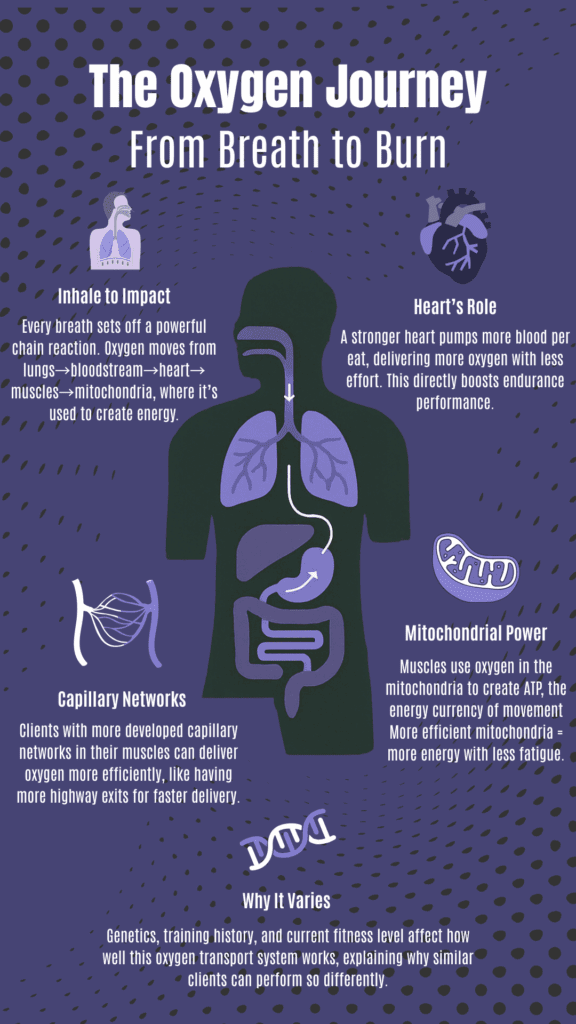
When your client inhales, oxygen enters the lungs and crosses into the bloodstream through tiny air sacs called alveoli. The heart then pumps this oxygen-rich blood through an intricate network of arteries, delivering it to working muscles throughout the body. Once oxygen reaches the muscle cells, it’s used in the mitochondria—the cellular powerhouses—to convert nutrients into usable energy.

This entire system works as a team. The lungs act as the intake valve, the heart serves as the pump, and the bloodstream functions as the highway system. But here’s where it gets interesting for trainers: the efficiency of this oxygen delivery system varies between individuals.

Some clients have hearts that pump more blood with each beat, allowing them to deliver oxygen more effectively. Others have developed extensive capillary networks in their muscles, creating more “off-ramps” for oxygen delivery. Training history, genetics, and current fitness level all influence how well this system operates.

The most efficient oxygen users have optimized every step of this journey. Their lungs extract oxygen, their hearts pump blood, their blood carries oxygen throughout their body, and their muscles extract and use it skillfully. This is why two clients of similar weight and age can have different endurance capabilities—their oxygen transport systems are operating at different levels of efficiency.

Understanding this system helps explain why some clients seem naturally gifted at cardio while others struggle, and more importantly, it reveals the pathways for improvement through targeted training.
Imagine you're watching two of your clients tackle the same workout. One is breathing heavily after just a few minutes, while the other seems to glide through the session with steady, controlled breaths. What's the difference? It's not just fitness level or motivation—it's how efficiently their bodies use oxygen.
As a trainer, you've probably noticed that some clients seem to have endless endurance while others hit a wall quickly, even when their strength and technique are comparable. The secret lies in understanding how the body processes and utilizes oxygen during exercise. This process determines everything from fat-burning efficiency to peak performance potential.
Oxygen is the fuel that powers every movement, every rep, and every training session. When you understand how your clients' bodies use oxygen, you unlock the ability to design personalized training programs that maximize their results. 
The difference between a client who struggles through cardio and one who thrives isn't just about willpower or genetics—it's about how effectively their cardiovascular system delivers oxygen to working muscles and how efficiently those muscles use it to produce energy.
The Oxygen Journey
Understanding how oxygen travels through your clients' bodies is like mapping the most important delivery system in human physiology. Every breath they take sets off a chain of events that determines their exercise capacity and performance potential.
When your client inhales, oxygen enters the lungs and crosses into the bloodstream through tiny air sacs called alveoli. The heart then pumps this oxygen-rich blood through an intricate network of arteries, delivering it to working muscles throughout the body. Once oxygen reaches the muscle cells, it's used in the mitochondria—the cellular powerhouses—to convert nutrients into usable energy.
This entire system works as a team. The lungs act as the intake valve, the heart serves as the pump, and the bloodstream functions as the highway system. But here's where it gets interesting for trainers: the efficiency of this oxygen delivery system varies between individuals.
Some clients have hearts that pump more blood with each beat, allowing them to deliver oxygen more effectively. Others have developed extensive capillary networks in their muscles, creating more "off-ramps" for oxygen delivery. Training history, genetics, and current fitness level all influence how well this system operates.
The most efficient oxygen users have optimized every step of this journey. Their lungs extract oxygen, their hearts pump blood, their blood carries oxygen throughout their body, and their muscles extract and use it skillfully. This is why two clients of similar weight and age can have different endurance capabilities—their oxygen transport systems are operating at different levels of efficiency.
Understanding this system helps explain why some clients seem naturally gifted at cardio while others struggle, and more importantly, it reveals the pathways for improvement through targeted training.
What Happens During Exercise
The Resting State: 
When your clients are sitting on the couch, their bodies are humming along at baseline oxygen consumption. Think of this as their metabolic idle speed—steady, predictable, and efficient. At rest, oxygen demand is low and easily met by their cardiovascular system.
The Exercise Switch: 
The moment your client steps onto the treadmill or picks up weights, everything changes. Oxygen demand can increase 10 to 20 times above resting levels during intense exercise. It's like going from city driving to racing on the highway—the engine (their cardiovascular system) has to work harder to meet the higher demand.
Two Energy Highways: Aerobic vs. Anaerobic
The Aerobic Highway (With Oxygen) When oxygen supply meets demand, your client's body operates in the aerobic zone. This is the sustainable lane—muscles can work for extended periods because oxygen is readily available to fuel the process. Think of a client who can maintain a steady jog while still holding a conversation.
The Anaerobic Highway (Without Sufficient Oxygen) When exercise intensity outpaces oxygen delivery and/or utilization, the body switches to anaerobic metabolism. This is the sprint lane—powerful but unsustainable. Your client might experience this during high-intensity intervals when their breathing becomes labored and they can't maintain the pace for long.
The Fuel Switch: Fat vs. Carbohydrates
Here's where training gets fascinating: your client's body doesn't just use one fuel source. At lower intensities with adequate oxygen, the body preferentially burns fat—a slow-burning, abundant fuel perfect for endurance activities. As intensity increases and oxygen becomes limited, the body shifts toward carbohydrates, which burn faster but are more limited in supply.
This fuel switching happens automatically, but the exact point where it occurs is unique to each client. Some switch to carbohydrate burning earlier, while others can maintain fat burning at higher intensities, a key factor in endurance performance and weight management goals.
VO2 Max And The Oxygen Ceiling
What Exactly Is VO2 Max?
Think of VO2 Max as your body's horsepower rating. It measures the maximum amount of oxygen your body can consume and use during intense exercise, expressed in milliliters of oxygen per kilogram of body weight per minute. But here's the simple way to explain it to your clients: VO2 Max represents the ceiling of their aerobic engine—the absolute peak of their oxygen-processing capacity.
When your client reaches their VO2 Max, they've hit the point where their cardiovascular system can’t deliver any more oxygen to their working muscles, no matter how hard they push. It's like flooring the gas pedal when the engine is already at redline—there's nowhere left to go.
Why VO2 Max Matters Beyond Elite Athletics
You might think VO2 Max only matters for competitive athletes, but it's crucial for every client you train. For the weekend warrior, a higher VO2 Max means climbing stairs without getting winded, keeping up with their kids at the park, or feeling energized throughout their day. For your serious athletes, it could determine the difference between winning and placing second.
VO2 Max is one of the strongest predictors of cardiovascular health and longevity. A higher VO2 Max is associated with reduced risk of heart disease, better metabolic health, and improved quality of life as we age. When you help clients improve their VO2 Max, you're not just enhancing their fitness, and investing in their long-term health.
The Mirror of Cardiovascular Efficiency
VO2 Max serves as a report card for your client's entire cardiovascular system. It reflects how well their lungs extract oxygen from air, how efficiently their heart pumps blood, how effectively their blood carries oxygen, and how skillfully their muscles use that oxygen to produce energy.
Two clients might have the same training schedule, but different VO2 Max values reveal the efficiency differences in their oxygen utilization systems. The client with the higher VO2 Max has a more refined, efficient cardiovascular machine—one that can extract more performance from every breath and every heartbeat.
This measurement gives you insight into your client's physiological potential and helps explain why some people seem naturally gifted at endurance activities while others need more targeted cardiovascular development.
Zone 2 Training - The Sweet Spot for Oxygen Efficiency
Why Everyone's Talking About It
Zone 2 training has become the fitness world's best-kept secret that's no longer secret. This low-intensity training zone, typically around 60-70% of maximum heart rate, is the sweet spot where your clients can sustain exercise while mainly burning fat for fuel. What was once considered "easy" training by many athletes is now recognized as the foundation for exceptional endurance and metabolic health.
The popularity surge is backed by decades of research showing that Zone 2 training builds the aerobic foundation that supports all other training intensities. Elite endurance athletes have long understood this, spending 80% of their training time in this zone, but now recreational athletes and health-conscious individuals are discovering its transformative benefits.
How Zone 2 Transforms Oxygen Utilization
When your clients train in Zone 2, they're teaching their bodies to become oxygen utilization masters. At this intensity, oxygen supply meets oxygen demand almost perfectly, allowing the aerobic energy system to operate at its most efficient level. This creates several adaptations:
The mitochondria in muscle cells—those cellular powerhouses—multiply and become more efficient at using oxygen to produce energy. Blood vessels develop and expand, creating more pathways for oxygen delivery to working muscles. The heart becomes more efficient, pumping more blood with each beat. These adaptations improve the entire oxygen transport and utilization system.
The Fat-Burning Connection
Zone 2 training is where metabolic magic happens. At this intensity, your clients' bodies burn fat as their main fuel source. This is crucial for metabolic efficiency. When the body becomes skilled at fat oxidation, it preserves carbohydrate stores for when they're needed during higher-intensity efforts.
This metabolic flexibility means your clients develop the ability to sustain energy levels for longer periods without the rollercoaster of blood sugar spikes and crashes. They become metabolically efficient machines that can tap into their abundant fat stores rather than relying on limited carbohydrate reserves.
The Foundation That Elevates All Training Zones
Here's where Zone 2 training proves its value: it enhances performance across all other training zones. Think of Zone 2 as the foundation of a fitness pyramid. The stronger this base, the higher you can build the rest of the structure.
Zone 1 (Active Recovery): Enhanced Zone 2 capacity improves recovery between intense sessions by increasing circulation and oxygen delivery to healing muscles.
Zone 3 (Tempo Training): A well-developed aerobic base allows clients to sustain higher intensities longer before crossing into anaerobic territory.
Zone 4 (Lactate Threshold): Strong Zone 2 conditioning helps buffer and clear lactate more efficiently, allowing clients to push harder before hitting the wall.
Zone 5 (VO2 Max/Neuromuscular Power): The improved oxygen delivery system supports faster recovery between high-intensity intervals, enabling higher quality efforts.
Zone 2 training targets the physiological systems that limit endurance performance and metabolic health. When your clients develop a strong Zone 2 capacity, they're upgrading the entire operating system that powers all their training efforts.
The only accurate way to determine an individual's true Zone 2 heart rate is through VO2 Max testing. Generic formulas and estimations can't account for the individual physiological differences that determine where each person's fat-burning zone actually occurs.
Measuring Your Oxygen Utilization
The Guesswork Problem in Fitness
How many times have you programmed training zones for clients based on age-predicted formulas, only to watch them struggle at intensities that should feel "moderate"? Or seen clients barely break a sweat during what should be challenging intervals? The problem isn't your programming—it's that generic formulas treat every 35-year-old or every 150-pound client as identical when their physiological responses can vary.
Accurate oxygen utilization testing eliminates this guesswork. When you know how a client's body processes oxygen at different intensities, you can design training programs that hit the targets for their goals, whether that's fat loss, endurance improvement, or performance optimization.
Precision Through Advanced Technology
Not all metabolic testing is created equal. While some testing methods rely on breath-by-breath analysis that can be affected by environmental factors and produce noisy, inconsistent data, mixing chamber technology represents the gold standard for accuracy and reliability.
Mixing chamber technology works by collecting and analyzing all exhaled air in a chamber before measurement, providing stable, precise readings of oxygen consumption and carbon dioxide production. This approach eliminates the variability and noise common in other testing methods, giving you confidence that the training zones you're prescribing are based on accurate, reproducible data.
The testing process is straightforward and efficient—no complex calibration procedures or environmental concerns that can compromise results. This reliability means you can focus on interpreting the data rather than questioning its accuracy.
Discovering Your Client's Metabolic Fingerprint
Another valuable insight from oxygen utilization testing is discovering each client's fat-burning zones. While generic calculations might suggest a client burns optimal fat at 65% of their maximum heart rate, testing often reveals their fat-burning sweet spot occurs at a completely different intensity—sometimes much higher or lower than predicted.
This metabolic fingerprint shows you where your client transitions from mainly burning fat to increasingly relying on carbohydrates for fuel. Armed with this information, you can prescribe precise heart rate ranges for different training goals: the exact zone for maximum fat oxidation, the threshold where carbohydrate burning begins to dominate, and the intensities that optimize different physiological adaptations.
Testing also reveals how well your client's cardiovascular system operates across the entire intensity spectrum. You'll see their oxygen consumption patterns, identify their anaerobic threshold, and understand their VO2 Max in the context of their individual physiology rather than population averages.
This level of precision transforms training from educated guessing to targeted intervention, ensuring every minute your clients spend exercising moves them closer to their goals with maximum efficiency.
Unlock Your Clients' Potential with KORR
As a trainer, you know that one-size-fits-all approaches fall short of delivering the exceptional results your clients deserve. The difference between good training and transformative training lies in understanding each individual's physiological blueprint—and that understanding starts with accurate oxygen utilization testing.
KORR's technology gives you the precision tools to move beyond guesswork and generic formulas. With our mixing chamber technology, you'll discover each client's fat-burning zones, precise training thresholds, and cardiovascular efficiency markers that reveal their potential. No more wondering why a program works perfectly for one client but misses the mark for another—you'll have the data to design truly personalized training protocols.
Whether you're working with clients who want to lose weight efficiently, athletes seeking performance breakthroughs, or individuals focused on long-term health optimization, KORR testing provides the roadmap to their success. Every test reveals insights that transform how you program cardio, structure periodization, and track progress.
Your expertise combined with KORR's precision creates an unbeatable combination. You bring the training knowledge and client relationship skills, while KORR provides the metabolic insights that make your programming laser-focused and results-driven.
The Oxygen Journey - From Breath to Burn

What Happens During Exercise

The Resting State: 

When your clients are sitting on the couch, their bodies are humming along at baseline oxygen consumption. Think of this as their metabolic idle speed—steady, predictable, and efficient. At rest, oxygen demand is low and easily met by their cardiovascular system.

The Exercise Switch: 

The moment your client steps onto the treadmill or picks up weights, everything changes. Oxygen demand can increase 10 to 20 times above resting levels during intense exercise. It’s like going from city driving to racing on the highway—the engine (their cardiovascular system) has to work harder to meet the higher demand.

Two Energy Highways: Aerobic vs. Anaerobic

The Aerobic Highway (With Oxygen) When oxygen supply meets demand, your client’s body operates in the aerobic zone. This is the sustainable lane—muscles can work for extended periods because oxygen is readily available to fuel the process. Think of a client who can maintain a steady jog while still holding a conversation.

The Anaerobic Highway (Without Sufficient Oxygen) When exercise intensity outpaces oxygen delivery and/or utilization, the body switches to anaerobic metabolism. This is the sprint lane—powerful but unsustainable. Your client might experience this during high-intensity intervals when their breathing becomes labored and they can’t maintain the pace for long.

The Fuel Switch: Fat vs. Carbohydrates

Here’s where training gets fascinating: your client’s body doesn’t just use one fuel source. At lower intensities with adequate oxygen, the body preferentially burns fat—a slow-burning, abundant fuel perfect for endurance activities. As intensity increases and oxygen becomes limited, the body shifts toward carbohydrates, which burn faster but are more limited in supply.

This fuel switching happens automatically, but the exact point where it occurs is unique to each client. Some switch to carbohydrate burning earlier, while others can maintain fat burning at higher intensities, a key factor in endurance performance and weight management goals.

VO2 Max And The Oxygen Ceiling

What Exactly Is VO2 Max?

Think of VO2 Max as your body’s horsepower rating. It measures the maximum amount of oxygen your body can consume and use during intense exercise, expressed in milliliters of oxygen per kilogram of body weight per minute. But here’s the simple way to explain it to your clients: VO2 Max represents the ceiling of their aerobic engine—the absolute peak of their oxygen-processing capacity.

When your client reaches their VO2 Max, they’ve hit the point where their cardiovascular system can’t deliver any more oxygen to their working muscles, no matter how hard they push. It’s like flooring the gas pedal when the engine is already at redline—there’s nowhere left to go.

Why VO2 Max Matters Beyond Elite Athletics

You might think VO2 Max only matters for competitive athletes, but it’s crucial for every client you train. For the weekend warrior, a higher VO2 Max means climbing stairs without getting winded, keeping up with their kids at the park, or feeling energized throughout their day. For your serious athletes, it could determine the difference between winning and placing second.

VO2 Max is one of the strongest predictors of cardiovascular health and longevity. A higher VO2 Max is associated with reduced risk of heart disease, better metabolic health, and improved quality of life as we age. When you help clients improve their VO2 Max, you’re not just enhancing their fitness, and investing in their long-term health.

The Mirror of Cardiovascular Efficiency

VO2 Max serves as a report card for your client’s entire cardiovascular system. It reflects how well their lungs extract oxygen from air, how efficiently their heart pumps blood, how effectively their blood carries oxygen, and how skillfully their muscles use that oxygen to produce energy.

Two clients might have the same training schedule, but different VO2 Max values reveal the efficiency differences in their oxygen utilization systems. The client with the higher VO2 Max has a more refined, efficient cardiovascular machine—one that can extract more performance from every breath and every heartbeat.

This measurement gives you insight into your client’s physiological potential and helps explain why some people seem naturally gifted at endurance activities while others need more targeted cardiovascular development.

Zone 2 Training – The Sweet Spot for Oxygen Efficiency

Why Everyone’s Talking About It

Zone 2 training has become the fitness world’s best-kept secret that’s no longer secret. This low-intensity training zone, typically around 60-70% of maximum heart rate, is the sweet spot where your clients can sustain exercise while mainly burning fat for fuel. What was once considered “easy” training by many athletes is now recognized as the foundation for exceptional endurance and metabolic health.

The popularity surge is backed by decades of research showing that Zone 2 training builds the aerobic foundation that supports all other training intensities. Elite endurance athletes have long understood this, spending 80% of their training time in this zone, but now recreational athletes and health-conscious individuals are discovering its transformative benefits.

How Zone 2 Transforms Oxygen Utilization

When your clients train in Zone 2, they’re teaching their bodies to become oxygen utilization masters. At this intensity, oxygen supply meets oxygen demand almost perfectly, allowing the aerobic energy system to operate at its most efficient level. This creates several adaptations:

The mitochondria in muscle cells—those cellular powerhouses—multiply and become more efficient at using oxygen to produce energy. Blood vessels develop and expand, creating more pathways for oxygen delivery to working muscles. The heart becomes more efficient, pumping more blood with each beat. These adaptations improve the entire oxygen transport and utilization system.

The Fat-Burning Connection

Zone 2 training is where metabolic magic happens. At this intensity, your clients’ bodies burn fat as their main fuel source. This is crucial for metabolic efficiency. When the body becomes skilled at fat oxidation, it preserves carbohydrate stores for when they’re needed during higher-intensity efforts.

This metabolic flexibility means your clients develop the ability to sustain energy levels for longer periods without the rollercoaster of blood sugar spikes and crashes. They become metabolically efficient machines that can tap into their abundant fat stores rather than relying on limited carbohydrate reserves.

The Foundation That Elevates All Training Zones

Here’s where Zone 2 training proves its value: it enhances performance across all other training zones. Think of Zone 2 as the foundation of a fitness pyramid. The stronger this base, the higher you can build the rest of the structure.

Zone 1 (Active Recovery): Enhanced Zone 2 capacity improves recovery between intense sessions by increasing circulation and oxygen delivery to healing muscles.

Zone 3 (Tempo Training): A well-developed aerobic base allows clients to sustain higher intensities longer before crossing into anaerobic territory.

Zone 4 (Lactate Threshold): Strong Zone 2 conditioning helps buffer and clear lactate more efficiently, allowing clients to push harder before hitting the wall.

Zone 5 (VO2 Max/Neuromuscular Power): The improved oxygen delivery system supports faster recovery between high-intensity intervals, enabling higher quality efforts.

Zone 2 training targets the physiological systems that limit endurance performance and metabolic health. When your clients develop a strong Zone 2 capacity, they’re upgrading the entire operating system that powers all their training efforts.

The only accurate way to determine an individual’s true Zone 2 heart rate is through VO2 Max testing. Generic formulas and estimations can’t account for the individual physiological differences that determine where each person’s fat-burning zone actually occurs.

Measuring Your Oxygen Utilization

The Guesswork Problem in Fitness

How many times have you programmed training zones for clients based on age-predicted formulas, only to watch them struggle at intensities that should feel “moderate”? Or seen clients barely break a sweat during what should be challenging intervals? The problem isn’t your programming—it’s that generic formulas treat every 35-year-old or every 150-pound client as identical when their physiological responses can vary.

Accurate oxygen utilization testing eliminates this guesswork. When you know how a client’s body processes oxygen at different intensities, you can design training programs that hit the targets for their goals, whether that’s fat loss, endurance improvement, or performance optimization.

Precision Through Advanced Technology

Not all metabolic testing is created equal. While some testing methods rely on breath-by-breath analysis that can be affected by environmental factors and produce noisy, inconsistent data, mixing chamber technology represents the gold standard for accuracy and reliability.

Mixing chamber technology works by collecting and analyzing all exhaled air in a chamber before measurement, providing stable, precise readings of oxygen consumption and carbon dioxide production. This approach eliminates the variability and noise common in other testing methods, giving you confidence that the training zones you’re prescribing are based on accurate, reproducible data.

The testing process is straightforward and efficient—no complex calibration procedures or environmental concerns that can compromise results. This reliability means you can focus on interpreting the data rather than questioning its accuracy.

Discovering Your Client’s Metabolic Fingerprint

Another valuable insight from oxygen utilization testing is discovering each client’s fat-burning zones. While generic calculations might suggest a client burns optimal fat at 65% of their maximum heart rate, testing often reveals their fat-burning sweet spot occurs at a completely different intensity—sometimes much higher or lower than predicted.

This metabolic fingerprint shows you where your client transitions from mainly burning fat to increasingly relying on carbohydrates for fuel. Armed with this information, you can prescribe precise heart rate ranges for different training goals: the exact zone for maximum fat oxidation, the threshold where carbohydrate burning begins to dominate, and the intensities that optimize different physiological adaptations.

Testing also reveals how well your client’s cardiovascular system operates across the entire intensity spectrum. You’ll see their oxygen consumption patterns, identify their anaerobic threshold, and understand their VO2 Max in the context of their individual physiology rather than population averages.

This level of precision transforms training from educated guessing to targeted intervention, ensuring every minute your clients spend exercising moves them closer to their goals with maximum efficiency.

Unlock Your Clients’ Potential with KORR

As a trainer, you know that one-size-fits-all approaches fall short of delivering the exceptional results your clients deserve. The difference between good training and transformative training lies in understanding each individual’s physiological blueprint—and that understanding starts with accurate oxygen utilization testing.

KORR’s technology gives you the precision tools to move beyond guesswork and generic formulas. With our mixing chamber technology, you’ll discover each client’s fat-burning zones, precise training thresholds, and cardiovascular efficiency markers that reveal their potential. No more wondering why a program works perfectly for one client but misses the mark for another—you’ll have the data to design truly personalized training protocols.

Whether you’re working with clients who want to lose weight efficiently, athletes seeking performance breakthroughs, or individuals focused on long-term health optimization, KORR testing provides the roadmap to their success. Every test reveals insights that transform how you program cardio, structure periodization, and track progress.

Your expertise combined with KORR’s precision creates an unbeatable combination. You bring the training knowledge and client relationship skills, while KORR provides the metabolic insights that make your programming laser-focused and results-driven.

Ready to revolutionize your training approach? Discover how KORR’s technology can elevate your practice and deliver the results that keep clients coming back. Contact us today to learn more about bringing precision metabolic testing to your facility and giving your clients the individualized training they deserve.


The European Union’s ePrivacy Directive (often referred to as the ‘cookie law’) and General Data Protection Regulation (GDPR) places requirements to provide information about, and gain consent for the use of cookies. This site uses cookies. By continuing to use this website, you agree to their use. To find out more, including how to control cookies, see here