



The fitness world is buzzing about Zone 2 training, and the excitement is backed by solid science. This low-intensity training sweet spot has revolutionized how athletes and fitness enthusiasts approach endurance building and metabolic health. But here’s the important insight many miss: without a VO2 Max test, you’re likely missing your true Zone 2 entirely. Recent research in exercise physiology has shown that most people training based on perceived exertion or generic formulas are working out at intensities that don’t deliver the promised benefits of Zone 2 training.
Let’s explore why precise zone training matters and how VO2 Max testing can transform your fitness journey from guesswork to science-based precision.
Understanding the Science Behind Zone Training
To understand why Zone 2 training has become a cornerstone of modern fitness, we need to learn about the way your body produces energy during exercise. Your body relies on two primary fuel sources during workouts: fat and carbohydrates. The proportion of each fuel source isn’t random – it’s a precise dance choreographed by your metabolism based on exercise intensity.
At Aerobic Threshold, a physiological marker measurable through VO2 Max testing, we can determine where your body begins to utilize oxygen as its primary fuel source. This is crucial because, as documented in cardiovascular research, training in that aerobic zone- in Zone 2- produces unique and powerful adaptations in your body:
- Enhanced mitochondrial density
- Improved fat oxidation efficiency
- Increased capillary density
- Better cardiovascular endurance
- Optimized metabolic flexibility
The magic of Zone 2 training lies in its ability to maximize fat utilization while building aerobic capacity. When you train in true Zone 2, your body becomes increasingly efficient at using fat for fuel, a vital adaptation for endurance and metabolic health. However, effective Zone 2 training must be integrated with Zones 4 and 5 to build peak efficiency and performance. While Zone 2 lays the foundation for endurance, training exclusively in this zone without accurately assessing Zones 4 and 5 can limit overall progress. Higher-intensity efforts in these zones are essential for developing speed, power, and cardiovascular resilience, creating a well-rounded and effective training program.
Finding your genuine Zone 2 is far more complex than many realize. It’s not as simple as working at a “conversational pace” or using standard heart rate calculations. Your individual Respiratory Exchange Rate and Anaerobic Threshold are unique to you, influenced by factors including:
- Current fitness level
- Muscle fiber composition
- Training history
- Age and genetics
- Overall metabolic health
This is where the precision of VO2 Max testing becomes invaluable. By measuring your oxygen consumption and carbon dioxide production across different exercise intensities, we can identify your exact physiological thresholds and training zones. Without this level of precision, you might be training too hard – pushing yourself out of the fat-burning zone – or not hard enough to stimulate the adaptations you’re seeking.
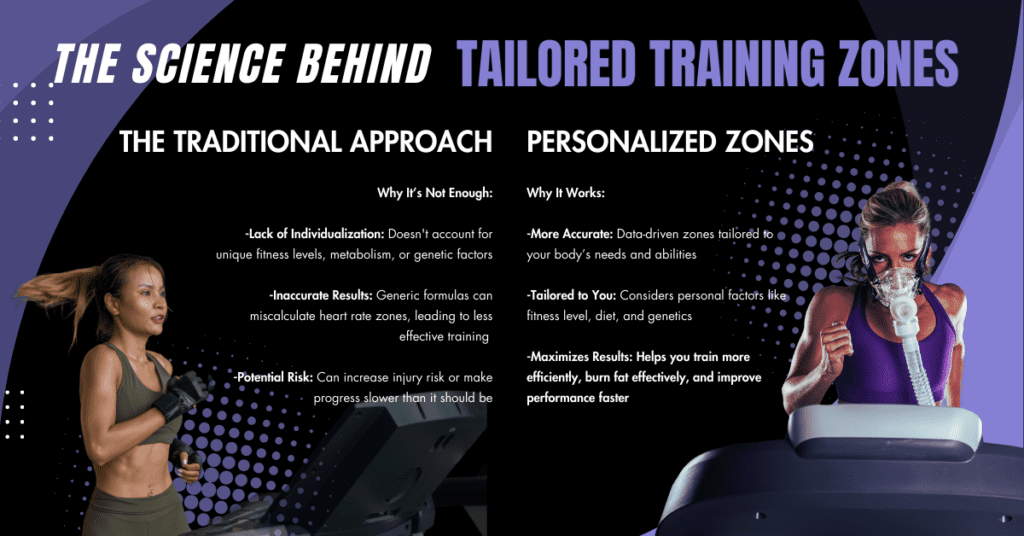
The Science Behind Training Zones
Training zones are the foundation of effective workout programming, yet many athletes and fitness enthusiasts rely on outdated methods to determine their zones. Here’s why the traditional approach may be holding you back and how modern testing can revolutionize your training.
The Limitations of Traditional Zone Calculations
Just as research shows that metabolic rates vary among individuals with similar physical characteristics, your optimal training zones are uniquely personal. Studies demonstrate that using generic formulas based on age and heart rate can lead to miscalculated training zones, compromising your results and potentially increasing injury risk.
Research published in leading journals reveals that traditional calculation methods fail to account for key individual variations in:
- Respiratory Exchange Ratio (RER): The ratio of carbon dioxide produced to oxygen consumed, indicating whether your body is burning primarily fats or carbohydrates. This varies significantly between individuals based on fitness level, diet, and genetics.
- Aerobic Threshold (AeT): The exercise intensity at which your respiratory rate increases and your body is utilizing oxygen as the primary source of fuel.
- Anaerobic Threshold (AT): The exercise intensity at which lactate begins to accumulate in your blood faster than it can be removed. This threshold varies by up to 30 beats per minute in people of similar fitness levels.
- Aerobic capacity: Your body’s maximum ability to transport and utilize oxygen during exercise, is influenced by factors like genetics, training history, and current fitness level.
- Individual metabolic efficiency: How effectively your body uses oxygen during exercise, which varies widely among individuals just as RMR does, affecting everything from calorie burn to recovery rates.
The Impact of Inaccurate Training Zones
Training with imprecise zones creates several challenges:
Compromised Fat-Burning Efficiency
Zone 2 training enhances the body’s ability to utilize fat as a primary energy source. Neglecting this training can impair fat metabolism, leading to decreased endurance and performance.
- Body Shifts Prematurely to Carbohydrate Metabolism
Without adequate Zone 2 training, the body relies more heavily on carbohydrates for energy, even at lower intensities, limiting fat oxidation and leading to faster glycogen depletion. - Reduced Overall Fat Oxidation
Zone 2 training increases mitochondrial density, enhancing fat oxidation. Skipping this training reduces the body’s efficiency in utilizing fat as fuel, compromising endurance performance. - Impaired Metabolic Adaptations
Consistent Zone 2 training improves metabolic flexibility, allowing the body to switch between energy sources efficiently. Without it, metabolic adaptations are impaired, leading to less efficient energy use during exercise. - Suboptimal Energy System Development
Zone 2 training is essential for building a strong aerobic base. Neglecting it leads to underdeveloped energy systems, limiting performance potential in endurance events and hindering recovery from high-intensity workouts.
Recovery and Adaptation Issues
Proper Zone 2 training promotes recovery and allows the body to adapt to higher training loads over time. Neglecting this zone can lead to imbalances, excessive fatigue, and a higher risk of injury.
- Excessive Fatigue Accumulation
Over-reliance on high-intensity workouts without adequate Zone 2 training can cause excessive fatigue accumulation, increasing the risk of burnout. - Missed Adaptation Windows
Zone 2 training is significant for progressive overload and adaptation. Skipping it means missing out on adaptations like improved fat metabolism and cardiovascular efficiency. - Training Load Imbalances
Neglecting Zone 2 can result in imbalanced training loads, with high-intensity sessions dominating. This imbalance limits progress, reduces recovery capacity, and increases the risk of overtraining. - Performance Plateaus
Without a solid aerobic base from Zone 2 training, performance plateaus are more likely. Endurance improvements stall, affecting speed, strength, and recovery. - Increased Injury Risk
Overtraining at high intensities without adequate Zone 2 work elevates injury risk. Muscles and tendons need lower-intensity training for recovery and strengthening. Skipping this can lead to chronic injuries.
Why Mixing Chamber Technology Sets the Gold Standard
Want to take your training to the next level? Understanding your body’s response to exercise isn’t just about heart rate anymore. Learn about how mixing chamber technology is revolutionizing athletic performance testing and why it matters for your fitness journey.
The Power of Precision Testing
Remember when tracking your heart rate seemed cutting-edge? Those days are behind us. Today’s mixing chamber technology provides unprecedented insights into your body’s performance. This sophisticated system analyzes your breathing patterns during exercise, delivering real-time data about oxygen utilization and metabolic efficiency. It’s like having a window into your body’s energy systems.
Key Markers That Transform Your Training
Finding Your Perfect Fat-Burning Zone
Ever wondered exactly when your body is maximizing fat burn? Your Aerobic Threshold (AeT) pinpoints this sweet spot with precision, eliminating guesswork and generic formulas. With testing from the CardioCoach, you’ll receive unique Respiratory Exchange Ratio data that reveals the heart rate zone where your body burns fat most efficiently. This insight allows your trainer to fine-tune your workouts, helping you optimize fat utilization and improve endurance over time.
The Anaerobic Breaking Point
Your Anaerobic Threshold (AT) marks the moment your body shifts from aerobic to anaerobic metabolism. Think of it as your physiological “red line.” Knowing this exact point helps optimize your interval training and race strategies. It’s the difference between pushing your limits and hitting the wall.
Peak Performance Potential
Your peak oxygen consumption tells the complete story of your cardiovascular fitness. This is a measure of how efficiently your body uses oxygen under pressure. It’s your fitness fingerprint, unique to you, and invaluable for training design.
Transforming Data into Results
Personalized Training Zones
Forget one-size-fits-all heart rate calculations. With CardioCoach’s mixing chamber technology, training zones are built using key metrics like Anaerobic Threshold and measured VO2 Max. These zones are specifically tailored to your endurance level and overall cardiovascular fitness, making sure that every workout targets the right energy system for maximum results. These aren’t just estimates—they’re precise, scientifically-backed ranges that will help you reach your fitness goals faster.
Benchmark Your Progress
How do you stack up against others in your sport? Where can you improve? The technology provides clear comparisons against both population norms and sport-specific benchmarks. It’s like having a roadmap for your fitness journey, showing exactly where you are and where you can go.
Energy System Optimization
Understanding your caloric expenditure at different intensities isn’t just about weight management – it’s about optimizing your training efficiency. This data helps fine-tune your nutrition strategy and guarantees your training program targets the right energy systems.
The Technology Behind the Results
The mixing chamber collects data and analyzes your breath composition with laboratory-grade precision. It accounts for environmental factors like temperature, humidity, and barometric pressure, ensuring accuracy that outperforms trendy gimmicks and creating a scientific foundation for your training success.
Why This Matters for You
Whether you’re an elite athlete or just starting your fitness journey, understanding your body’s unique responses to exercise is pivotal. Mixing chamber technology provides the insights you need to:
- Train smarter, not just harder
- Optimize your fat-burning potential
- Design truly personalized workouts
- Track your progress with scientific precision
Why Regular Testing Matters
Fitness levels change as you train and adapt. VO2 Max testing helps maintain progress, avoid plateaus, and stay motivated by providing concrete data on your improvements.
- Measure Cardiovascular Fitness Improvements: VO2 Max scores provide a clear picture of how your heart, lungs, and muscles are adapting to training.
- Adjust Training Zones for Accuracy: As fitness changes, your training zones need updates to keep workouts effective.
- Maintain Steady Progress: Adjusting your approach based on current fitness levels helps avoid stagnation.
- Break Through Plateaus: Regular testing highlights when adjustments are needed to continue improving.
- Stay Motivated with Measurable Results: Seeing quantifiable improvements boosts motivation and keeps you focused on achieving goals.
Taking Action
Stop guessing at your training zones and start training with precision. A VO2 Max test provides the scientific foundation needed to optimize your Zone 2 training while incorporating Zones 4 and 5 for peak efficiency and performance. These insights can transform your approach to fitness, helping you build endurance, improve metabolic efficiency, and create a well-rounded, highly effective training program.
Remember: just as every person’s metabolism is unique, so are their training zones. Generic formulas and perceived effort can only take you so far. Invest in understanding your body’s specific needs through VO2 Max testing, and unlock your true endurance potential.
Want to learn more about how VO2 Max testing can optimize your training? Schedule a consultation with our experts to discover the science behind your perfect workout zones.