


Metabolic testing used to be limited to universities and pro sports because the gear was expensive, complex, and slow to run. That’s changed. VO2 max and resting metabolic rate testing now show up in clinics, wellness programs, and even local gyms.
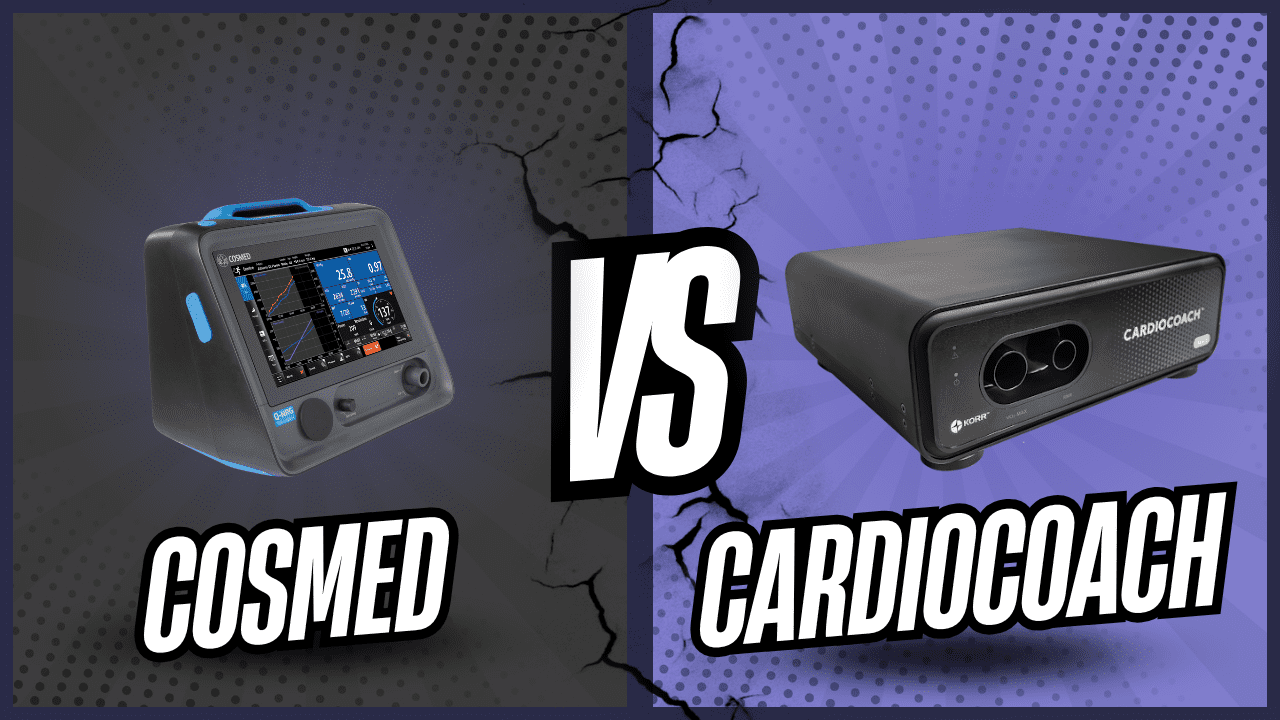
This shift created demand for equipment that works in real-world settings. Easy to use, low-maintenance, and profitable. Two devices dominate this space: KORR’s CardioCoach and COSMED’s Q-NRG Max. Both are accurate and well-validated. The real differences aren’t in the data, they’re in setup, upkeep, software, and staff time.
This comparison examines those practical differences to help you choose the right equipment for your facility.
Calibration
Calibration is where marketing claims meet operational reality. Every metabolic test depends on accurate gas analysis, and accurate gas analysis depends on proper calibration. The question isn’t whether calibration matters, it’s how much time, training, and ongoing expense it demands from your facility.
CardioCoach PRO: Room Air Calibration
CardioCoach auto-calibrates using ambient room air in approximately 90 seconds. The device measures temperature, humidity, and barometric pressure during each calibration cycle, then compensates automatically to standard conditions (STPD). No calibration syringe. No gas cylinders. No manual adjustments.
This approach eliminates an entire category of potential errors. Staff can’t miscalibrate the device because the calibration process doesn’t involve staff decisions. The system handles environmental compensation internally, producing consistent results regardless of weather changes, altitude, or HVAC fluctuations.
Every test begins with fresh calibration. There’s no warm-up period, no waiting for sensors to stabilize, no judgment calls about whether yesterday’s calibration still holds.
Q-NRG Max: Automatic Gas Calibration Plus Periodic Cylinder Calibration
COSMED improved on traditional metabolic cart calibration with their Q-NRG Max design. The device performs automatic gas sensor calibration prior to each test, taking about one minute. Flowmeter calibration uses a built-in blower that generates known flow rates, eliminating the calibration syringe that older systems required.
However, periodic gas cylinder calibration remains part of the maintenance protocol. The device’s O2 and CO2 sensors require calibration against known gas mixtures to maintain accuracy over time. This means facilities need to procure calibration gas cylinders, store them properly, track expiration dates, and ensure staff know how to perform the procedure correctly.
Why This Matters Clinically
The calibration difference affects daily operations in ways that compound over time.
Staff training becomes simpler when calibration is automatic. New employees can run accurate tests on their first day. There’s no specialized knowledge to transfer when someone leaves the organization.
Test preparation time drops when you remove manual calibration steps. Saving five minutes per test doesn’t sound significant until you multiply it across 20 tests per week for a year. That’s roughly 87 hours of staff time annually—more than two full work weeks.
Supply chain management disappears as a concern when your device calibrates with room air. No vendor relationships to maintain for calibration gases. No storage requirements. No expiration tracking. No reordering when cylinders run low.
Cost predictability improves when consumables aren’t part of the equation. CardioCoach’s operating costs don’t fluctuate based on calibration gas prices or usage rates.
Measurement Technology: Flow Sensors and Accuracy
Accurate metabolic measurement depends on precise airflow measurement across a wide range of breathing intensities. A resting metabolic rate test involves low, quiet breathing. A VO2 max test at peak exertion involves high-volume, rapid breathing. These represent dramatically different measurement challenges.
CardioCoach PRO: Dual Flow Sensor Design
KORR uses two different flow sensors to ensure both low flow rates (during RMR testing) and high flow rates (during intense VO2 max testing) are measured accurately. The device offers two ports—a smaller port optimized for RMR and a larger port for VO2 max—but these aren’t just different port sizes. Each port leads to a different flow sensor with different tolerances, ensuring accurate measurement across the full physiological range.
This dual-sensor approach means the device is specifically calibrated for the measurement conditions it encounters. Low-flow accuracy matters for RMR because small errors in oxygen consumption measurement translate to significant errors in calorie calculations. High-flow accuracy matters for VO2 max because peak performance data drives training recommendations.
Q-NRG Max: Single Flow Sensor
Like most metabolic devices, the Q-NRG Max uses a single turbine flowmeter. COSMED’s brochure states the measurement range covers 0-300 L/min, which spans the physiological range. However, a single sensor optimized for one flow range may be less accurate at the extremes.
Some manufacturers try to address this limitation with adapters that focus air movement, but adapters don’t solve the fundamental issue of having one sensor calibrated for a broad range rather than two sensors each optimized for their specific measurement conditions.
Oxygen Sensor Maintenance
Oxygen sensors are consumable components in any metabolic testing device. They degrade over time through normal use. How you replace them, and what happens after replacement, varies significantly between these two systems.
CardioCoach PRO
CardioCoach oxygen sensors typically last 18 months under normal use. Replacement is a tool-free process that facility staff can perform on-site in less than a minute. Remove the old sensor, insert the new one, and resume testing. No post-replacement calibration required. No service appointment needed.
The practical impact: when your sensor reaches end of life, you order a replacement from KORR, swap it yourself, and continue testing the same day. No revenue interruption. No scheduling around service technician availability.
Q-NRG Max
The Q-NRG Max uses Galvanic Fuel Cell (GFC) technology for O2 measurement and Non-Dispersive Infrared (NDIR) for CO2. Both sensor types require periodic calibration with gas mixtures to maintain measurement accuracy.
COSMED’s public documentation doesn’t detail user-serviceable sensor replacement procedures. Facilities should clarify maintenance protocols and associated costs during the purchasing process.
The Operational Impact
Device downtime translates directly to lost revenue. A metabolic test that bills at $100-150 represents lost income every day the equipment sits idle waiting for service. CardioCoach’s user-replaceable sensor design minimizes this exposure. You control the timeline.
Service costs add up beyond the sensor itself. Shipping, labor, and potential expedite fees can multiply the actual expense of routine maintenance. In-house replacement eliminates these ancillary costs.
Infection Control Design
Any equipment involving respiratory contact requires clear infection control protocols. Patient and client safety demands it. Post-2020, facilities face heightened scrutiny from both regulatory bodies and the people using their services.
CardioCoach PRO
CardioCoach uses a one-way valve system that prevents exhaled air from re-entering the breathing circuit. This is a mechanical barrier, physics, not filtration. Air flows in one direction only. There’s no pathway for contaminants to travel backward through the system.
Disposable components are available for facilities requiring single-use protocols. The mask, valve, and hose can all be replaced between patients, eliminating any reprocessing requirements. The CardioCoach KIOSK model takes this further with completely disposable mask kits that require zero cleaning between tests.
For facilities that prefer reusable components, the one-way valve still provides baseline protection against cross-contamination at the hardware level.
Q-NRG Max
COSMED’s system uses multi-use silicone face masks with headgear, protected by antibacterial and antiviral single-use filters connected to a turbine pnuemotach that allows air to freely flow in and out. The filter provides the contamination barrier, capturing pathogens before they can reach reusable components or the device itself.
However, there’s a significant cleaning burden that facilities should understand before purchasing. COSMED utilizes a turbine pneumotach on its masks with small moving parts. Each breath of each client—both inspiratory and expiratory—passes through that spinning turbine. While the filter provides some protection to the client, the turbine MUST be cleaned between each client test. Cleaning the small parts of the turbine can be laborious. COSMED’s instructions state that the turbine must be soaked completely.
This cleaning requirement adds time between tests and creates a potential failure point if staff skip or shortcut the process. In a busy clinic running multiple tests per day, turbine cleaning can become a bottleneck.
For resting energy expenditure testing, Q-NRG Max offers a canopy hood option that eliminates facial contact entirely. The subject lies beneath the hood while the system measures gas exchange through dilution. This approach sidesteps mask-fit issues and may improve comfort for some patients.
The Design Philosophy Difference
One-way valve systems provide mechanical prevention. The physical design of the valve makes backward airflow impossible. KORR’s disposable options eliminate cleaning requirements entirely.
Turbine-based systems like COSMED’s require meticulous cleaning between each test. The small moving parts of a spinning turbine can trap particulates and biological material, making thorough cleaning essential—but also time-consuming.
Facilities should evaluate which approach aligns with their infection control philosophy, patient volume, and staff capacity for between-test maintenance.
User Interface and Training Requirements
Staff turnover is a fact of life in healthcare and fitness facilities. Equipment that requires extensive training creates vulnerability every time a trained employee leaves. The learning curve for new staff affects how quickly they become productive, and how many errors they make while learning.
CardioCoach
KORR designed CardioCoach for operators who aren’t exercise physiologists. The software prompts users through each step of the testing process, from client setup through results delivery. KORR states that anyone can learn to operate the system in minutes. No certification required.
The CardioCoach line offers different interfaces for different user needs. The MAX model presents fully analyzed results for non-technical users—staff members who need to run tests and explain results without diving into raw data. The PRO model provides detailed gas exchange information for users who want granular data, custom analysis, and intervention design capability.
Free training by credentialed personnel comes with every purchase. KORR’s approach assumes you shouldn’t need to budget separately for implementation support.
Results integrate with the CardioCoach mobile app, allowing clients to view their data during workouts. Heart rate zones, calorie burn, and training targets display in real-time on the client’s phone. Garmin Connect IQ integration extends this functionality to wearable devices.
Q-NRG Max
The Q-NRG Max features a 10-inch LCD touchscreen with graphical widgets for data visualization and quality control verification. The interface walks users through testing procedures with prompted instructions at each stage.
Multiple testing modes accommodate different assessment needs: VO2 Max, Sub-Max, REE via canopy hood, and REE via hose and mask. Each mode has its own workflow and parameter set. This flexibility serves facilities running varied testing protocols, but adds complexity compared to single-purpose devices.
OMNIA software, sold separately, unlocks advanced capabilities: custom dashboard layouts, threshold calculations (VT1, VT2), trend analysis, and detailed reporting options. Users comfortable with exercise physiology concepts will find powerful tools here. Users wanting simple pass/fail or zone-based outputs may find it overwhelming.
Training structure and costs aren’t detailed in COSMED’s public materials. Facilities should clarify what implementation support is included versus billable during the sales process.
Training Zones and Workout Programming
For facilities using metabolic testing to guide client training, rather than just generating reports, the workout zone methodology matters. Different training philosophies use different approaches to defining zones, and the ability to customize those approaches affects how well test results translate into actionable programming.
CardioCoach PRO: Multiple Zoning Methods
KORR offers multiple zoning method options that competitors don’t match. Available methods include:
- Percentage of VO2 max
- Percentage of HR max
- Percentage of HR at anaerobic threshold
- Anaerobic threshold-based zones (with metabolic or ventilatory options)
- Manual zone definition
For percentage-based methods, KORR allows you to customize the actual percentages used to define zone boundaries. You can change the zoning methodology for each individual test, allowing practitioners to choose the method that best fits each client’s goals and training philosophy.
This flexibility matters because training zone science isn’t settled. Some coaches prefer threshold-based approaches. Others use percentage-of-max models. Some work with athletes who need sport-specific zone definitions. CardioCoach accommodates all of these approaches rather than forcing everyone into a single methodology.
Q-NRG Max: Fixed Zoning System
COSMED’s Q-NRG Max provides training zone output, but does not allow multiple zoning methods. Users work with whatever zones are built into the system. The specific methodology isn’t disclosed in their documentation, making it difficult to know exactly how zones are calculated or whether they align with a practitioner’s preferred approach.
For research applications where zone definitions follow published protocols, this may not matter. For coaching and training applications where practitioners have specific methodological preferences, the lack of flexibility limits utility.
Why Zoning Flexibility Matters
A VO2 max test that generates zones your client can’t use effectively is a missed opportunity. If your training philosophy centers on threshold-based programming but your device only outputs percentage-of-max zones, you’re doing manual conversions for every client. CardioCoach’s approach assumes practitioners know what they want and gives them the tools to get it.
RMR Analysis Methods
For resting metabolic rate testing, how you analyze the data matters as much as how you collect it. RMR tests typically run 10-20 minutes, but not every minute of that test represents true resting metabolism. Clients may be nervous at the start. Breathing patterns may be irregular. Equipment adjustments happen. The question is: which portion of the test best represents actual resting metabolic rate?
CardioCoach PRO: Flexible RMR Analysis
KORR allows you to select the analysis method that best fits each individual test:
- Best 5 minutes: The system identifies the most stable 5-minute period
- Last 5 minutes: Uses the final portion when clients are typically most relaxed
- Douglas Bag method: Traditional approach for research applications
This flexibility lets practitioners choose the section of each test that best represents true resting metabolism. A nervous client who settles down halfway through the test shouldn’t have their RMR skewed by the anxious first few minutes. An experienced client who relaxes immediately might have their best data at the start.
Without this ability, you cannot select the optimal portion of each individual RMR to analyze, potentially producing outputs that don’t reflect actual resting metabolism.
Q-NRG Max: Fixed Analysis Method
COSMED does not offer the option to choose RMR analysis methods. The system applies its default analysis approach to all tests. For research protocols requiring standardized methodology, this consistency may be appropriate. For clinical applications where individual test conditions vary, it limits accuracy.
Software and Ongoing Costs
The purchase price of metabolic testing equipment tells only part of the cost story. Software fees, service contracts, and consumables create ongoing expenses that affect long-term ROI.
CardioCoach
CardioCoach comes with software included. No ongoing fees for the core application, reports, or analysis features. No mandatory service contracts.
The system includes pre-designed workout programs for weight loss, endurance, and cardio strengthening. Trainers can use these directly or create custom programs using the same interface. Client-facing features, rate zones, calorie targets, workout guidance, come standard.
The CardioCoach mobile app extends functionality to client devices. A subscription model exists for extended app features, but the core device functionality doesn’t depend on recurring payments.
What you pay upfront is what you pay. There’s no moment two years in when you discover that the analysis feature you’ve been using requires a now-expiring license.
Q-NRG Max
COSMED markets the Q-NRG Max as “available at less than half the price of typical metabolic carts.” The base unit price of $13,635 supports that claim. But a quote for a complete, functional system tells a different story.
Here’s what a fully equipped Q-NRG Max actually costs, based on a 2024 COSMED quotation:
| Item | Cost |
| Q-NRG Max Performance Package (base unit) | $13,635 |
| X1 Cart | $1,520 |
| Gas Cylinder Holder | $250 |
| Extra Consumables (filters, veils, adapters) | $710 |
| Calibration Kit (regulator, gas tank, syringe) | $1,725 |
| OMNIA Software (CPET + REE modules) | $2,600 |
| PC Laptop | $1,995 |
| On-site Installation & Training | $2,100 |
| 1-Year Extended Service Plan | $3,100 |
| Shipping | $738 |
| Total | $28,373 |
The base unit represents less than half of the total system cost. Facilities comparing the Q-NRG Max against a CardioCoach PRO may not be making an apples-to-apples comparison.
Some line items are technically optional. You could skip the cart ($1,770 with holder), supply your own PC (but pay a $200 setup fee), or forgo the extended service plan. But you cannot skip the calibration kit if you want to maintain accuracy, and OMNIA software unlocks features that make the device practical for clinical use.
Important Note:
Neither the CardioCoach nor the COSMED Q-NRG Max is FDA cleared for medical use. Testing performed with these devices cannot be submitted for insurance reimbursement. These systems serve the fitness, performance, and wellness markets where practitioners charge directly for testing services.
Comparison Table
Feature: | Clinical Significance | KORRCardioCoach PRO | CosMedQ-ENRG-Max |
| Mixing ChamberTechnology | Gold Standard for Precise Gas Sampling,decreasing algorithm errors | ✓ | ✗ |
| Hands Free Calibration | Auto-calibrates without syringe,calibration tanks, or manual processes | ✓ | ✗ |
| Simple O2 SensorReplacement | No tools or calibration required forroutine oxygen sensor replacement | ✓ | ✗ |
| Minimal Risk of DiseaseTransmission | Non-rebreathing valve preventsre-breathing of contaminants | ✓ | ✗ |
| No ongoing fees | No hidden charges for software,reports, analysis or service contracts | ✓ | ✗ |
| Intuitive UX Design | User interface designed for minimal stafftraining and easy data management | ✓ | ✓ |
| Lightweight, portable | Less than 10 lbs with battery power options | ✓ | ✓ |
| Training included withpurchase | Free training by credentialed personnelwith each purchase | ✓ | ✗ |
| Designed for Clinic Use | Designed to move patients through efficiently with robust equipment and little down time.Outputs that aid patient education. | ✓ | ✓ |
| Priced below $18K | Price of full set-up: cart, operating systemand accessories | ✓ | ✗ |
Which Device Fits Your Facility?
The right choice depends on your operational context, not abstract feature comparisons.
CardioCoach PRO fits better if:
- You run a clinic, gym, physical therapy practice, or wellness center where patient throughput matters. You need to move people through testing efficiently without bottlenecks.
- Staff turnover is a reality. You can’t build your testing program around one specialized employee who might leave. Anyone on staff should be able to run accurate tests with minimal training.
- You want predictable operating costs. No gas cylinder orders. No software renewals. No surprise expenses when a sensor needs replacement.
- Infection control simplicity matters to your patients or clients. The one-way valve provides a clear, understandable safety story.
- Price transparency influences your purchasing decisions. You want to know what you’re paying before you engage with sales.
- You’re adding metabolic testing as a new revenue stream. Lower equipment cost means faster payback. No ongoing fees mean better per-test margins.
Q-NRG Max may be worth considering if:
- You’re a research facility or academic institution already invested in COSMED equipment. Ecosystem integration through OMNIA provides unified data management.
- You need advanced analysis capabilities that go beyond standard VO2 max and REE reporting. Custom dashboards, sophisticated threshold calculations, and research-grade data export matter for your work.
- You have dedicated exercise physiologists on staff who will use the advanced features. The investment in OMNIA makes sense when someone actually exploits its capabilities.
- You’re conducting studies that benefit from ICALIC-validated methodology. Mass spectrometry validation may carry weight with journal reviewers and grant committees.
- Canopy hood REE testing is preferable for your patient population. Some subjects find the hood more comfortable than mask-based systems.
- Your budget accommodates both the device and the software investment required to unlock full functionality.
Making the Smart Investment in Metabolic Testing
Both CardioCoach PRO and Q-NRG Max deliver accurate metabolic measurements. The validation data confirms this. You won’t compromise on measurement quality with either device.
The meaningful differences are operational.
CardioCoach PRO is built for busy clinics, removing friction with room-air calibration, tool-free sensor swaps, included software, simple staff operation, and transparent pricing. Q-NRG Max offers deeper, research-grade features and fits best for facilities with specialized staff or existing COSMED systems.
For clinics, fitness facilities, physical therapy practices, and wellness centers—organizations where metabolic testing serves patient care and revenue generation rather than research publication—CardioCoach PRO’s operational simplicity drives long-term value.
The best metabolic testing equipment is equipment that gets used. Devices that sit idle because calibration is complicated, or staff isn’t trained, or supplies ran out, don’t generate results or revenue. CardioCoach PRO was designed to remove those barriers.
To see the CardioCoach in action and discuss how it fits your specific practice, contact KORR at 1-801-483-2080 or schedule a demonstration.