


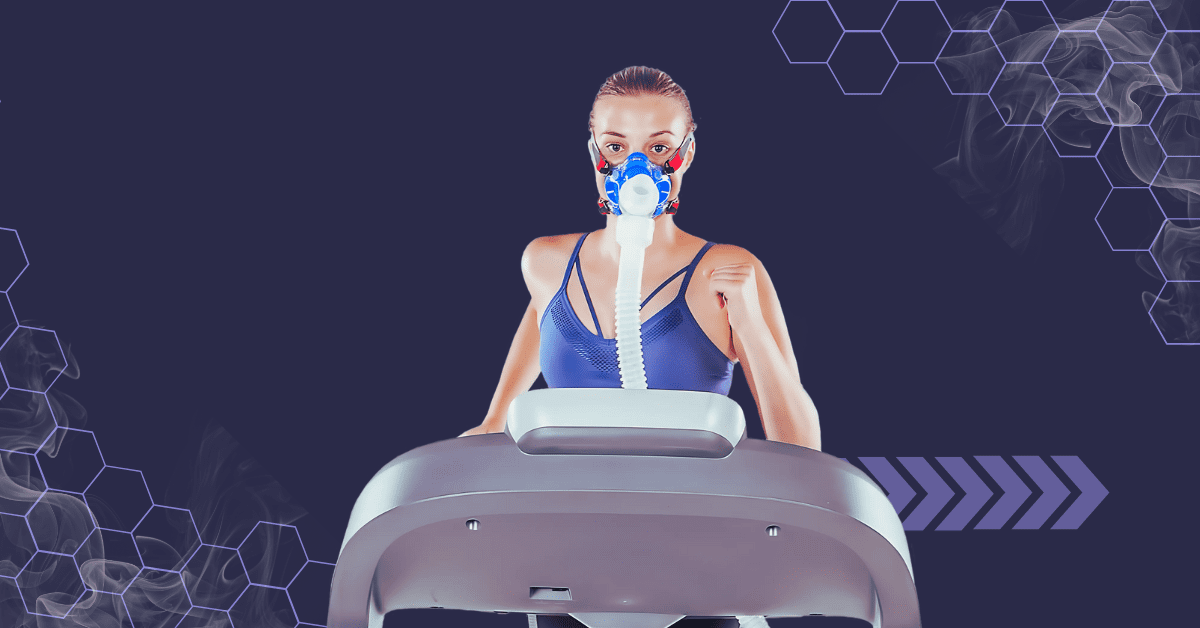
The Bruce Protocol was developed in the 1960s, and while it served its purpose for cardiac stress testing, it’s not ideal for today’s endurance athletes or fitness clients looking to improve fat burning and build metabolic efficiency.
If your client’s goal is smarter training, not just pushing to their max, they need more than just a VO2 max number. They need to understand their Zone 2 heart rate, how their body shifts from fat to carbohydrate burning, and how to train in the right zones for endurance, performance, and longevity. Modern metabolic testing offers precise, personalized data. So if you’re still relying on an outdated, one-size-fits-all protocol, it’s time to evolve your approach and give your clients the insights they need.
Don’t get us wrong—the Bruce Protocol deserves respect. For decades, it served as the standard for cardiovascular assessment, helping countless medical professionals evaluate heart health and determine basic fitness levels. This treadmill-based protocol, with its increases in speed and incline every three minutes, was revolutionary for its time and laid important groundwork for exercise testing.
But here’s the reality: today’s fitness goals have evolved beyond what the Bruce Protocol was designed to measure. Modern athletes and fitness enthusiasts aren’t just asking “What’s my VO2 Max?” They want to know their precise fat-burning zones, their peak training intensities, and how to build endurance that enhances performance across all training zones. They’re seeking metabolic insights that can transform their workouts and their approach to health and fitness.
The fitness industry has moved toward precision, personalization, and practical application. While the Bruce Protocol tells you how hard someone can push at their absolute limit, it doesn’t provide the nuanced metabolic data that drives today’s most effective training programs.
What Made the Bruce Protocol Popular?
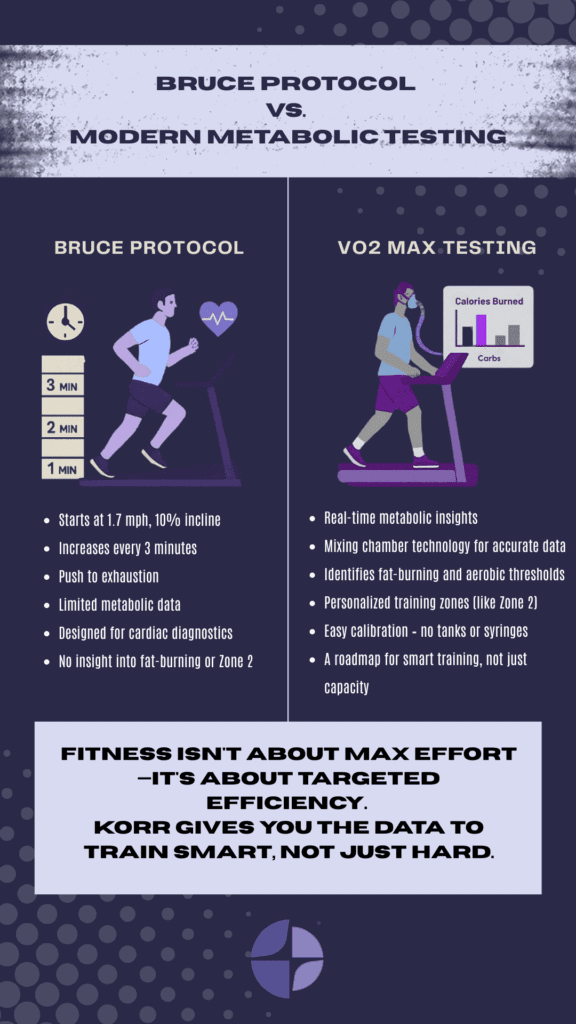
The Bruce Protocol earned its place in fitness history for good reason. Developed in the 1960s and 70s by Dr. Robert Bruce at the University of Washington, this standardized treadmill test was designed for cardiac stress testing. Its approach—starting at 1.7 mph at 10% grade and increasing speed and incline every three minutes—provided medical professionals with a reliable way to evaluate cardiovascular health and detect heart disease.
The protocol’s popularity exploded because it solved a problem: it gave healthcare providers and fitness professionals a standardized, reproducible method for measuring cardiovascular capacity. Before the Bruce Protocol, exercise testing lacked consistency. This protocol created a universal language for fitness assessment, making it easier to compare results across facilities and track progress over time.
As VO2 Max testing gained traction in the fitness world, the Bruce Protocol became the go-to method. It was familiar, well-documented, and widely accepted in medical settings. Many fitness professionals adopted it because it was what they knew, and equipment manufacturers built their systems around its established framework.
The limitations of the Bruce Protocol in today’s fitness landscape are apparent. First, it’s designed to push people to absolute exhaustion—great for medical stress testing, but not ideal for gathering the metabolic insights that modern training demands. The protocol focuses on maximum output rather than the nuanced zones where most effective training occurs.
More importantly, Bruce Protocol testing often misses the metabolic data that today’s athletes and fitness enthusiasts desperately need. It can tell you someone’s peak oxygen consumption, but it doesn’t provide clear insights into fat-burning zones, aerobic thresholds, or the precise heart rate ranges that optimize different training adaptations. In an era where Zone 2 training and metabolic efficiency are driving performance gains, the Bruce Protocol feels like using a sledgehammer when you need a precision instrument.
Zone 2 Training Takes Center Stage
While the Bruce Protocol was pushing people to their limits, the fitness world was discovering something revolutionary: the power of training in Zone 2. This isn’t about going all-out or gasping for air—Zone 2 training occurs at a low intensity where you can still hold a conversation, yet you’re working at the sweet spot for metabolic adaptation.
Zone 2 is the highest intensity at which your body can still primarily burn fat for fuel while maintaining predominantly aerobic metabolism. Think of it as your body’s most efficient engine setting—you’re working hard enough to create adaptation, but not so hard that you shift into sugar-burning, anaerobic territory. This zone falls around 60-70% of your maximum heart rate, but here’s the catch: those generic formulas are just estimates.
Why Zone 2 Has Become Essential
The fitness revolution around Zone 2 training is based on solid metabolic science. When you train in Zone 2, you’re teaching your body to become a more efficient fat-burning machine. You’re improving your mitochondrial function, enhancing your aerobic base, and building the metabolic foundation that supports all other training.
But here’s what makes Zone 2 truly special: Zone 2 improves performance and enhances your capacity across all training zones. A stronger aerobic base in Zone 2 means better recovery between high-intensity intervals in Zones 4 and 5. It means you can sustain Zone 3 efforts longer. It even improves your ability to clear lactate and maintain form during those all-out Zone 5 sprints.
The Metabolic Efficiency Athletes Are Chasing
Today’s athletes and fitness enthusiasts understand that performance isn’t just about how hard you can push—it’s about how efficiently your body can generate and sustain energy. Zone 2 training develops this efficiency by:
- Maximizing fat oxidation, which provides a virtually unlimited fuel source
- Improving mitochondrial density and function
- Enhancing oxygen delivery and utilization
- Building capillary networks that support better nutrient delivery
- Creating metabolic flexibility—the ability to efficiently switch between fuel sources
This metabolic efficiency translates to real-world benefits: better endurance, faster recovery, improved body composition, and the ability to maintain higher intensities for longer periods.
The Problem with Guessing Your Zone 2
Here’s where the Bruce Protocol and generic heart rate formulas fall short: determining your true Zone 2 requires precise metabolic measurement, not mathematical estimates. Your actual Zone 2 heart rate might be significantly different from what a formula suggests, and training in the wrong zone means missing out on these crucial adaptations.
Without proper VO2 Max testing that measures your metabolic responses, you’re training blind. You might think you’re building your aerobic base in Zone 2, but you could be working too easy in Zone 1 (minimal adaptation) or too hard in Zone 3 (different metabolic pathway). Only through accurate metabolic testing can you identify the precise heart rate range where your body maximizes fat burning while maintaining aerobic metabolism—your true Zone 2.
Why Traditional Protocols Fall Short for Modern Goals
The disconnect between traditional testing methods and modern fitness goals has never been more apparent. While the Bruce Protocol remains laser-focused on pushing clients to their absolute maximum—measuring how much oxygen they can consume when completely exhausted—today’s athletes and fitness enthusiasts need something entirely different: precise training zones that optimize their daily workouts.
Think about it: when was the last time your client asked, “What’s the most oxygen I can consume before I collapse?” More likely, they’re asking questions like, “What heart rate should I maintain during my long runs?” or “How do I know I’m burning fat during my cardio sessions?” The Bruce Protocol’s all-or-nothing approach doesn’t provide answers to these training questions.
The Need for Metabolic Information
Modern fitness success hinges on understanding your metabolic profile, not just your maximum capacity. Today’s training programs are built around metabolic efficiency: knowing exactly when your body shifts from fat burning to carbohydrate burning, identifying your aerobic threshold, and understanding how different intensities affect your fuel utilization.
This metabolic information is game-changing for several reasons. First, it allows for personalized training zones rather than generic formulas that might be completely wrong for an individual. Second, it provides insight into fat burning patterns, which is crucial for performance and body composition goals. Third, it reveals metabolic flexibility—how well someone can switch between different fuel sources during exercise.
Without this data, you’re prescribing training blindfolded. A client might spend months training in what they think is their fat-burning zone, only to discover they’ve been working at an intensity that mainly burns carbohydrates. That’s not just inefficient—it’s counterproductive to their goals.
Where Technology Makes the Difference
Here’s where the technology behind your testing equipment becomes crucial. Many traditional systems rely on breath-by-breath analysis, which sounds sophisticated but actually introduces limitations. Breath-by-breath systems capture data from individual breaths, creating noisy, inconsistent readings that require extensive mathematical smoothing to make sense of the results.
This approach becomes problematic when you’re trying to identify metabolic transitions—like the exact heart rate where fat burning peaks or where aerobic metabolism shifts to anaerobic. The noise in breath-by-breath data makes these transition points difficult to identify accurately.
Mixing chamber technology takes a different approach. Instead of analyzing each individual breath, it collects expired air in a chamber, creating a stable, averaged sample that provides much cleaner, more reliable data. This technology is the gold standard for metabolic measurement because it eliminates the noise and variability that plague breath-by-breath systems.
The practical difference is significant: with mixing chamber technology, you can confidently identify precise training zones and metabolic transitions. With breath-by-breath systems, you’re working with estimates and approximations—hardly the precision that modern training demands.
The KORR Advantage
While other testing systems struggle with complex calibration procedures and noisy data, KORR has revolutionized metabolic testing by addressing the real-world needs of fitness professionals and their clients. The result is a testing experience that’s more accurate, efficient, and practical.
Effortless Calibration That Works
One of the biggest frustrations with traditional metabolic testing equipment is the calibration process. Most systems require syringes, gas tanks, and lengthy procedures that can take 5-10 additional minutes—time that adds up quickly in a busy practice. Even worse, these complex calibration methods introduce human error that can compromise your results before you even begin testing.
KORR’s approach is different. The system auto-calibrates using the air already in your room. No syringes, no gas tanks, no complex procedures. Simply push a button, and within 90 seconds, your equipment is calibrated and ready for testing. This is more accurate because it eliminates the human error factor that comes with manual calibration procedures.
Mixing Chamber Technology
At the heart of KORR’s accuracy advantage is mixing chamber technology—the same approach used in research laboratories and considered the standard for metabolic measurement. While competitors rely on breath-by-breath systems that create noisy, inconsistent data, KORR’s mixing chamber approach provides the reliable measurements that modern training demands.
This technology difference is practical. When you’re trying to identify a client’s Zone 2 heart rate or their optimal fat-burning intensity, you need accurate data. Mixing chamber technology delivers this precision by eliminating the variability and noise that make other systems unreliable for detailed metabolic analysis.
Real Metabolic Intelligence
While many testing systems focus solely on maximum oxygen consumption, KORR provides comprehensive metabolic data that drives training decisions. The system doesn’t just measure how much oxygen someone consumes—it reveals when and how efficiently they burn fat versus carbohydrates at different intensities.
This metabolic intelligence includes precise identification of fat-burning zones, aerobic thresholds, and the heart rate ranges where different fuel sources dominate. Instead of leaving clients with a single VO2 Max number, you’re providing them with a complete metabolic roadmap for their training.
Translating Data into Training Success
The real test of any metabolic testing system isn’t the technology—it’s how that technology translates into better training outcomes. KORR’s approach delivers results that clients can immediately apply to their workouts.
A client leaves with specific heart rate zones for different training goals: their optimal fat-burning range for easy aerobic sessions, their Zone 2 range for base-building workouts, and their higher-intensity zones for interval training. They understand not just what their maximum capacity is, but how to train across all intensities.
This precision leads to more effective training programs, better adherence (because clients see results), and ultimately, the kind of transformative outcomes that build your reputation as a fitness professional. When clients can train with confidence, knowing they’re working at the right intensities for their goals, their results and their satisfaction improve dramatically.
The Future of Fitness Testing Starts Today
The fitness industry has evolved beyond the limitations of the Bruce Protocol, and your testing capabilities should evolve with it. While others remain stuck in outdated approaches, you have the opportunity to offer your clients something transformative: precision metabolic testing that delivers insights for real-world training success.
KORR partners with fitness professionals who are ready to elevate their practice and deliver exceptional value to their clients. Our mixing chamber technology, effortless calibration, and metabolic analysis are more than technical advantages; they represent your ability to stand out in a competitive fitness landscape.
Why Leading Professionals Choose KORR
The most successful fitness professionals understand that their reputation is built on results. When you can provide clients with precise training zones, accurate metabolic data, and clear pathways to their goals you’re delivering transformative experiences that clients remember and recommend.
KORR’s approach eliminates the guesswork and generic formulas that have held back the industry for decades. Instead of telling clients to train at “60-70% of maximum heart rate,” you can provide them with their individualized fat-burning zone. Instead of relying on outdated protocols designed for medical stress testing, you can offer modern metabolic analysis that directly supports their training objectives.
The question isn’t whether metabolic testing will become standard in fitness—it’s whether you’ll be leading that transformation or following it. KORR provides the technology, support, and expertise to position your practice at the forefront of modern fitness testing.
Our team of metabolic testing specialists is ready to show you how KORR’s precision testing can enhance your client relationships, improve training outcomes, and differentiate your services in the marketplace.
Discover how KORR’s advanced metabolic testing can transform your practice and your clients’ results. Contact our team today to schedule a demonstration and see the difference precision testing makes.