



You’re about to conduct an RMR test for a client who’s been struggling with weight loss. They’ve followed every diet, counted every calorie, and still can’t seem to shed the pounds. This test should finally give them the answers they need, the scientific data that explains why their body responds the way it does. But what if the results don’t make sense? What if the numbers seem impossibly high or surprisingly low?
Getting accurate RMR results isn’t just about turning on the machine and having your client breathe into a tube. The difference between meaningful data and misleading numbers often comes down to proper preparation, correct positioning, and knowing how to spot when something’s off. Let’s explore how to ensure every RMR test you conduct delivers the reliable insights your clients deserve.
Setting Up for Success
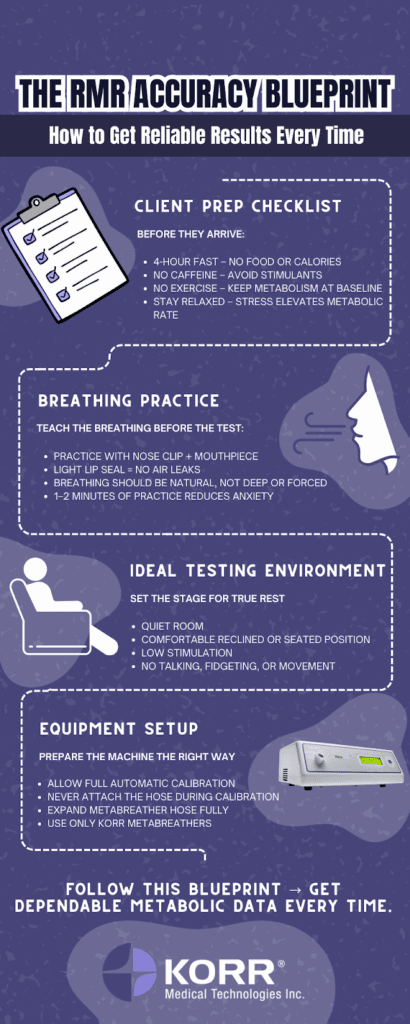
The foundation of accurate RMR testing begins before your client arrives at your facility. Testing resting metabolic rate requires measuring oxygen uptake while the body is truly at rest, and achieving that state takes careful preparation.
Breathing Practice Makes Perfect
Many clients have never breathed through a mouthpiece with a nose clip before. This unfamiliar sensation can cause anxiety, altered breathing patterns, or mouth breathing that doesn’t seal properly around the mouthpiece. Before starting the actual test, spend a few minutes letting your client practice. Have them get comfortable with the sensation of the nose clip and mouthpiece. Remind them to keep their lips sealed lightly around the mouthpiece throughout the test, as this ensures all exhaled air gets analyzed by the machine.
The breathing should be relaxed and natural. If your client is taking deep, deliberate breaths or breathing rapidly due to nervousness, the results won’t reflect their true resting metabolic rate. A few practice breaths can make all the difference.
Creating the Ideal Testing Environment
Your client needs to avoid eating a meal within four hours of the test. Food consumption increases metabolic rate as the body works to digest, absorb, and process nutrients. Similarly, exercise on the day of testing should be avoided, as physical activity elevates metabolism for hours afterward.
Stimulants like caffeine also artificially raise metabolic rate, so clients should skip their morning coffee before testing. During the test itself, comfort is paramount. Your client should be in a relaxed position, whether sitting in a comfortable chair or lying down. The room should be quiet and calm, free from distractions that might cause stress or fidgeting.
Equipment Preparation
Before each test, your KORR machine will automatically calibrate, accounting for factors like humidity, temperature, and barometric pressure. This calibration process is critical for accuracy, so never attach the hose or filter during this phase. Once calibration is complete, expand the MetaBreather hose to its full length and connect it to the machine.
Using only KORR-manufactured MetaBreathers ensures accuracy and maintains your factory warranty. After approximately 10 minutes of normal breathing, the machine will complete the test and provide results you can compare to expected averages.
Understanding High RMR Values: When Numbers Exceed Expectations
Sometimes you’ll get RMR results that seem higher than anticipated. A client might show a metabolic rate well above what predictive formulas suggested, and your first instinct might be to question the accuracy of the test. But high RMR values aren’t necessarily wrong.
True High RMR
Most overweight and obese individuals actually have average or higher than average metabolic rates. This statistical reality surprises many clients who are convinced their metabolism is slow. In fact, carrying extra body weight requires more energy, as the body must work harder to maintain basic functions. Higher body mass, particularly lean body mass, naturally increases resting metabolic rate.
Taking an RMR measurement removes the excuse of a “slow metabolism” and can be incredibly motivating. When clients see that their bodies can indeed burn calories efficiently, it shifts their focus from blaming their metabolism to addressing other factors affecting their weight.
Factors That Elevate RMR
Several legitimate factors can increase metabolic rate beyond baseline expectations. If your client was stressed, anxious, or fidgeting during the test, their metabolic rate will be elevated. Recent caffeine consumption, exercise, or food intake can also artificially raise the numbers. These aren’t equipment errors but rather indications that the client wasn’t truly at rest during measurement.
Understanding Low RMR Values: Separating Truth from Technical Issues
Low RMR readings require careful interpretation. They might represent a true metabolic adaptation, or they could indicate a problem with the test itself.
True Low RMR: The Weight Loss Adaptation
Regardless of the method used to lose weight, a person’s RMR decreases after weight loss. This decrease is actually below the level predicted by fat-free mass. Research shows that in most cases, if someone can maintain their new weight for six months, their RMR will eventually rise to the expected level. This metabolic adaptation is real and represents one of the body’s most significant challenges to sustained weight loss.
Pinpointing the precise number of calories necessary to maintain weight during this crucial period is key to helping clients navigate this metabolic transition. An accurate RMR test provides this essential information, allowing you to adjust caloric goals appropriately.
False Low RMR: Technical Culprits
Sometimes low RMR values don’t reflect true metabolism but rather problems with the testing process. The most common culprit is air leakage. If your client isn’t maintaining a proper seal around the mouthpiece, some exhaled air escapes without being measured, leading to artificially low oxygen consumption readings.
Mechanical issues can also cause false low readings. If the equipment isn’t properly calibrated or if there’s a problem with the oxygen sensor, the measurements won’t be accurate. Environmental factors like temperature fluctuations during the test can also affect results if the machine hasn’t properly compensated for these variables.
Troubleshooting Steps: What to Do When Results Don’t Add Up
When you encounter unexpected RMR values, follow a systematic approach to determine whether you’re seeing true metabolic variation or a testing error.
First, review the pre-test protocol with your client. Did they fast for four hours? Did they avoid exercise and caffeine? Were they truly relaxed during the test? If any of these conditions weren’t met, the elevated or depressed readings might simply reflect a body that wasn’t at rest.
Next, check for air leaks. Watch your client breathe through the mouthpiece. Are their lips sealed properly? Is the nose clip positioned correctly? Even small air leaks can significantly impact results.
Examine the equipment. Did the machine calibrate properly before the test? Is the MetaBreather in good condition without any tears or damage? When was the last time the oxygen sensor was checked?
If everything appears correct but the results still seem inconsistent with your clinical assessment, consider retesting. Schedule the test for a different time of day, ensure even more rigorous adherence to pre-test protocols, and monitor the client’s state throughout the measurement.
Frequently Asked Questions
Why is my client’s RMR higher than expected?
Higher than expected RMR values are actually quite common and often accurate. Most overweight individuals have average or above-average metabolic rates because their bodies require more energy to maintain additional body mass. If the test was conducted properly and pre-test protocols were followed, the high reading likely reflects your client’s true metabolic rate. However, if your client was stressed, had recently consumed caffeine, or exercised on the day of testing, these factors could artificially elevate the results.
What causes false low RMR readings?
False low readings typically stem from air leaks around the mouthpiece or technical issues with the equipment. If your client isn’t maintaining a tight seal with their lips or if the nose clip isn’t positioned properly, exhaled air escapes without being measured. Equipment problems, such as improper calibration or oxygen sensor issues, can also produce inaccurately low readings.
How do I know if it’s the device or the client?
Distinguish between equipment and client issues by systematically checking both. First, verify that pre-test protocols were followed: four-hour fast, no exercise that day, and no caffeine. During the test, observe the client’s breathing and ensure proper mouthpiece seal and nose clip placement. If the client’s behavior and positioning are correct, examine the equipment for calibration issues or sensor problems. The KORR machine’s automatic calibration system eliminates many potential device-related errors, so client-related factors are often more likely culprits.
Should I retest immediately or reschedule?
If you identify a specific problem during the test, such as an air leak or client anxiety, you can retest immediately after addressing the issue. However, if the client consumed food or caffeine, exercised, or was particularly stressed, reschedule the test for another day when proper pre-test conditions can be met. For unexplained inconsistencies where both the client and equipment appear fine, schedule a retest to compare results and establish a reliable baseline.
Master RMR Testing for Better Client Outcomes
Accurate RMR testing transforms weight loss from guesswork into precision science. When you understand how to prepare clients properly, recognize the difference between true and false readings, and troubleshoot effectively, you provide clients with personalized nutrition guidance they can trust.
The RMR measurement is scientific information about each client that allows you to give them realistic goals you cannot get from any other source. Whether you’re working with post-bariatric surgery patients, athletes fine-tuning their nutrition, or everyday clients struggling with weight management, precise metabolic data makes all the difference. Master these testing techniques, and you’ll deliver the accurate insights that help your clients finally achieve their goals.