



When it comes to precision fitness testing, heart rate is your most valuable training metric. It’s the data point that bridges the gap between what’s happening inside your body and the numbers you see on the screen. Heart rate data is only as good as how you collect it. Whether you’re conducting VO2 Max tests in a clinical setting or training athletes in the field, understanding how to capture accurate heart rate readings can make the difference between actionable insights and misleading information.
Getting Accurate HR Readings
Accurate heart rate monitoring starts with proper sensor contact and placement. The technology has evolved, but the fundamentals remain critical to obtaining reliable data.
Sensor Contact Tips
The quality of your heart rate data depends on consistent electrode contact with the skin. Before placing any heart rate monitor, ensure the contact area is clean and dry. Sweat, lotions, and oils create barriers that disrupt electrical signals. For chest straps, lightly moisten the electrode patches with water or electrode gel to improve conductivity. This simple step can eliminate many common signal dropout issues during testing.
If you’re working with clients who have very dry skin, consider using a small amount of electrode gel on the sensor pads. This becomes especially important during longer tests when natural perspiration might not develop quickly enough to maintain good contact.
Strap Placement Adjustments
Proper strap placement is where science meets practicality. For chest straps, the best position is just below the pectoral muscles, centered on the sternum. The strap should fit snugly but not restrict breathing. Too loose and you’ll get erratic readings; too tight and you’ll compromise comfort and potentially affect breathing patterns during maximal effort tests.
For female clients, placement may need adjustment to sit comfortably beneath sports bras while maintaining proper electrode contact. The key is finding the position where the electrodes rest flat against the skin without gaps. During VO2 Max testing, any movement of the strap relative to the body can introduce noise into your data, so taking extra time to dial in the fit pays dividends in data quality.
Optical Alternatives
Optical heart rate monitors using photoplethysmography (PPG) technology have gained popularity for their convenience. These wrist-based monitors detect heart rate by shining light into the skin and measuring blood flow changes. While they work well for steady-state activities and general fitness tracking, they face limitations during maximal testing.
During high-intensity efforts, arm movement, muscle flexion, and changes in peripheral blood flow can all compromise optical sensor accuracy. For VO2 Max testing where you need precise heart rate data at threshold levels and maximal efforts, chest strap monitors remain the gold standard. That said, optical monitors can serve as backup devices or for clients who cannot tolerate chest straps.
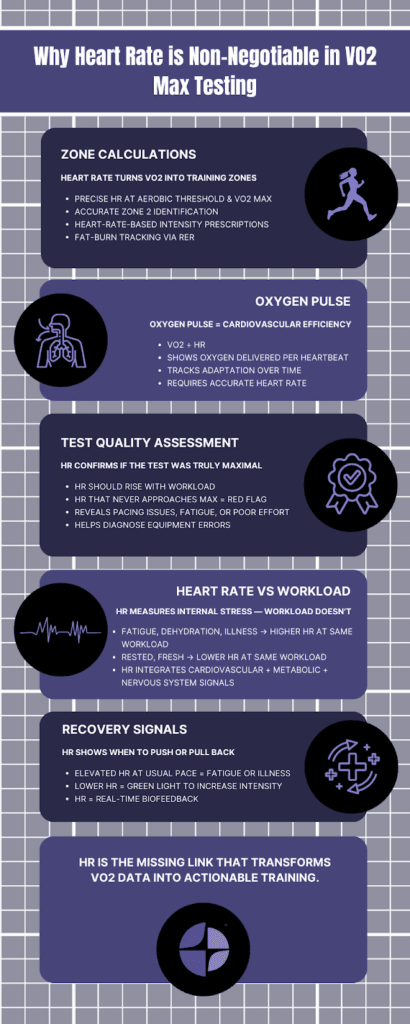
Why Heart Rate Cannot Be Removed from Testing
Some might wonder: if we’re measuring oxygen consumption directly, why do we need heart rate data? The answer lies in how we translate raw VO2 data into practical training applications. Heart rate serves as the bridge between laboratory measurements and real-world training sessions.
Zone Calculations
Training zones are the language that coaches and athletes speak. While VO2 percentages provide physiological benchmarks, heart rate zones translate those benchmarks into numbers your clients can track every single workout. When individual zones are defined by a measure of oxygen uptake, precise heart rates are determined at key physiological markers like Anaerobic Threshold and VO2 Max.
The Respiratory Exchange Rate allows tracking of the heart rates that most effectively burn fat. Zone 2 Training, which has become the cornerstone of endurance development, can only be accurately identified through the combination of oxygen consumption and heart rate data. Without heart rate, you lose the ability to prescribe specific training intensities that your clients can actually use.
Oxygen Pulse
Oxygen pulse, calculated as VO2 divided by heart rate, represents how much oxygen your body delivers per heartbeat. This metric reveals cardiovascular efficiency and provides insights into both cardiac function and peripheral oxygen extraction. It’s particularly valuable for tracking training adaptations over time. As fitness improves, oxygen pulse typically increases, meaning the heart delivers more oxygen with each beat. This calculation requires accurate heart rate data at every stage of the test.
Test Quality Assessment
Heart rate data serves as a quality control mechanism during testing. An appropriate heart rate response to increasing workload confirms that your client is providing genuine maximal effort. If you see VO2 plateau but heart rate hasn’t reached age-predicted maximums, you know something is off. Either the test wasn’t truly maximal, or there’s an underlying issue worth investigating. Heart rate patterns also help identify when clients are holding back, when they’re fatigued from previous training, or when equipment malfunction is affecting data collection.
Heart Rate vs Workload
On the surface, workload seems like the more objective training metric. After all, watts are watts, and miles per hour are measurable and consistent. But here’s what makes heart rate superior for individualized training: it reflects your body’s internal response to that external stress.
Internal Physiological Stress
The same external workload creates different physiological demands depending on your current state. Heart rate captures this internal stress in real time. When you’re well-rested and fresh, your heart rate response to a given pace or power output will be lower than when you’re fatigued, stressed, or fighting off illness. This variability isn’t a flaw in the metric; it’s what makes heart rate so valuable for training.
Integration of Multiple Body Systems
Heart rate integrates signals from your cardiovascular system, respiratory system, nervous system, and metabolic systems into a single, trackable number. It accounts for heat stress, hydration status, altitude, and even psychological stress. This holistic integration means that heart rate-based training automatically adjusts to your body’s capacity on any given day.
This is why heart rate based training zones make sense. With those zones based on a VO2 Max test, you assist your clients to work out smarter, not harder. The zones determined through metabolic testing reflect actual physiological thresholds, not generic formulas.
Response to Recovery, Stress, and Illness
Maybe the most compelling argument for heart rate training is its sensitivity to recovery status. A runner might maintain their usual pace, but if their heart rate is elevated by 10 beats per minute at that pace, their body is telling them something important. Maybe they need more recovery. Maybe they’re dehydrated. Maybe they’re developing an illness. Heart rate serves as an early warning system that workload alone cannot provide.
This responsiveness allows athletes and coaches to make real-time adjustments. On days when heart rate is elevated for a given workload, backing off intensity prevents overtraining while maintaining training consistency. On days when heart rate is lower than expected, there’s room to push a bit harder. This dynamic adjustment optimizes training adaptation while minimizing injury and burnout risk.
Frequently Asked Questions
What if the chest strap doesn’t work on my client?
First, troubleshoot the basics: check battery status, ensure proper moisture on the electrodes, and verify strap placement. If problems persist, try a different strap size or model. Some clients simply have unique physiology that makes certain monitors more compatible than others. For clients who consistently have issues with chest straps, high-quality armband monitors using electrical sensors (not optical) can provide comparable accuracy.
Can I use a wrist-based heart rate monitor?
Wrist-based optical monitors work well for general training but face accuracy limitations during maximal effort testing. The gold standard remains chest strap monitors for VO2 Max testing. If you must use wrist monitors, ensure they’re positioned properly (one finger width above the wrist bone, snug but not restrictive) and be aware that data may become less reliable above 85% of maximum heart rate.
Why does the software require heart rate data?
Metabolic testing software requires heart rate to calculate training zones, assess test quality, and compute oxygen pulse. These metrics transform raw oxygen consumption data into practical training applications. Without heart rate, the test provides physiological measurements but lacks the practical framework needed to design effective training programs.
What’s the best HR strap for testing?
The best heart rate strap is one that consistently provides accurate data and integrates seamlessly with your testing equipment. Look for monitors that use ANT+ or Bluetooth connectivity, have replaceable batteries, and feature comfortable, adjustable straps. Many testing facilities keep multiple strap sizes on hand to ensure proper fit for all clients. Quality matters more than brand name; choose monitors with proven track records in clinical and performance testing environments.
Moving Forward with Confidence
Accurate heart rate monitoring isn’t just about having the right equipment. It’s about understanding the science behind the measurements, taking time to ensure proper setup, and recognizing the irreplaceable role heart rate plays in translating metabolic data into actionable training guidance.
The most sophisticated metabolic testing equipment in the world can’t compensate for poor heart rate data collection. By mastering these best practices for sensor placement, understanding why heart rate cannot be separated from quality testing, and appreciating how heart rate reflects your body’s integrated physiological response, you position yourself to deliver truly personalized, effective training recommendations.
Equip your testing setup with reliable heart rate monitors for accurate, actionable results. The precision of your data determines the effectiveness of your training prescriptions.