



Imagine a woman named Sarah, a dedicated runner in her early 40s, regularly trains in what her fitness tracker calls the “fat-burning zone” – around 140 beats per minute, based on the standard 220-minus-age formula. Despite months of effort, she’s frustrated by her lack of progress. Meanwhile, her training partner Tom, also 42, seems to effortlessly shed pounds and build endurance training at the exact same heart rate. What Sarah doesn’t realize is that her body’s unique physiology means her fat-burning zone might be completely different from Tom’s – and from what any generic formula suggests.
This scenario plays out in gyms, on running trails, and in fitness studios every day. For decades, athletes and fitness enthusiasts have relied on outdated, one-size-fits-all formulas that treat every 40-year-old the same, every 30-year-old the same, regardless of their individual cardiovascular fitness, metabolism, or training history. These generic calculations, while convenient, often lead people to train in zones that are either too easy to create meaningful adaptation or too intense to sustain effectively.
The solution isn’t to train harder or follow more complicated formulas – it’s to discover your body’s physiological markers through VO2 Max testing. When you understand your personal aerobic threshold, anaerobic threshold, and peak oxygen consumption, you unlock training zones that are truly yours, maximizing every minute you spend working toward your fitness goals.
The Problem with Generic Training Zones
The main flaw with generic heart rate formulas lies in their assumption that all bodies respond identically to exercise. The widely used “220 minus your age” formula was never intended for precise training guidance – it was developed as a rough clinical estimate for maximum heart rate, yet it’s become the foundation for millions of workout plans. This approach ignores the individual variations in cardiovascular fitness, genetics, and metabolic efficiency that make each person’s response to exercise unique.
Consider two 35-year-old athletes with identical maximum heart rates of 185 beats per minute according to the formula. Runner A, who has been training for years, might maximize fat burning at 155 beats per minute, while Runner B, newer to endurance training, could be maximizing fat burn at just 125 beats per minute. If both follow the same “low intensity” zone of 130-145 beats per minute, Runner A will be training too easily to see maximize improvement, while Runner B might be working too hard to sustain the effort or efficiently burn fat.
This individual variation reaches beyond fitness level. Two people of the same age and similar fitness backgrounds can have largely different aerobic and anaerobic thresholds due to genetics, muscle fiber composition, and training history. One person’s Zone 2 fat-burning sweet spot might occur at 140 beats per minute, while another’s happens at 165 beats per minute – a difference that generic formulas can’t account for.
The result is inefficient training that wastes time and effort. Athletes unknowingly train in the wrong zones, missing their fat-burning targets, failing to build the aerobic base they need, or pushing too hard during what should be recovery sessions. This guesswork approach explains why so many dedicated exercisers plateau despite consistent effort – they’re not training in the zones that would drive the adaptations they’re seeking.
The Science Behind Training Zones
What VO2 Max Testing Reveals About Your Body
VO2 Max testing does more than measure how much oxygen your body can use at maximum effort. During this assessment, you breathe through a specialized mask while exercising at gradually increasing intensities on a treadmill or bike. The test captures your body’s real-time oxygen consumption and carbon dioxide production, creating a detailed map of how your metabolism shifts as exercise intensity increases.
The Three Markers That Define Your Training Zones
Aerobic Threshold (AeT): The Turning Point in Fuel Utilization
Your Aerobic Threshold marks a subtle but important shift in how your body powers movement. Below this threshold, your body is highly efficient at burning fat for energy, making it ideal for building endurance and metabolic health. Above this threshold, your body increasingly relies on carbohydrates to meet the rising energy demands. This shift marks a critical boundary in training: staying just below it helps optimize fat metabolism, while crossing it engages more intense, carb-driven efforts. Understanding your unique AeT is key to effective Zone 2 training and long-term performance gains.
Anaerobic Threshold (AT/VT2): The Gateway to High Intensity
The Anaerobic Threshold marks the point where sustained effort becomes increasingly difficult—typically only manageable for a few seconds to several minutes. At this intensity, your body relies almost entirely on carbohydrates for fuel, as fat metabolism can’t keep up with the rapid energy demand. This threshold represents a critical metabolic shift and the onset of high-intensity work. It’s not just the zone for intervals—it’s your physiological red line, defining the upper limit of sustainable performance and guiding how you train for speed, power, and endurance under pressure.
Peak VO2: Your Cardiovascular Ceiling Your peak oxygen consumption represents the maximum rate at which your body can use oxygen during intense exercise. This measurement serves as your fitness fingerprint, providing the upper boundary for all your training zones and a benchmark for tracking improvements over time.
From Data to Personalized Heart Rate Zones
These markers work together to create training zones tailored to your body’s responses. Your Aerobic Threshold becomes the target for Zone 2 training, your Anaerobic Threshold marks the transition to high-intensity, and your Peak VO2 defines your maximal aerobic capacity—supporting short, intense efforts that push your speed and power to their physiological limits.. Instead of guessing based on formulas, you train with the precision of knowing exactly what each heart rate range accomplishes for your physiology.
VO2 Max testing relies on mixing chamber technology to capture accurate measurements of your oxygen consumption and carbon dioxide production. This approach provides clean, reliable data that translates directly into actionable heart rate zones, guaranteeing that every training session targets the adaptations you’re seeking.
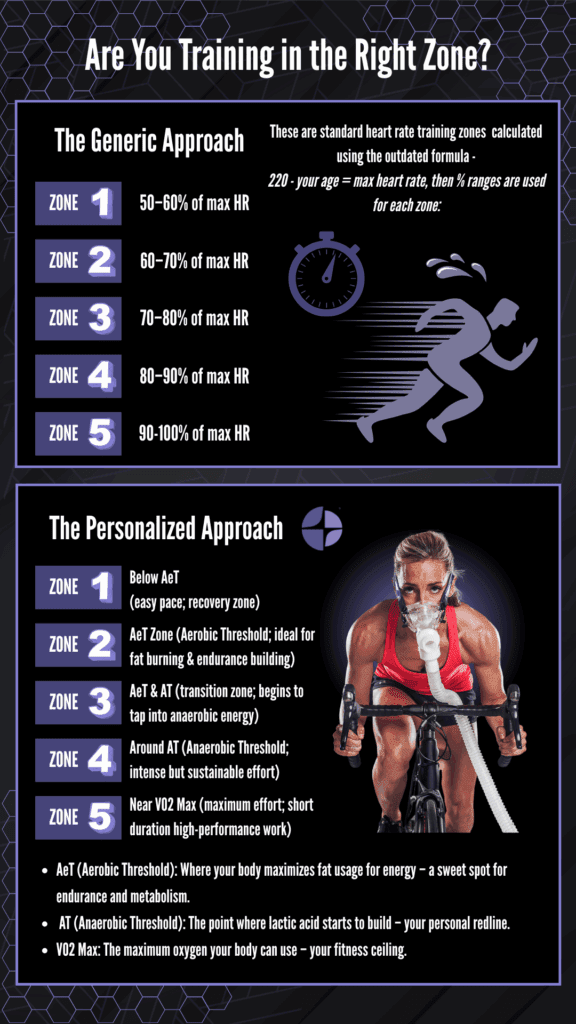
Zone 2: The Foundation That Powers All Other Zones
When you train in your personalized Zone 2, your body becomes remarkably efficient at using oxygen to convert fat into energy. This metabolic state teaches your muscles to work aerobically, building the cellular machinery needed for sustained performance. Your mitochondria – the powerhouses of your cells – multiply and become more efficient, creating a stronger foundation for all physical activity.
Here’s why Zone 2 creates the foundation for every other training zone:
Your cardiovascular system develops the capacity to deliver oxygen more effectively to working muscles. When you strengthen this base through Zone 2 training, you enhance your body’s ability to manage lactate and maintain performance in higher intensity zones. Think of Zone 2 as building the roads that allow faster traffic to flow smoothly in Zones 3, 4, and 5.
The fat-burning efficiency you develop in Zone 2 becomes a game-changer for endurance. When your body becomes proficient at utilizing fat for fuel, you conserve glycogen stores for when you need them, like during high-intensity efforts or prolonged training sessions. This metabolic flexibility means you can sustain effort longer before hitting the wall.
Proper Zone 2 training creates a ripple effect throughout your entire training program. Your recovery between intervals improves because your body becomes better at clearing metabolic byproducts. Your ability to repeat high-quality efforts in Zones 4 and 5 increases because you’ve built the aerobic foundation that supports them. Even your Zone 1 recovery sessions become more effective because your enhanced circulation and oxygen utilization speed the repair process.
The beauty of Zone 2 training lies in its sustainability – you can accumulate training volume without excessive stress, building the aerobic engine that powers every aspect of your fitness journey.
The Complete Training Zone Spectrum
Zone 1: Active Recovery and Base Building
Heart Rate Range: Below your Aerobic Threshold
Primary Function: Recovery and movement preparation
Zone 1 is your body’s most relaxed working state. Training in this zone promotes blood flow and nutrient delivery to muscles without creating additional stress. These sessions serve as active recovery, helping clear metabolic waste while maintaining movement patterns. Zone 1 work is essential for athletes who train frequently, providing the gentle stimulus needed between harder efforts while contributing to overall aerobic development.
Zone 3: Aerobic Power Development
Heart Rate Range: Between your Aerobic and Anaerobic Thresholds
Primary Function: Building sustained aerobic capacity
Zone 3 sits in the middle ground between comfortable aerobic work and anaerobic stress. Training in this zone develops your ability to sustain moderately hard efforts for extended periods. This zone is valuable for endurance athletes who need to maintain steady, sub-threshold paces during competitions. Zone 3 work teaches your body to operate efficiently at intensities that feel “comfortably hard.”
Zone 4: Lactate Threshold and Anaerobic Power
Heart Rate Range: At and slightly above your Anaerobic Threshold
Primary Function: Improving lactate clearance and threshold power
Zone 4 training occurs right at your metabolic breaking point, where lactate production begins to exceed your body’s ability to clear it. Training in this zone improves your anaerobic threshold, allowing you to sustain higher intensities before accumulating fatigue. These efforts typically last 8-40 minutes and are crucial for racing performance and the ability to maintain hard efforts during competition.
Zone 5: Neuromuscular Power and VO2 Max
Heart Rate Range: Above your Anaerobic Threshold, approaching Peak VO2
Primary Function: Developing maximum power and neuromuscular coordination
Zone 5 represents your highest intensity training, focusing on short, powerful efforts that stress your cardiovascular system to its limits. These sessions improve your peak power output, neuromuscular coordination, and your body’s ability to tolerate high levels of metabolic stress. Zone 5 work is essential for developing the “top-end” speed and power needed for sprints, climbs, and decisive race moves.
Each training zone serves a distinct physiological purpose, but they build on one another. Zone 2 develops your aerobic base and fat metabolism, supporting endurance and recovery across all higher zones. Zone 3 bridges aerobic and anaerobic systems, improving muscular endurance and pacing. Zone 4 raises your lactate threshold, allowing you to sustain higher intensities longer. Zone 5 targets your VO₂max, enhancing your peak aerobic power. Together, these zones create a layered system that supports performance across a wide range of intensities.
How Personalized Training Zones Transform Your Workouts
The Marathon Runner’s Strategy Take elite marathoner training: 80% of weekly volume happens in Zones 1 and 2, building that crucial aerobic engine. Weekly tempo runs target Zone 3 for sustained pace development. Bi-weekly threshold sessions push Zone 4 to improve lactate processing. Short Zone 5 strides maintain leg turnover and neuromuscular coordination.
The Weekend Warrior’s Discovery Sarah, our frustrated runner from earlier, finally learned her true Zone 2 occurred around 125 beats per minute – not the 140 her tracker suggested. Within weeks of training at her actual fat-burning zone, she could sustain longer runs, recover faster between sessions, and started seeing the body composition changes she’d been chasing.
The Competitive Cyclist’s Edge Professional cyclists use Zone 4 data for race pacing precision. Knowing their threshold heart rate allows them to sustain maximum effort for 40-kilometer time trials without fading. They pace climbs in Zone 3, attack in Zone 5, and recover in Zone 1 during group rides.
Training Benefits by Zone
- Zone 1 sessions: Enhanced recovery, improved circulation, movement quality maintenance
- Zone 2 workouts: Maximized fat burning, mitochondrial development, aerobic base building
- Zone 3 efforts: Sustained aerobic power, tempo pace development, metabolic efficiency
- Zone 4 intervals: Improved lactate threshold, race pace endurance, anaerobic capacity
- Zone 5 training: Peak power development, neuromuscular coordination, VO2 Max improvement
With accurate zones, your heart rate monitor stops being a basic step counter and becomes your personal coach. That 158 beats per minute reading now tells you you’re perfectly positioned in Zone 2 for optimal fat burning. No more guessing whether you’re working hard enough or too hard – you know exactly which physiological adaptation you’re targeting with every heartbeat.
Unlock Your Clients’ Potential with Precision Testing
Your clients deserve better than generic formulas and guesswork. They deserve training zones based on their physiology, not outdated calculations that treat every body the same. Every day, dedicated athletes and fitness enthusiasts train hard but see limited results because they’re following heart rate zones that don’t match their individual metabolic responses.
With KORR’s VO2 Max testing technology, you can provide the precision your clients need to transform their fitness results. Our mixing chamber technology delivers the accurate, reliable data that turns every heart rate monitor into a powerful coaching tool and every workout into a targeted step toward their goals. Unlike breath-by-breath systems that produce noisy, inconsistent data, our technology provides clean, actionable insights that directly translate into personalized training zones.
Don’t let another client struggle with ineffective training zones or wonder why their efforts aren’t paying off. Whether you’re working with elite athletes seeking that competitive edge, weekend warriors chasing personal bests, or individuals focused on health and fat loss, personalized zones make the difference between spinning wheels and achieving breakthroughs.
Give them the gift of personalized data that unlocks their true potential. Contact KORR today to discover how our testing solutions can elevate your practice and deliver the results your clients have been working so hard to achieve. Their breakthrough is waiting in the data – let us help you find it.