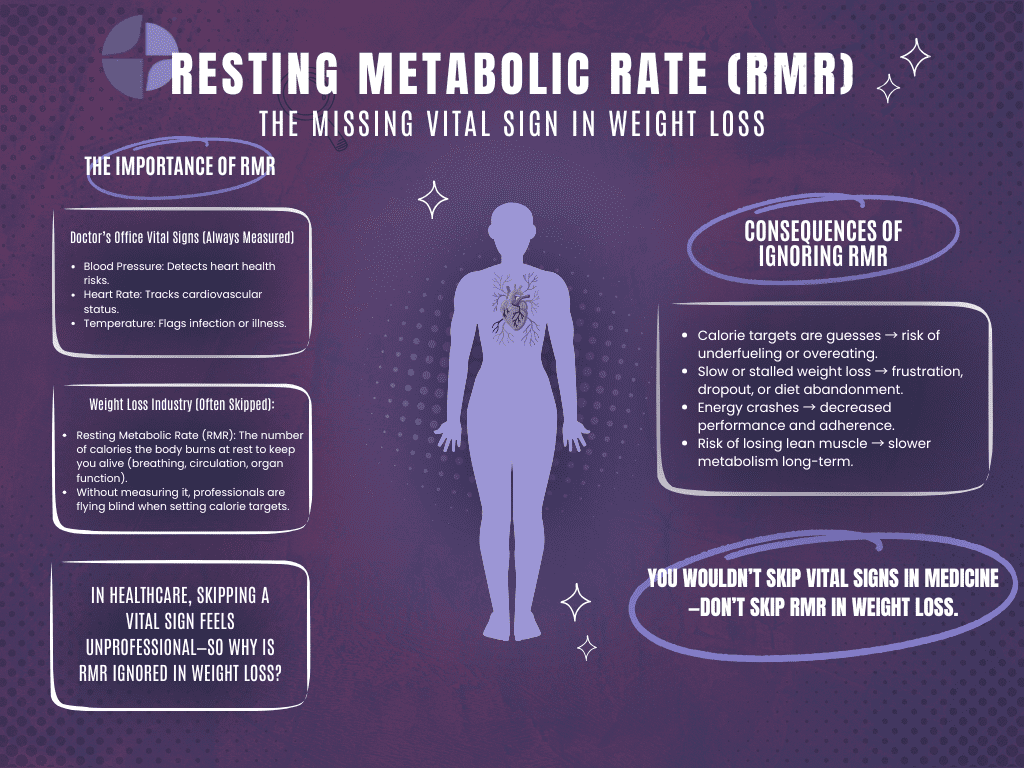



When you start researching metabolism testing, you’ll quickly encounter two abbreviations: RMR and BMR. They sound similar, they measure similar things, and they’re often used interchangeably in casual conversation. But these two measurements represent different testing conditions with different practical applications. Understanding the distinction helps you know what you’re measuring and how to use that information effectively in your fitness and nutrition planning.
BMR Explained
Basal metabolic rate (BMR) is the absolute minimum number of calories your body requires to sustain life. This measurement captures the energy needed for your most essential functions: keeping your heart beating, maintaining body temperature, supporting brain activity, and powering cellular processes throughout your body.
The Reality of BMR Testing
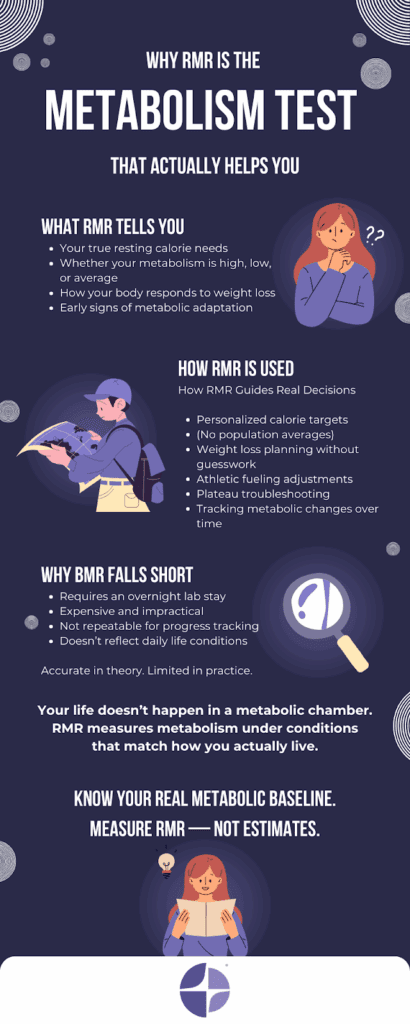
Measuring true BMR requires extraordinarily strict conditions that make it impractical for most clinical settings. You would need to spend the night in a specialized metabolic chamber, sleeping in a controlled environment. Upon waking, before moving, speaking, or experiencing any stimulation whatsoever, technicians would measure your oxygen consumption while you remain completely still.
These conditions guarantee that absolutely no external factors influence your metabolic rate. No digestion occurs because you fasted overnight. No muscle activity happens because you haven’t moved. No stress response activates because you just woke from sleep. The result is the purest possible measurement of your baseline metabolic needs.
When BMR Gets Used
BMR measurements appear mainly in research settings where scientists need to establish baseline metabolic function under standardized conditions. Pharmaceutical studies examining drug effects on metabolism might use BMR. Research investigating genetic or hormonal influences on energy expenditure often requires BMR precision.
For clinical practice, athletic training, or weight management, BMR’s strict requirements make it impractical. The overnight stay, the specialized equipment, and the need for complete physical and mental rest create barriers that prevent widespread use outside research facilities.
RMR Explained
Resting metabolic rate (RMR) measures the calories you burn at rest under more relaxed, realistic conditions. While you still need to be rested and avoid recent food or exercise, RMR testing happens in regular clinic settings without overnight stays or metabolic chambers.
How RMR Testing Works
RMR testing requires simple preparation. You avoid eating for four hours before the test, skip exercise on testing day, and ideally avoid stimulants like caffeine. When you arrive, you sit or recline comfortably for approximately 10 minutes while breathing normally into a metabolic analyzer.
The device measures your oxygen consumption and carbon dioxide production. Since burning one calorie requires a specific amount of oxygen, the analyzer calculates your caloric burn rate with scientific precision. The entire process takes less than 15 minutes from start to finish.
Real-World Applications
RMR testing provides the metabolic information you need for practical decision-making. Whether you’re designing a weight loss program, adjusting nutrition for athletic performance, or managing weight after significant loss, RMR gives you actionable data.
Fitness professionals use RMR results to calculate personalized caloric targets. Instead of relying on generic formulas that estimate your needs based on population averages, you know your actual metabolic rate. This precision helps set realistic expectations and prevents the disappointment that happens when standard recommendations don’t match your physiology.
RMR testing also reveals metabolic adaptation, the phenomenon where your metabolism slows after weight loss. By measuring RMR before starting a weight loss program and again at key intervals, you can track how your metabolism responds. This information allows you to adjust your caloric intake to maintain progress rather than hitting frustrating plateaus.
Medical professionals use RMR in clinical settings to detect metabolically abnormal conditions. A clinically low RMR might indicate thyroid dysfunction or other metabolic disorders requiring medical intervention. Identifying these conditions allows proper treatment before investing time and effort in weight loss programs that can’t succeed without addressing the underlying issue.
Which One Should You Measure?
For virtually everyone outside a research laboratory, RMR is the appropriate measurement. The practical benefits of RMR testing outweigh the marginal accuracy gained from BMR’s stricter conditions.
RMR typically measures about 10% higher than BMR because it includes the slight metabolic cost of being awake and sitting upright rather than sleeping. This difference is predictable and consistent, meaning RMR provides equally useful information for planning and decision-making.
Think of it this way: your daily life doesn’t happen in a metabolic chamber while you sleep. You live, work, and make food choices while awake and active. RMR captures your metabolic baseline under conditions that actually resemble your real life, making it the more relevant measurement for practical applications.
The accessibility of RMR testing means you can measure it regularly. Track your metabolism as you lose weight, build muscle, or age. Monitor how your body responds to training programs or nutritional changes. This ongoing data collection would be impossible with BMR’s demanding testing requirements.
Frequently Asked Questions
Which is more accurate, RMR or BMR?
BMR is technically more precise because it measures metabolism under the most controlled conditions possible. However, RMR is more accurate for real-world planning because it reflects your actual resting state during normal daily life. The 10% difference between RMR and BMR is well-documented and predictable, so RMR provides the accuracy you need.
Why don’t clinics measure BMR?
The strict requirements for true BMR measurement make it impractical outside specialized research facilities. Requiring overnight stays in metabolic chambers with immediate morning testing would make the service prohibitively expensive and logistically challenging. RMR provides the same practical information through a simple 10-minute test.
Will my results be different for RMR vs BMR?
Yes, your RMR will typically measure approximately 10% higher than your BMR. This difference reflects the metabolic cost of being awake and maintaining posture rather than sleeping. Both measurements track together, meaning changes in one will mirror changes in the other.
Which measurement is better for weight loss planning?
RMR is better for weight loss planning because it represents your actual resting metabolic state during normal daily activities. When you calculate your total daily energy expenditure by adding activity calories to your resting rate, you want to start with RMR, which reflects your awake baseline, not your sleeping baseline.
Get Started with RMR Testing
Understanding your resting metabolic rate removes guesswork from nutrition planning and weight management. Instead of following generic calorie recommendations that may not match your physiology, you’ll have precise data about your actual metabolic needs.
RMR testing reveals whether your metabolism falls above, below, or within the average range for someone your age, sex, height, and weight. This knowledge helps you set realistic expectations and avoid the frustration that leads 60% of people to abandon their weight loss efforts.
Whether you’re starting a fitness journey, struggling to break through a plateau, or maintaining hard-won weight loss, RMR testing provides the metabolic baseline you need for informed decision-making. Learn how RMR testing can guide your nutrition and weight management goals by contacting a KORR-certified testing provider today.