


You’re preparing for a VO2 Max test with a 35-year-old triathlete who’s been plateauing in her training. As you review protocol options from the traditional Bruce Protocol to sport-specific ramp tests you realize this decision will determine whether you capture meaningful training zones or miss the metabolic markers that could unlock her performance potential.
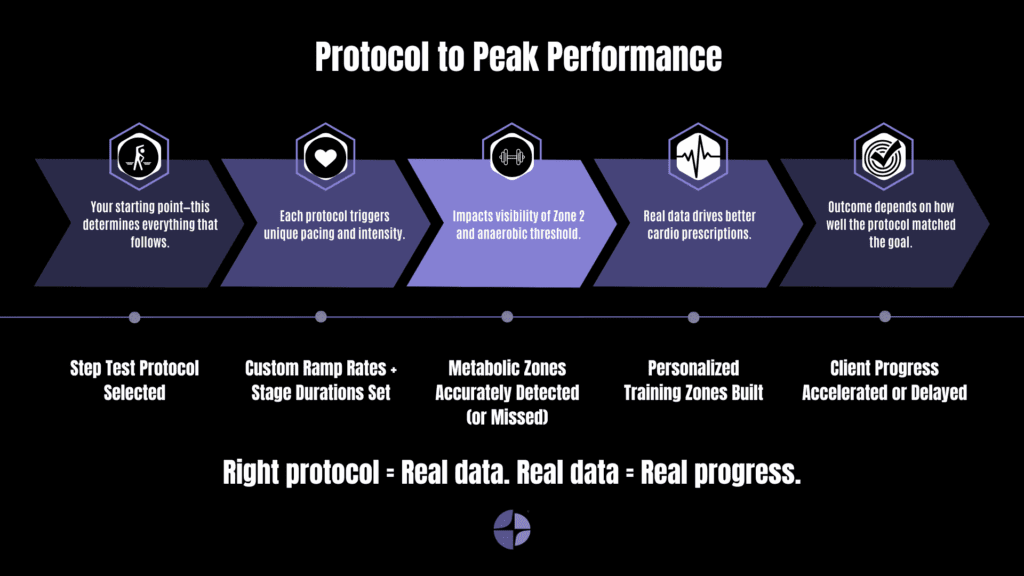
The protocol you select is the blueprint that determines the quality and relevance of every piece of data you collect. Choose poorly, and you might rush past fat-burning zones or fail to reach the intensities needed for accurate threshold identification. Choose wisely, and you’ll reveal the precise heart rate zones that transform training from guesswork into science.
This becomes even more critical when you understand that accurate Zone 2 is best determined through proper VO2 Max testing. Unlike generic heart rate formulas, a well-designed graded exercise test reveals your client’s physiological markers, creating personalized training zones that deliver real results.
Understanding VO2 Max Testing Fundamentals
When you conduct a VO2 Max test using a graded exercise protocol, you’re creating a controlled physiological stress test that maps how well your client’s body uses oxygen under increasing demands. But here’s what makes it powerful: you’re not measuring just one number—you’re revealing an entire metabolic landscape.
As your client progresses through the protocol, their oxygen consumption rises predictably, but the real insights emerge from the metabolic transitions. Mixing chamber technology captures the precise moments when their body shifts from burning primarily fat to relying more heavily on carbohydrates. This aerobic threshold shows their fat-burning sweet spot; information impossible to determine through estimation or generic formulas.
The test also identifies their anaerobic threshold, where their body can no longer meet oxygen demands and begins operating unsustainably. These two markers create the foundation for personalized heart rate zones, making every future training session more effective.
Why Protocol Selection Determines Success
Many fitness professionals assume all VO2 Max protocols yield similar results. In reality, your protocol choice impacts the quality and usefulness of every data point you collect.
A protocol that increases intensity too quickly might push your client past their anaerobic threshold before you’ve properly mapped their aerobic zones. Conversely, a protocol that progresses too slowly might not provide enough physiological stress to reveal their capabilities. The result? Incomplete or inaccurate heart rate zones that fail to optimize training.
Zone 2 training has become the standard for endurance development because it maximizes fat burning while building aerobic capacity. But Zone 2 is a highly individual zone that can only be identified through precise testing. When your protocol selection aligns with your client’s fitness level and goals, you capture this information with scientific accuracy.
An accurately established Zone 2 enhances the effectiveness of all other zones. A properly developed aerobic base makes Zone 3 and Zone 4 training more productive and prevents the common mistake of training too hard during easy sessions and too easy during hard sessions.
Key Factors in Protocol Selection
The Four Pillars of Smart Protocol Choice
Selecting the right VO2 Max protocol requires balancing multiple factors that impact data quality and client experience. Think of these as the foundation that supports everything else:
PILLAR ONE: Client Fitness Level & Training Background
Your client’s current fitness level and training history should drive your protocol selection. A recreational runner and an elite cyclist require different approaches, even if they share similar demographics.
Novice exercisers benefit from longer, gentler progressions that allow their cardiovascular system to adapt gradually. These clients need protocols that spend enough time in lower heart rate zones to properly map their fat-burning capacity. Avoid aggressive ramp rates that might cause them to hit their anaerobic threshold too quickly, missing the Zone 2 data that will drive their training success.
Trained athletes can handle more aggressive protocols that reach higher intensities efficiently. They may need longer testing durations to capture their full aerobic capacity and could benefit from sport-specific modifications. The advantage of mixing chamber technology is that it captures accurate metabolic data regardless of fitness level, but your protocol choice determines whether you’ll reach the zones that matter most.
PILLAR TWO: Testing Objectives and Goals
What you’re trying to discover should influence which protocol you choose. Different goals require different approaches to data collection.
For fat burn zone identification, prioritize protocols that spend time in low-moderate intensities. Use longer stages or smaller workload increases to make sure your mixing chamber technology captures stable metabolic measurements, focusing on identifying the heart rate where fat burning peaks. This becomes their Zone 2 training target.
When peak performance assessment is the goal, implement protocols that efficiently push toward true VO2 Max using appropriate progression rates to reach maximum capacity while capturing aerobic and anaerobic thresholds for training zone development.
PILLAR THREE: Equipment and Testing Environment
Your available equipment influences protocol options. Treadmill protocols offer control and familiarity for runners but require clients comfortable with increasing speeds and inclines. Cycle protocols work well for cycling enthusiasts and provide stable measurement conditions, but may not translate to other activities.
Consider factors like client comfort with equipment, space requirements, and safety considerations. Your CardioCoach system’s portability and auto-calibration capabilities mean you can conduct accurate testing on various equipment types without compromising data quality.
PILLAR FOUR: Individual Limitations and Considerations
Age, injury history, and physical limitations add important considerations to protocol selection. Older clients may require longer warm-up periods and gentler progressions, while those with joint issues might need equipment modifications.
Cardiovascular medications can affect heart rate response, requiring protocol adjustments. Previous injuries might influence testing duration or intensity progression. The insight is that mixing chamber technology provides accurate metabolic data regardless of these individual factors, but your protocol selection determines whether that data will be useful for your client’s situation and goals.
Popular VO2 Max Protocols Compared
The Bruce Protocol
The Bruce Protocol remains one of the most recognized testing protocols, featuring 3-minute stages with predetermined speed and incline increases. Originally developed for clinical cardiac assessment, it provides an approach that allows for comparison across populations and research studies.
Strengths:
- Universally recognized with decades of research data
- Standardized progression allows for population comparisons
- Well-suited for clinical or research environments requiring consistency
- Established normative data available for result interpretation
Limitations:
- One-size-fits-all approach doesn’t accommodate individual fitness levels
- May progress too rapidly for deconditioned clients
- Might not spend adequate time in low-moderate intensities for optimal Zone 2 identification
- Can be challenging for clients unfamiliar with treadmill exercise
The Bruce Protocol works best when you need standardized results for comparison against established research data or when working in clinical settings with established protocols.
Shorter-Stage Ramp Protocols:
Unlike traditional staged protocols such as the Bruce (with 3-minute blocks and larger workload jumps ramp protocols can be designed with shorter stages—often 1-minute or even continuous adjustments—that create a more gradual increase in workload. This approach provides smooth physiological stress progression and can be customized to individual fitness levels by adjusting the ramp rate.
Strengths:
- Smooth progression reduces physiological “shock” from bigger intensity changes
- Highly customizable to individual fitness levels and goals
- Typically shorter testing duration while maintaining data quality
- Excellent for identifying precise metabolic thresholds
Limitations:
- Requires more careful planning to select an appropriate ramp rate
- Less research data for normative comparisons
- May require equipment capable of smooth or continuous adjustments
Ramp protocols excel when you need individualized testing that efficiently captures metabolic thresholds while accommodating specific fitness levels and goals.
Sport-Specific Protocols:
Sport-specific protocols modify traditional approaches to better reflect the demands of particular activities. These might include running protocols for runners, cycling protocols for cyclists, or rowing protocols for rowers.
Strengths:
- Results directly applicable to sport-specific training
- Higher comfort level for athletes familiar with the movement pattern
- Can incorporate sport-specific movement patterns and intensities
- More relevant training zone identification for specific activities
Limitations:
- May not provide general fitness assessment
- Requires sport-specific equipment and expertise
- Results may not translate to other activities
- More complex to standardize across different sports
Sport-specific protocols work best when you’re testing athletes who need training zones specific to their primary sport or activity.
Zone 2 Focused Protocols:
These newer protocols prioritize spending extended time in moderate intensities to identify each individual’s aerobic threshold with precision. They feature longer stages in the 60-80% intensity range to capture detailed metabolic transitions.
Strengths:
- Detailed mapping of fat-burning zones
- Excellent for endurance athletes and recreational exercisers
- Provides highly accurate Zone 2 identification
- Supports the growing emphasis on aerobic base development
Limitations:
- May not reach true VO2 Max in highly fit individuals
- Longer testing duration required
- Less focus on anaerobic capacity assessment
- May not suit clients primarily interested in high-intensity training
Zone 2 focused protocols excel when your primary goal is creating precise training zones for endurance development and fat-burning optimization.
Maximizing Results with KORR’s Technology
While other systems struggle with noisy breath-by-breath data that requires filtering and smoothing, KORR’s mixing chamber technology provides crystal-clear metabolic information throughout your entire protocol. This isn’t just a technical advantage—it’s the difference between guessing and knowing.
As your client progresses through their chosen protocol, their breathing varies with intensity and effort. Breath-by-breath systems attempt to measure oxygen consumption from each individual breath, creating erratic data that requires complex algorithms to interpret. This approach becomes problematic during exercise when breathing patterns change rapidly.
KORR’s mixing chamber technology collects all expired air in a chamber where gases mix completely before analysis. This process eliminates the variability in individual breaths and provides stable, accurate measurements throughout the entire test. The result is reliable data that reflects your client’s true metabolic response.
Auto-Calibration:
Traditional metabolic systems require gas tanks, syringes, and complex calibration procedures that can take 10-15 minutes before each test. KORR’s CardioCoach auto-calibrates in just 90 seconds using room air, eliminating the possibility of human error in calibration procedures.
Every test begins with perfect calibration, ensuring that the data you collect today is as reliable as the data you collected last month. No gas tank concerns, no syringe protocols, no calibration anxiety.
Why Mixing Chamber Technology Delivers Superior Results
The stability of mixing chamber technology becomes crucial when you’re trying to identify subtle metabolic transitions. The shift from fat burning to carbohydrate burning occurs gradually over a narrow heart rate range. Breath-by-breath systems might miss these subtle changes in the noise of variable breathing patterns.
KORR’s technology captures these transitions with precision, allowing you to identify the exact heart rate where fat burning peaks. This becomes your client’s Zone 2 training target—not an estimation, not a calculation, but a scientifically determined metabolic marker.
The protocol you choose today determines whether your client receives generic training recommendations or a personalized roadmap to their fitness goals. Every day, fitness professionals watch clients struggle with training programs built on assumptions rather than science. They see endurance athletes hitting unexpected walls, weight loss clients frustrated by plateaus, and recreational exercisers following heart rate zones that don’t match their physiology.
The real power of precision VO2 Max testing is in the results your clients achieve. When training zones are based on individual metabolism rather than population averages, everything changes. Workouts become more effective, progress becomes more predictable, and clients develop confidence in their training approach.
Your role evolves from prescribing generic exercise to optimizing training based on each individual’s unique physiology. You become the professional who doesn’t just recommend heart rate zones, but explains exactly why those zones will deliver the results your clients seek.
Ready to elevate your testing practice with precision that transforms training? Discover how KORR’s technology and thoughtful protocol selection can revolutionize your approach to fitness assessment. Your clients’ goals deserve precision. Their efforts deserve optimization. And you deserve technology that makes both possible.
Connect with KORR today to learn how our CardioCoach system can transform your VO2 Max testing practice and deliver the precise, actionable data your clients need to achieve their fitness goals.