



You’ve probably heard trainers and coaches talk about “training zones” and “staying aerobic,” but have you ever wondered what that actually means for your body? Here’s the confusion: aerobic threshold (AeT) isn’t just one thing. Depending on who you ask—a physiologist, a coach, or a metabolic testing specialist—you might get three different definitions. And if you’ve ever taken a VO₂ Max test and wondered why your aerobic threshold seemed low, you’re not alone.
Understanding your aerobic threshold is the key to unlocking efficient fat burning, building endurance, and training smarter. Let’s clear up the confusion and discover why this metabolic marker matters for your fitness journey.
The Three Faces of Aerobic Threshold
The term “aerobic threshold” can refer to three distinct physiological markers, each measured differently but all pointing to a critical transition point in your metabolism:
VT1 (Ventilatory Threshold 1)
This is the point where your breathing pattern changes noticeably. As exercise intensity increases, there’s a moment when you shift from comfortable, conversational breathing to slightly heavier ventilation. At VT1, your body begins producing more carbon dioxide relative to oxygen consumption, which triggers an increase in breathing rate. This is the first ventilatory breakpoint your body experiences during exercise.
LT1 (Lactate Threshold 1)
This marker is identified through blood lactate testing and represents the exercise intensity where lactate begins to accumulate above resting levels in your bloodstream. While your body produces lactate even at rest, LT1 marks the point where production starts to exceed clearance. This method requires blood sampling during exercise, making it more invasive than other testing approaches.
RER ≈ 0.85
Respiratory Exchange Ratio (RER) is calculated by dividing carbon dioxide production by oxygen consumption. An RER of approximately 0.85 indicates your body is burning a roughly equal mix of fat and carbohydrates for fuel. Below this threshold, fat oxidation predominates, making this an excellent marker for identifying your optimal fat-burning zone.
The CardioCoach Advantage: Using mixing chamber technology, CardioCoach identifies your AeT through precise ventilatory analysis. Unlike breath-by-breath systems used by competitors, our mixing chamber approach provides cleaner, more reliable data that accurately pinpoints these transitions without the need for blood sampling.
Why Your Aerobic Threshold Might Be Low
If your VO₂ Max test revealed an aerobic threshold that seems surprisingly low, don’t be discouraged. Several factors can explain a low AeT, and understanding them is the first step toward improvement:
Low Aerobic Fitness or Deconditioning
Your aerobic system is like any other physiological capacity—it requires consistent training to develop. If you’re new to structured exercise, returning after a break, or have primarily focused on high-intensity workouts without building an aerobic base, your AeT will naturally be lower. The good news? This responds remarkably well to targeted Zone 2 training.
Research demonstrates that previously sedentary individuals can increase their VO₂ Max by 15-20% with consistent aerobic training over just six months. This improvement extends to your aerobic threshold as well, effectively raising the ceiling on your fat-burning capacity.
Metabolic Inflexibility
Your body’s ability to efficiently switch between burning fat and carbohydrates (known as metabolic flexibility) directly impacts your aerobic threshold. If you mainly burn carbohydrates even at low intensities, you’ll hit your aerobic threshold sooner. This can result from years of insufficient aerobic training or dietary patterns that prioritize quick-burning carbohydrate fuel.
The solution lies in strategic Zone 2 training, which teaches your body to become more efficient at oxidizing fat for fuel. As your metabolic flexibility improves, you’ll notice your AeT rising, allowing you to maintain higher intensities while still primarily burning fat.
Testing Protocol Variables
Sometimes a low AeT reading reflects the testing protocol rather than your actual fitness level. Factors that can influence results include:
- Insufficient warm-up: Starting the test cold can delay the emergence of clear metabolic markers
- Recent food intake: Eating within 3-4 hours of testing can elevate your RER and obscure your true AeT
- Caffeine or stimulants: These substances can artificially elevate heart rate and affect breathing patterns
- Environmental conditions: While CardioCoach automatically calibrates for temperature and humidity, extreme conditions can still influence your physiological responses
Recent Illness or Accumulated Fatigue
Your aerobic threshold is a marker that reflects your current physiological state. If you’re recovering from illness, fighting off an infection, or carrying accumulated training fatigue, your AeT may be temporarily suppressed. This is your body’s way of protecting itself, forcing you to work at lower intensities during the recovery process.
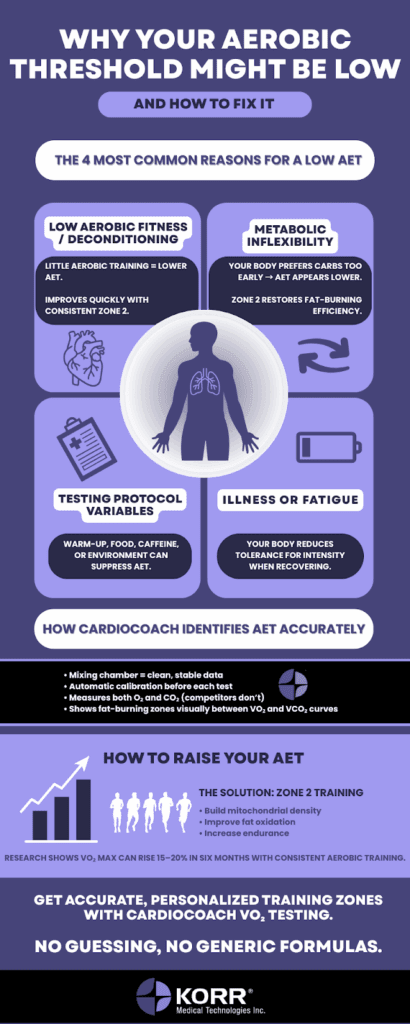
How CardioCoach Identifies Your Aerobic Threshold
Understanding how your AeT is determined helps you trust and act on your test results. CardioCoach uses the ventilatory method to identify both your aerobic threshold (AeT/VT1) and your anaerobic threshold (AT/VT2) without requiring invasive blood sampling or complicated equipment.
Here’s what makes our approach better:
Mixing Chamber Technology: Unlike breath-by-breath systems that produce noisy data requiring extensive algorithmic correction, our mixing chamber approach provides smooth, reliable measurements at both high and low flow rates. This precision is essential for accurately identifying subtle ventilatory shifts that mark your AeT.
Automatic Calibration: Before each test, CardioCoach automatically calibrates in just 90 seconds, adjusting for barometric pressure, temperature, and humidity. This eliminates human error and ensures consistent, accurate results every time without the need for gas tanks, syringes, or complicated setup procedures that other systems require.
Comprehensive Metabolic Data: While competitors like VO₂ Master focus solely on oxygen consumption, CardioCoach measures both oxygen uptake and carbon dioxide production. This dual measurement is crucial because it allows us to calculate your RER and identify not just where you’re working aerobically, but specifically where you’re burning the most fat. Why bother testing if you can’t target fat burn?
Visual Clarity: When you look at your CardioCoach results, you’ll see your VO₂ Max at the top, CO₂ production below it, and the area in between represents your fat-burning zones. This visual representation makes it immediately clear where your aerobic threshold falls and what heart rate zones will optimize fat oxidation.
Zone 2 Heart Rate Precision: The only accurate way to determine your true Zone 2 heart rate—that sweet spot for building aerobic capacity and maximizing fat burn—is through VO₂ Max testing. CardioCoach doesn’t rely on generic formulas based on age or maximum heart rate. Instead, it identifies your personalized training zones based on your actual metabolic responses, ensuring every workout targets the right energy system.
Building Your Aerobic Base
Once you understand your aerobic threshold, you can design training that improves it. Zone 2 training is the foundation for this improvement. This training intensity feels deceptively easy, often allowing you to hold a conversation, but it’s precisely this moderate effort that teaches your body to become a more efficient fat-burning machine.
The benefits reach beyond your aerobic threshold. Strong Zone 2 capacity enhances your performance in Zones 3, 4, and 5 as well. Think of your aerobic system as the foundation of a fitness pyramid—the broader and stronger your base, the higher you can build. Athletes with well-developed aerobic systems recover faster between high-intensity intervals, maintain higher power outputs for longer durations, and experience less fatigue during competition.
Research supports this approach: training at various intensities above 60% of VO₂ Max improves maximal oxygen uptake, but similar adaptations can be achieved with lower training volumes at higher intensities when you have a solid aerobic foundation. This is why building your Zone 2 capacity first creates a platform for all other training adaptations.
Frequently Asked Questions
What’s the difference between AeT and AT?
Your aerobic threshold (AeT) marks the upper boundary of predominantly aerobic metabolism, where fat burning is still optimal. Your anaerobic threshold (AT)—also called VT2 or lactate threshold—represents the point where lactate accumulation accelerates rapidly and you shift more heavily toward carbohydrate metabolism. The gap between these two thresholds defines your aerobic training zone. In well-trained endurance athletes, this gap is larger, allowing them to maintain higher intensities while staying aerobic.
Why is my AeT only slightly above resting heart rate?
This typically indicates either deconditioning or metabolic inflexibility. Your body hasn’t developed the cellular machinery necessary to efficiently burn fat at higher intensities, so it shifts to carbohydrate metabolism very early in the intensity spectrum. The encouraging news is that this responds quickly to consistent Zone 2 training. Within weeks, you should see your AeT rising as your body adapts.
Can I improve a low AeT?
Absolutely. Your aerobic threshold is highly trainable. Consistent Zone 2 training—working at or slightly below your AeT for extended durations—is the most effective way to improve this marker. Most individuals see meaningful improvements within 6-8 weeks of dedicated aerobic base training. As your mitochondrial density increases and your body becomes more metabolically flexible, you’ll be able to maintain higher intensities while still primarily burning fat.
How does CardioCoach flag AeT without blood testing?
CardioCoach identifies your AeT by analyzing changes in your ventilation pattern and respiratory exchange ratio as exercise intensity increases. Our mixing chamber technology provides precise measurements of both oxygen consumption and carbon dioxide production throughout your test. When we see the characteristic increase in ventilation relative to oxygen uptake (VT1) combined with an RER approaching 0.85, we’ve identified your aerobic threshold. This ventilatory method correlates closely with blood lactate measurements but without the invasiveness or time-consuming sampling procedures.
Take Control of Your Metabolic Health
Understanding your aerobic threshold is the first step toward training with precision and purpose. Generic heart rate formulas and one-size-fits-all training zones leave you guessing. VO₂ Max testing with CardioCoach removes the guesswork, providing you with personalized heart rate zones based on your actual metabolic responses.
Whether you’re training for your first 5K or optimizing performance for competitive endurance events, knowing your AeT allows you to train smarter, burn fat more efficiently, and build the aerobic foundation that supports all other fitness adaptations.
Ready to discover your personalized fat-burning and endurance zones? Learn how VO₂ Max testing with CardioCoach can transform your training approach and help you achieve your fitness goals more efficiently than ever before.