



Imagine that you’re halfway through an intense workout when that familiar burning sensation hits your legs. Your muscles feel heavy, your pace slows, and you think to yourself, “Here comes the lactate buildup—time to back off.” If you’ve ever blamed lactate for cutting your workout short or holding back your performance, you’re not alone. In fact, you’re part of a massive fitness myth that’s been circulating for decades.
Meet Clint, a dedicated marathon runner who’s been chasing a personal record for two years. Every time he hits that uncomfortable threshold during training—you know, that point where breathing gets harder and muscles start to burn—he immediately dials back his intensity. “I can’t let lactate build up,” he tells his training partner. “It’ll just slow me down and make me sore tomorrow.” Clint has unknowingly become a victim of one of the most persistent misconceptions in endurance sports: that lactate is the enemy of athletic performance.
Here’s the plot twist that might surprise you: Clint’s strategy is not only wrong—it’s holding him back from reaching his full potential. The truth about lactate is far more fascinating and performance-enhancing than the myths would have you believe.
What People Think They Know About Lactate
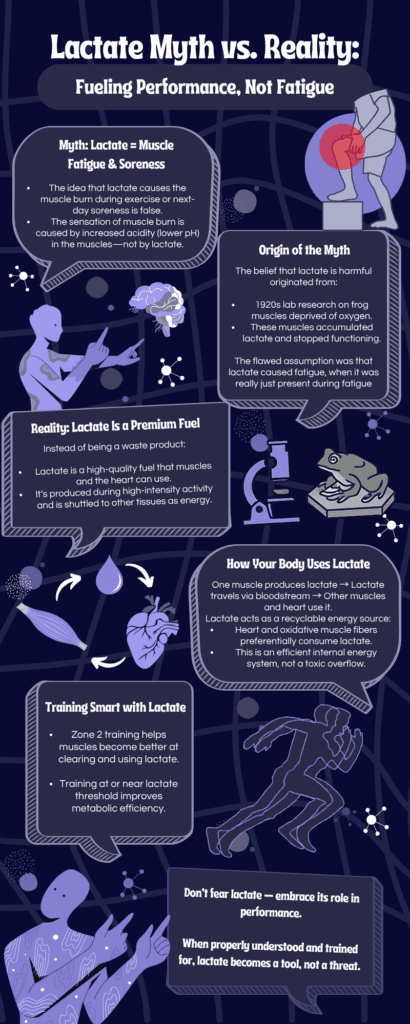
If you’ve spent any time in gyms, running groups, or reading fitness magazines, you’ve probably heard lactate described as the villain of athletic performance. The most common myths paint lactate as a toxic waste product that your muscles desperately want to get rid of. According to popular belief, lactate is responsible for that burning sensation during intense exercise, the fatigue that forces you to slow down, and even the muscle soreness you feel the next day.
These misconceptions run so deep that many athletes structure their whole training philosophy around “avoiding lactate buildup” or “clearing lactate faster.” You’ll hear people talk about lactate like it’s poison coursing through their veins, something to be flushed out as quickly as possible through cool-downs and recovery protocols.
So, how did lactate get such a bad reputation? The confusion stems from early exercise physiology research conducted in the 1920s by scientists studying isolated frog muscles in laboratory settings. When these muscles were deprived of oxygen and worked to exhaustion, researchers found high levels of lactate alongside decreased muscle function. The natural conclusion seemed obvious: lactate must be causing the muscle fatigue.
Although the idea originated in early research, it’s persisted in textbooks and popular culture long after new evidence (especially from the 1980’s onward) revised our understanding. Coaches, trainers, and athletes passed down the belief that lactate equals bad performance, without questioning whether lab conditions on frog muscles accurately reflected what happens in living, breathing human athletes.
The myths persist today partly because they make intuitive sense. After all, when you exercise intensely and feel that burn, lactate levels are indeed elevated. It’s easy to assume cause and effect when two things happen at the same time. The fitness industry has built training methodologies and recovery products around these misconceptions, creating a cycle where misinformation gets reinforced and repeated.
But here’s what makes this frustrating: clinging to these outdated beliefs is actively limiting athletic potential.
What Lactate Actually Does
Here’s where everything you thought you knew gets turned upside down: lactate isn’t a waste product at all—it’s a premium fuel source that your body produces and uses for energy. Think of lactate as your muscles’ way of being efficient and resourceful, not wasteful.
When your muscles break down glucose for energy, they don’t just randomly create lactate as an unwanted byproduct. Instead, your body produces lactate as part of an energy system designed to keep you moving when demands are high. Rather than being something your body wants to eliminate, lactate is something your muscles actively seek out and consume for fuel.
This misunderstanding has led countless athletes to work against their body’s natural energy systems instead of optimizing them. Your muscles aren’t trying to poison you with lactate—they’re trying to feed you with it.
How Muscles Use Lactate for Energy
The process is elegant. When one muscle group produces lactate during intense exercise, other muscles—including your heart—can take up that lactate and convert it back into energy. It’s like having an internal fuel delivery system that redistributes energy where and when you need it most.
Your heart muscle is particularly good at this lactate recycling process. In fact, your heart preferentially uses lactate as fuel when it’s available, making it one of your cardiovascular system’s favorite energy sources. During exercise, lactate travels through your bloodstream from working muscles to other tissues that can immediately put it to work.
Even more impressive is that well-trained muscles become incredibly efficient at producing and using lactate. The fitter you become, the better your muscles get at this internal energy trading system. This is why elite endurance athletes can maintain higher intensities for longer periods—their muscles have become lactate-processing powerhouses.
The Relationship Between Lactate and Performance
While lactate doesn’t directly cause fatigue, its accumulation reflects an energy system under high demand and is closely associated with increased acidity, which can impair muscle function. When your muscles can quickly shuttle lactate around and use it for energy, you can maintain higher intensities longer. When this system becomes overwhelmed, that’s when performance starts to decline.
This is why lactate threshold testing is valuable—not because it tells you when lactate becomes “bad,” but because it reveals how well your energy systems are working. Athletes with higher lactate thresholds aren’t avoiding lactate; they’re better at using it as fuel.
Understanding this shift changes everything about how you should approach training and performance optimization.
Understanding True Lactate Threshold
Your lactate threshold isn’t measuring when lactate becomes problematic. Instead, it’s identifying the exercise intensity where lactate production outpaces your muscles’ ability to immediately use it as fuel. Think of it like a busy restaurant kitchen—the threshold is when orders start coming in faster than the chefs can prepare and serve them.
Most people have been taught to fear this threshold as the “red line” they shouldn’t cross. But that’s like telling a chef to never accept more than three orders at once. Sure, it keeps things simple, but it limits what’s possible in the kitchen.
Your lactate threshold represents a sweet spot of metabolic efficiency, not a danger zone. When you’re training at or near this intensity, you’re teaching your muscles to become better lactate processors—like training those restaurant chefs to work faster and more efficiently.
The Training Zone Connection
This is where lactate threshold becomes incredibly valuable for performance. Rather than marking an intensity to avoid, it helps define the training zones that will make you faster, stronger, and more efficient.
Zone 2 training—that comfortable, conversational pace—sits well below your lactate threshold and teaches your muscles to become lactate-clearing machines. These changes enhance your muscles’ ability to use lactate efficiently, which improves your capacity to use lactate as a fuel source during higher-intensity efforts.
Zone 3 and 4 training dance around your lactate threshold, challenging your muscles to get better at the lactate shuffle—producing it in some areas while using it in others.
Improving your lactate threshold helps your body become so efficient at lactate utilization that you can maintain higher intensities while keeping your internal energy-trading system humming smoothly.
This completely reframes how you should think about training intensity and why accurate testing matters so much.
Where VO2 Max Testing Fits In
VO2 Max testing using mixing chamber technology provides the precise metabolic data you need to understand your body’s energy systems, not the myths you’ve been told. Unlike breath-by-breath systems that can produce inconsistent data, mixing chamber technology delivers the accuracy that reveals your true physiological markers.
During a VO2 Max test, you’re mapping your entire metabolic landscape. The test identifies your anaerobic threshold, aerobic threshold, and the heart rate zones where your body transitions between different fuel sources. Most importantly, it shows you exactly where your body maximizes fat-burning efficiency, giving you data rather than guesswork.
This testing reveals the relationship between your heart rate, oxygen consumption, and metabolic efficiency at every intensity level. Instead of relying on generic formulas or outdated lactate fears, you get a personalized roadmap that shows how your energy systems function under stress.
Why Heart Rate Zones Matter More Than Lactate Fears
Rather than worrying about lactate accumulation, focus on training within your scientifically determined heart rate zones. These zones, derived from your metabolic responses during testing, tell you precisely where to train for specific adaptations.
Your heart rate zones show different metabolic states where your body preferentially uses different fuel sources and develops different physiological adaptations. Zone 2, for instance, isn’t defined by avoiding lactate—it’s defined as the intensity where your aerobic system can efficiently process the lactate being produced while maximizing fat oxidation.
When you train according to your tested heart rate zones rather than lactate mythology, you’re working with your body’s natural energy systems instead of against them. This approach optimizes training stimulus while ensuring adequate recovery between sessions.
The Connection Between Lactate Threshold and Zone 2 Training
Zone 2 training occurs at intensities well below your lactate threshold, where your aerobic system can comfortably handle lactate production and utilization.
This zone is the sweet spot where your muscles become efficient at using both fat and lactate as fuel sources. When you train in Zone 2, you’re teaching your muscles to become better lactate processors—not by avoiding lactate, but by optimizing how efficiently your body can shuttle and utilize it.
The relationship is symbiotic: a well-developed Zone 2 base allows you to handle higher lactate production at threshold intensities, while threshold training challenges your lactate processing systems to become more efficient.
How Zone 2 Training Improves Lactate Clearance and Utilization
Zone 2 training acts as the foundation that supports performance across all other training zones. When you develop your aerobic base through Zone 2 work, you’re building the infrastructure that allows your muscles to use lactate as fuel rather than struggle with its presence.
This training enhances mitochondrial density and efficiency, the cellular powerhouses responsible for converting lactate back into usable energy. More efficient mitochondria mean better lactate utilization, which translates to sustained performance at higher intensities.
The result is a cascading effect: improved Zone 2 efficiency enhances your ability to recover between high-intensity intervals, maintain power output during threshold efforts, and sustain race pace for longer durations. Only through accurate VO2 Max testing can you identify your true Zone 2 heart rate range and guarantee you’re training at the intensities that deliver these powerful adaptations.
Stop Fighting Your Fuel System
The Cost of Misinformation
Every time an athlete backs off when they feel that familiar burn, every training plan built around “lactate avoidance,” every recovery protocol designed to “flush out toxins” misses the point; these approaches are ultimately counterproductive. When you treat lactate as the enemy, you’re training your body to be less efficient at using one of its most readily available fuel sources.
The lactate myths limit individual workouts and cap long-term potential. Athletes who embrace these misconceptions often plateau because they’re avoiding the training intensities that would push their metabolic systems to adapt and improve.
The Performance Breakthrough
Proper understanding, backed by accurate VO2 Max testing, changes everything. When you know your heart rate zones and understand how your body actually processes energy, you can train with precision and confidence. You’re no longer guessing or following generic formulas—you’re working with data that reflects your unique physiology.
This shift from myth to science typically results in breakthrough performances that seemed impossible under the old paradigm. Athletes discover they can sustain higher intensities, recover more effectively, and train more consistently because they’re finally working with their body’s natural systems instead of against them.
The Reality of Your Potential
The difference between myth and reality is the key to unlocking performance breakthroughs you never thought possible. While the fitness industry continues to perpetuate outdated lactate myths, you now have access to the scientific truth that can transform how you train and coach others.
This is where KORR Medical Technologies changes the game. Our mixing chamber technology reveals the complete metabolic picture that separates elite performers from those still trapped by lactate mythology. While competitors rely on breath-by-breath systems that produce inconsistent data, KORR’s gold standard mixing chamber technology delivers the precise metabolic markers you need to design effective training programs.
The Competitive Advantage
As a trainer or coach, understanding lactate science gives you a competitive advantage. While others structure programs around fear-based lactate myths, you can design training that optimizes energy systems for maximum performance. Your clients won’t just train harder—they’ll train smarter, with the confidence that comes from understanding their body’s capabilities.
KORR’s auto-calibrating technology means you can focus on interpreting results and designing programs, not wrestling with complicated equipment setup. Our mixing chamber technology provides the metabolic insights that distinguish fat burning from carbohydrate utilization—data that’s impossible to obtain accurately without proper testing.
Ready to move beyond the myths and start delivering results based on real metabolic science? Discover how KORR’s VO2 Max testing technology can revolutionize your training approach and give your clients the performance breakthroughs they’ve been seeking. Because when you understand the science, everything becomes possible.