



You’ve scheduled your resting metabolic rate test, reviewed the preparation instructions, and then a question stops you: should you take your daily medication before the test? This dilemma affects many people, especially those taking stimulant medications like Adderall for ADHD. The answer isn’t as straightforward as you might hope, and it depends entirely on what information you want your test to reveal about your metabolism.
The Clinical Debate
The metabolic testing community recognizes two legitimate perspectives on medication timing, each serving different purposes.
Baseline RMR: Your Unmedicated Metabolism
Some practitioners advocate measuring your baseline metabolic rate without any stimulants influencing the results. This approach reveals your natural resting metabolism, the caloric burn rate your body maintains when no external factors are elevating it.
The logic here is compelling: if you want to understand your true metabolic capacity, you need to measure it without artificial enhancement. This baseline becomes particularly valuable if you ever discontinue medication or need to understand how your unmedicated body processes energy.
Baseline testing also helps identify whether you have a genuinely slow metabolism that might benefit from medical intervention, or whether your metabolism falls within the normal range when stimulants aren’t elevating it artificially.
Functional RMR: Your Daily Reality
The opposing perspective argues that you should take your medication as prescribed because the test should reflect your actual daily metabolic state. If you take Adderall every morning, then your functional metabolism includes the metabolic elevation that medication provides.
This approach prioritizes practical utility over theoretical purity. Your nutrition planning needs to account for your real-world caloric needs, which include whatever metabolic boost your medication provides. Measuring your medicated metabolism ensures your caloric targets match your daily energy expenditure.
For many people taking prescription stimulants, skipping medication isn’t just inconvenient, it’s disruptive to their ability to function normally throughout the day. Measuring while medicated acknowledges this reality and provides actionable data for daily decision-making.
Adderall and Metabolism: What the Research Shows
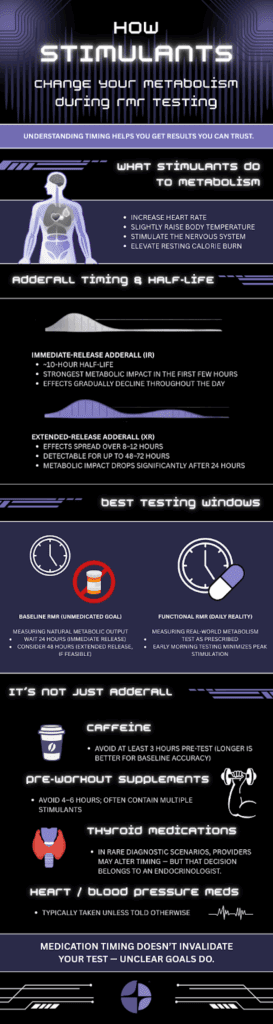
Adderall combines amphetamine and dextroamphetamine, both of which are central nervous system stimulants. These compounds increase metabolic rate through multiple mechanisms: elevating heart rate, increasing body temperature slightly, and stimulating the sympathetic nervous system.
Understanding Half-Life
The half-life of immediate-release Adderall is approximately 10 hours. This means that 10 hours after taking your medication, half of the active compounds remain in your system. After another 10 hours, half of that remaining amount persists, and so on.
Extended-release formulations have more complex pharmacokinetics, with initial release followed by sustained release over 8 to 12 hours. The active compounds can remain detectable in your system for 48 to 72 hours after your last dose, though their metabolic effects diminish as concentrations decrease.
Timing Your Test
If you decide to measure baseline metabolism without medication influence, current best practice suggests waiting at least 24 hours after your last Adderall dose. This window allows blood concentrations to drop substantially, though trace amounts may persist longer.
For extended-release formulations, some practitioners recommend waiting 48 hours to ensure minimal residual stimulant effect. However, this extended waiting period can significantly impact daily functioning for people who depend on their medication for work, school, or managing ADHD symptoms.
The metabolic elevation from stimulants peaks within a few hours of administration and gradually declines. Testing in the early morning before taking your daily dose captures a lower-stimulant state while minimizing disruption to your day.
General Medication Guidance for Metabolic Testing
Adderall is just one category of medications that can influence metabolic testing results. Other stimulants, thyroid medications, beta-blockers, and certain antidepressants may also affect your resting metabolic rate.
Stimulants Beyond Prescription Medications
Caffeine is the most common metabolic stimulant. Even your morning coffee can elevate your metabolic rate for several hours. Standard RMR testing protocols recommend avoiding caffeine for at least three hours before testing, ideally longer.
Pre-workout supplements often contain multiple stimulants: caffeine, synephrine, yohimbine, or other compounds designed to boost energy and metabolism. These products can significantly elevate your resting metabolic rate for four to six hours after consumption.
Thyroid Medications
Thyroid hormone directly regulates metabolic rate. People taking levothyroxine or other thyroid medications face a similar decision: measure with medication to reflect daily reality, or measure without to assess underlying thyroid function.
Most endocrinologists recommend taking thyroid medication as prescribed before metabolic testing because the goal is usually to confirm that replacement therapy has normalized metabolism. However, specific clinical situations might warrant different approaches.
Blood Pressure and Heart Medications
Beta-blockers can lower heart rate and slightly reduce metabolic rate. Calcium channel blockers and other cardiac medications may have similar effects. These medications are typically taken as prescribed before testing unless your healthcare provider specifically recommends otherwise for clinical reasons.
Consulting Your Provider
The decision about medication timing before metabolic testing should never be made in isolation. Two professionals need to be involved: your prescribing physician and your metabolic testing specialist.
Your prescribing physician understands your medical needs and can advise whether skipping doses for testing purposes is safe and appropriate. Some conditions require consistent medication levels, making interruption inadvisable even for testing purposes.
Your testing specialist can explain what information each approach provides and help you decide which aligns better with your goals. Are you troubleshooting unexplained weight gain and need to know your baseline metabolism? Test without stimulants. Are you planning nutrition for athletic performance while continuing your medication? Test with it.
This conversation should happen before your testing appointment. Arriving uncertain about whether to take your medication creates unnecessary stress and may compromise the quality of your results. Clear advance planning ensures you’re tested under the conditions that serve your needs.
Frequently Asked Questions
Should I take my Adderall before an RMR test?
The answer depends on your goals. If you want to measure your baseline, unmedicated metabolism, skip your dose for at least 24 hours before testing. If you want to measure your functional, daily metabolism that includes medication effects, take it as prescribed. Discuss this decision with both your prescribing physician and testing specialist.
How long does Adderall affect metabolism?
Immediate-release Adderall has a half-life of approximately 10 hours, with metabolic effects most pronounced in the first few hours after administration. Extended-release formulations maintain elevation for longer periods. Detectable traces can remain in your system for 48 to 72 hours, though metabolic impact decreases substantially after 24 hours.
What about other stimulants like coffee?
Standard RMR testing protocols recommend avoiding caffeine for at least three hours before testing, though longer abstinence provides more accurate baseline results. Caffeine elevates metabolic rate for several hours after consumption, potentially inflating your measured RMR.
Should I discuss this with my doctor?
Absolutely. Your prescribing physician needs to approve any medication interruption, even brief ones for testing purposes. Some conditions require consistent medication levels, and skipping doses without medical guidance can be dangerous. Always consult your doctor before altering your medication schedule.
Get Accurate Results That Match Your Goals
Metabolic testing provides valuable insights only when conducted under conditions that align with your specific needs. Whether you measure baseline or functional metabolism, the key is making an informed decision with guidance from qualified professionals.
Talk to your healthcare provider and testing specialist about medication timing for accurate results. Together, you can determine the testing approach that provides the most useful information for your health, fitness, and nutrition goals. Contact a KORR-certified testing provider today to discuss your individual situation and schedule your RMR test.