


You download a calorie calculator app, input your age, height, weight, and activity level, and receive a confident recommendation: eat 1,800 calories daily to lose weight. Three weeks later, the scale hasn’t budged. Frustrated, you wonder what went wrong. The answer is simple: generic formulas estimate your needs based on population averages, but your metabolism is uniquely yours. RMR testing reveals your caloric needs with scientific precision, giving you the foundation for a weight loss plan that works.
How Maintenance Calories Are Calculated
Your total daily energy expenditure consists of three components: resting metabolic rate, activity-related burn, and the thermic effect of food. RMR represents the largest portion, accounting for 60 to 75% of your total caloric needs.
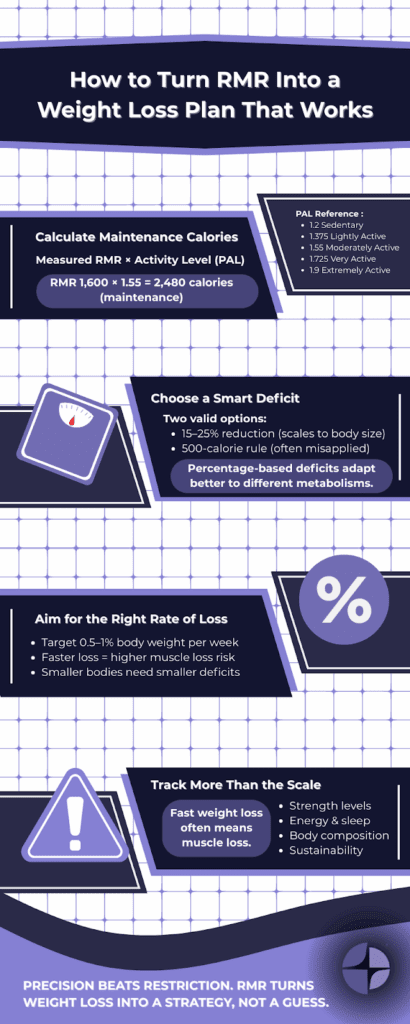
RMR Plus Activity Level
Once you know your measured RMR, calculating maintenance calories requires adding energy expended through movement and daily activities. This is where physical activity level (PAL) multipliers come into play.
PAL multipliers estimate how many additional calories you burn beyond your resting rate based on your lifestyle and exercise habits. Here’s how the standard categories break down:
Sedentary (PAL 1.2): Minimal movement beyond basic daily activities, desk job with little exercise. Multiply your RMR by 1.2.
Lightly Active (PAL 1.375): Light exercise or sports one to three days per week, or a job requiring some movement. Multiply your RMR by 1.375.
Moderately Active (PAL 1.55): Moderate exercise three to five days per week, or physically demanding occupation. Multiply your RMR by 1.55.
Very Active (PAL 1.725): Intense exercise six to seven days per week, or highly physical job combined with regular training. Multiply your RMR by 1.725.
Extremely Active (PAL 1.9): Professional athlete training schedule or physically demanding job plus intense daily training. Multiply your RMR by 1.9.
For example, if your measured RMR is 1,600 calories and you exercise moderately three to five days weekly, your maintenance calories would be approximately 2,480 (1,600 × 1.55). This is the caloric intake that keeps your weight stable.
The Precision Advantage
Generic calculators estimate both your RMR and your activity level, compounding potential errors. If the formula underestimates your actual RMR by 200 calories, then applies an activity multiplier, the final recommendation could be off by 300 calories or more.
RMR testing eliminates half of this guesswork. You know your actual resting burn, leaving only activity level as the variable requiring estimation. This precision dramatically improves the accuracy of your maintenance calculation and the success of your weight loss plan.
Creating a Caloric Deficit That Works
Weight loss requires consuming fewer calories than you burn, creating an energy deficit your body fills by metabolizing stored fat. The size of your deficit determines how quickly you lose weight and how well you preserve lean muscle mass.
Understanding Deficit Strategies
Two common approaches exist for calculating deficits: percentage-based and fixed-number reductions. Each has merit depending on your starting point and goals.
Percentage-Based Deficits: Reducing maintenance calories by 15 to 25% creates a meaningful but sustainable deficit. Someone maintaining weight at 2,400 calories might target 1,800 to 2,040 calories (25% to 15% reduction). This approach scales appropriately regardless of body size.
Fixed-Number Deficits: The popular 500-calorie deficit originates from the approximation that one pound of fat contains 3,500 calories. A 500-calorie daily deficit theoretically produces one pound of weekly weight loss (500 × 7 = 3,500). This approach doesn’t account for individual metabolic differences or body size, however.
The Body Weight Percentage Guideline
Current research suggests targeting weight loss of 0.5 to 1% of your body weight per week balances meaningful progress with muscle preservation. A 200-pound person would aim for one to two pounds weekly, while a 150-pound person targets 0.75 to 1.5 pounds.
This guideline adjusts as you lose weight. Slower loss rates at lower body weights reflect the biological reality that smaller bodies require less aggressive deficits to avoid metabolic adaptation and muscle loss.
For someone with measured RMR of 1,600 calories and maintenance at 2,480, creating a 20% deficit yields approximately 1,984 calories daily. This moderate deficit supports steady fat loss while providing sufficient energy for training and daily activities.
Tracking Progress Beyond the Scale
Body weight alone tells an incomplete story about your progress. The scale measures total mass without distinguishing between fat, muscle, water, and glycogen. Comprehensive tracking reveals whether your approach is working optimally.
Body Composition Monitoring
Regular body composition assessment shows what’s changing beneath the surface. Losing two pounds weekly sounds excellent until you discover that half came from muscle rather than fat. This information allows immediate course correction before significant muscle loss occurs.
Methods for tracking composition range from simple to sophisticated: progress photos, circumference measurements, bioelectrical impedance scales, or professional DEXA scans. The specific method matters less than consistency. Use the same measurement technique under similar conditions throughout your weight loss journey.
Questions That Reveal Progress
Numbers don’t capture everything. Ask yourself these questions regularly:
Are you maintaining strength in the gym? Significant strength loss suggests insufficient protein or excessive caloric restriction.
How’s your energy throughout the day? Persistent fatigue may indicate your deficit is too aggressive.
Are you sleeping well? Poor sleep can signal stress from inadequate caloric intake.
Can you sustain this approach long-term? If your diet feels miserable, it’s not sustainable regardless of how fast you’re losing weight.
These subjective markers complement objective data, painting a complete picture of how your body is responding to the deficit.
Avoiding Excessive Muscle Loss
Preserving muscle during weight loss requires more than just calculating the right caloric deficit. Three factors protect muscle mass: adequate protein intake, resistance training, and appropriate deficit size.
Protein Requirements
Research consistently shows that higher protein intake preserves muscle during caloric restriction. Target 0.7 to 1.0 grams of protein per pound of body weight. A 180-pound person would consume 126 to 180 grams daily.
Protein provides building blocks for maintaining existing muscle and supports recovery from training. It also has the highest thermic effect of all macronutrients, meaning you burn more calories digesting protein than carbohydrates or fats.
Resistance Training
Muscle requires a stimulus to justify its maintenance. Without resistance training, your body views muscle as metabolically expensive tissue that can be sacrificed during energy deficit. Regular strength training signals that muscle remains functionally necessary, encouraging your body to preferentially metabolize fat.
Two to four resistance sessions weekly, targeting all major muscle groups, provides sufficient stimulus. You don’t need to spend hours in the gym, but you do need consistent progressive overload.
Avoiding Extreme Deficits
Aggressive caloric restriction accelerates muscle loss regardless of protein intake or training. Very low-calorie diets (below 1,200 calories for women or 1,500 for men) rarely preserve muscle effectively and often trigger metabolic adaptation.
The dramatic weight loss seen on shows like “The Biggest Loser” came with severe metabolic consequences. Contestants lost muscle along with fat, and their metabolisms slowed dramatically. Six years later, most had regained weight while maintaining suppressed metabolic rates, making weight maintenance extraordinarily difficult.
Starting with measured RMR and creating moderate deficits protects against this outcome. Your body adapts to any deficit over time, but moderate restrictions minimize adaptation while maximizing fat loss relative to muscle loss.
Frequently Asked Questions
How do I calculate my maintenance calories from RMR?
Multiply your measured RMR by the physical activity level multiplier that matches your lifestyle and exercise habits. Sedentary individuals use 1.2, while moderately active people use 1.55. The result estimates your total daily energy expenditure, the calories needed to maintain current weight.
Is a 500-calorie deficit right for everyone?
Not necessarily. A 500-calorie deficit might be appropriate for someone with 2,500-calorie maintenance but excessive for someone maintaining at 1,800 calories. Percentage-based deficits (15 to 25% reduction) scale better across different body sizes. Targeting 0.5 to 1% body weight loss per week provides another useful framework.
How fast should I lose weight to preserve muscle?
Research suggests 0.5 to 1% of body weight per week balances meaningful progress with muscle preservation. Faster loss increases muscle loss risk, while slower rates may feel frustratingly gradual. Within this range, heavier individuals can sustain faster absolute loss rates than lighter individuals.
Why might weight loss slow down over time?
As you lose weight, your body requires fewer calories to maintain its new, smaller size. Your RMR decreases because you have less tissue to support. Additionally, metabolic adaptation may reduce your RMR below what’s predicted for your new weight. Periodic RMR retesting reveals these changes, allowing you to adjust your caloric targets appropriately.
Start Your Weight Loss Journey With Precision
Generic calorie recommendations leave you guessing, hoping the estimates align with your unique metabolism. RMR testing eliminates that uncertainty, revealing your actual caloric needs and providing the foundation for sustainable weight loss.
Whether you’re beginning your first weight loss attempt or troubleshooting a plateau, knowing your measured metabolic rate transforms vague recommendations into precise, personalized targets. Start with an RMR test to create a sustainable, personalized weight loss plan. Contact KORR today to discover your actual caloric needs and build a weight loss strategy designed for your body.