



You’ve heard people say it countless times: “I have a slow metabolism.” Maybe you’ve said it yourself after struggling to lose weight despite eating well and exercising regularly. But here’s the truth that might surprise you: most people who believe they have a slow metabolism actually fall within the normal range. Your metabolism isn’t slow, it’s just unique to you. Let’s explore what metabolic rate means, how it’s measured, and why the labels “fast” and “slow” might be misleading you.
How Metabolism Is Actually Measured
When you take a resting metabolic rate (RMR) test, the results compare your measured metabolism to a predicted value calculated using mathematical equations. The most common formula is the Harris-Benedict equation, which estimates your caloric needs based on age, sex, height, and weight.
Here’s what happens during an RMR test: you breathe normally into a metabolic analyzer for approximately 10 minutes while resting comfortably. The device measures your oxygen consumption, which directly correlates to calorie burn. This measurement reveals exactly how many calories your body requires to maintain basic functions like breathing, circulation, and cellular processes.
The CardioCoach then compares your measured rate to your predicted rate. If your actual metabolism falls within 10% above or below the prediction, you’re considered to have an “average” metabolism. Measurements more than 10% above the prediction indicate a faster metabolism, while measurements more than 10% below suggest a slower one.
But here’s the critical insight: the majority of people, including those carrying extra weight, test within or above the average range. Research consistently shows that overweight and obese individuals typically have average or higher metabolic rates, not slower ones. The extra body mass requires more energy to maintain, which naturally elevates resting metabolic rate.
Why “Fast” and “Slow” Labels Can Mislead
The terms “fast metabolism” and “slow metabolism” oversimplify a complex biological reality. Your metabolic rate reflects numerous factors that standard predictive equations can’t capture.
Body Composition Makes the Difference
Muscle tissue burns more calories at rest than fat tissue. Two people with identical height, weight, age, and sex can have dramatically different metabolic rates depending on their body composition. Someone with more lean muscle mass will naturally burn more calories than someone with higher body fat, even when both are completely at rest.
Predictive equations use body weight but don’t distinguish between muscle and fat. This limitation means the equations often underestimate metabolism for muscular individuals and overestimate it for those with lower muscle mass. Your “slow” metabolism might simply reflect that you have less muscle tissue than the equation assumes.
Metabolic Adaptation After Weight Loss
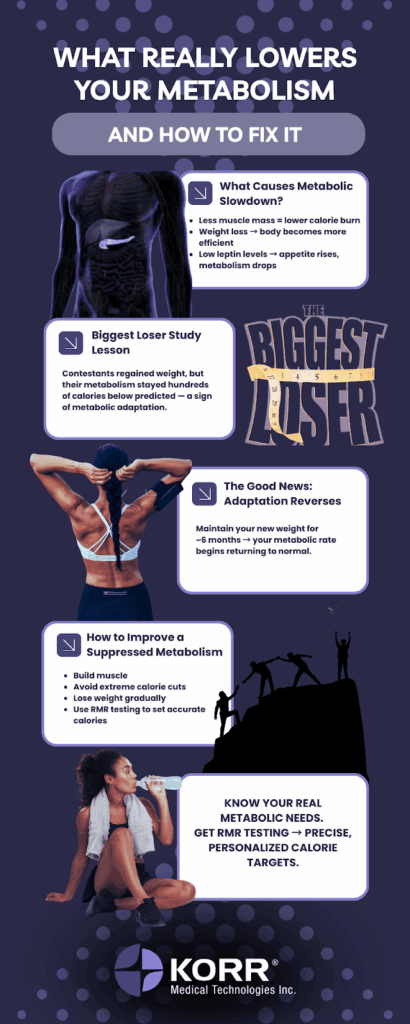
When you lose weight, your metabolism adapts. This is a biological reality that surprises many people. After significant weight loss, your body becomes more metabolically efficient, meaning it requires fewer calories to maintain basic functions than predicted by equations.
This phenomenon became dramatically clear in research examining contestants from “The Biggest Loser” television show. Six years after their extreme weight loss, most contestants had regained significant weight. More striking was what happened to their metabolism: despite weight regain, their metabolic rates remained suppressed by several hundred calories per day compared to what would be predicted for their size.
One contestant had to eat 800 calories per day less than a typical man his size just to maintain his current weight. This wasn’t a character flaw or lack of willpower. His body had adapted metabolically to defend against further weight loss, slowing his metabolism even as the pounds returned.
The study also revealed plummeting leptin levels. Leptin is a hormone that signals fullness and helps regulate metabolism. With leptin near zero by the end of the competition, contestants experienced constant hunger and overwhelming cravings. As they regained weight, leptin levels rose but only recovered to about half their baseline, potentially explaining continued struggles with appetite control.
Adaptations Can Reverse
The good news is that metabolic adaptation isn’t necessarily permanent. Research suggests that if you can maintain your new weight for approximately six months, your resting metabolic rate gradually rises toward expected levels. Your body stops fighting the weight loss quite so aggressively.
This finding has profound implications for weight management. The critical period immediately following weight loss requires the most careful calorie management. Knowing your precise metabolic rate through RMR testing during this vulnerable window helps you set realistic caloric goals that support weight maintenance rather than triggering regain.
BMI: A Useful but Limited Tool
You might wonder why RMR reports include body mass index (BMI) when this measurement has well-documented limitations. BMI is a simple calculation dividing weight in kilograms by height in meters squared. It categorizes people as underweight, normal weight, overweight, or obese based solely on this number.
BMI doesn’t account for muscle mass, bone density, age, sex, or ethnicity. A muscular athlete might be classified as overweight despite having very low body fat. An older adult might fall in the normal range despite having lost significant muscle mass and gained fat.
Despite these limitations, BMI remains included in metabolic reports for several reasons. First, it provides a standardized reference point that healthcare providers recognize and use in clinical decision-making. Second, at a population level, BMI correlates reasonably well with health risks, even if it fails to accurately categorize individuals.
Most importantly, BMI appears in your RMR results as context, not as a definitive assessment of your health or fitness. It’s one data point among many, including your actual measured metabolic rate, which provides far more actionable information for managing your weight and health.
Your Unique Metabolic Reality
Labels like “fast” and “slow” metabolism can become excuses or sources of frustration. What matters more than the label is understanding your actual metabolic rate and using that knowledge to set realistic expectations.
If you discover your metabolism measures 200 calories per day below predictions, you now have concrete information. This isn’t permission to give up on your goals. It’s an invitation to adjust your approach with data-driven precision. You know you need to eat 200 fewer calories than standard recommendations suggest, or increase your activity to compensate.
RMR testing removes guesswork from the equation. Instead of wondering why you’re not losing weight on 1,500 calories when calculators say you should, you discover your body actually requires only 1,400 calories to maintain its current weight. This knowledge prevents the disappointment and dropout that happens when expectations don’t match reality.
Research shows that 60% of people who abandon weight loss programs cite unmet expectations as a contributing factor. When the numbers on the scale don’t align with what they imagined, they quit. Measuring your actual metabolic rate from the start establishes realistic expectations grounded in your physiology, not generic formulas.
Frequently Asked Questions
What equation does CardioCoach use to compare my metabolism?
The CardioCoach uses the Harris-Benedict equation, one of the most widely validated formulas for predicting resting metabolic rate based on age, sex, height, and weight. Your measured rate is then compared to this prediction to determine if your metabolism falls above, below, or within the average range.
Is a “slow” metabolism permanent?
No. Metabolic rate responds to changes in body composition, activity level, and weight maintenance. If your metabolism has adapted downward after weight loss, maintaining your new weight for approximately six months often allows your metabolic rate to recover toward predicted levels.
Why is BMI included if it’s not perfect?
BMI provides a standardized reference that healthcare providers use in clinical settings. While it has limitations for individuals, it offers useful context alongside your measured metabolic rate. Think of BMI as one piece of a larger puzzle rather than a complete picture of your health.
Can I improve a suppressed metabolism?
Building muscle through resistance training increases your metabolic rate because muscle tissue requires more energy at rest than fat tissue. Avoiding extreme calorie restriction and focusing on sustainable weight loss also helps prevent excessive metabolic adaptation. Most importantly, maintaining lost weight allows your metabolism time to recover from adaptive suppression.
Discover Your True Metabolic Rate
Stop guessing about your metabolism. RMR testing reveals your actual caloric needs with scientific precision, giving you the foundation for realistic goals and sustainable results. Whether your metabolism measures fast, slow, or average, knowing your unique metabolic reality empowers you to make informed decisions about nutrition and exercise.
Get your actual metabolic rate measured, not estimated, with RMR testing through a KORR-certified provider. Contact us today to find a testing location near you and take the guesswork out of your fitness journey.