


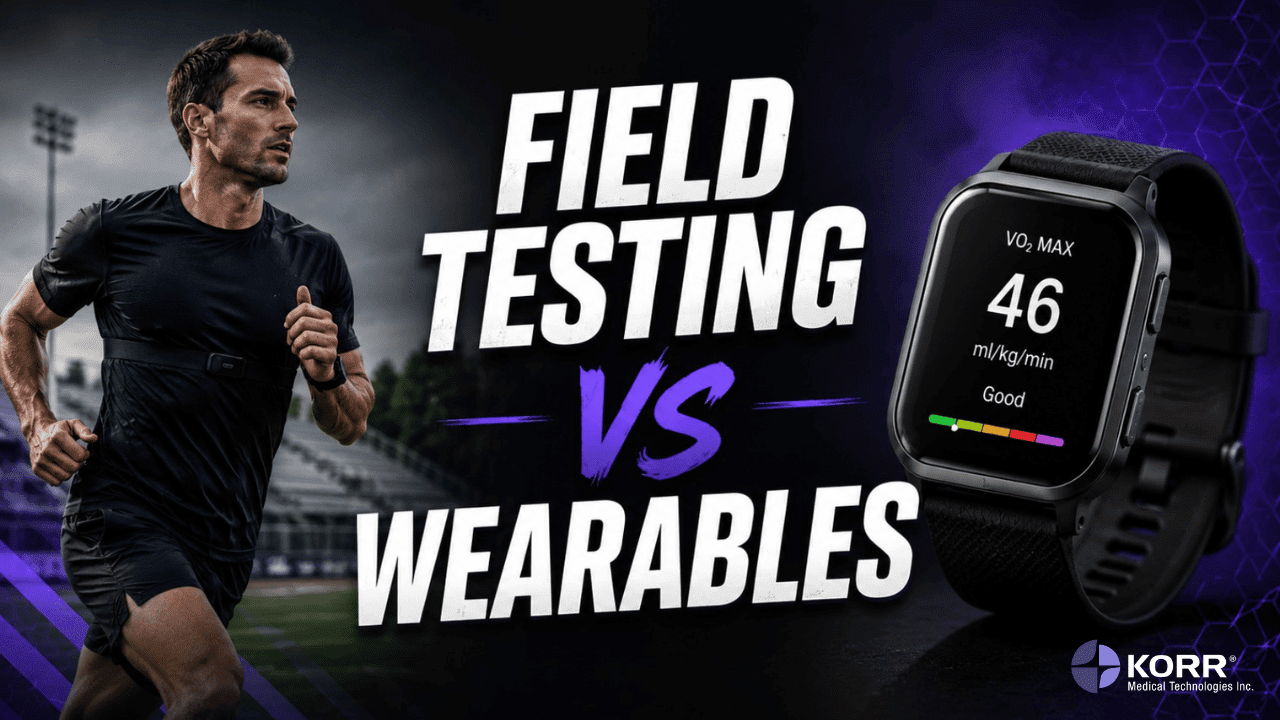
VO2 max testing has moved well beyond elite sports labs. Gyms, wellness centers, physical therapy clinics, corporate wellness programs, and occupational health facilities are all adding metabolic testing to their service offerings as demand for objective, personalized health data continues to grow.
With that expansion has come a wider range of equipment options. Wearable consumer devices, portable breath-by-breath analyzers, and professional mixing chamber systems all occupy different positions in the market, with different accuracy profiles, workflow requirements, and operational costs. For facility operators evaluating which system fits their needs, the choice is not simply about which device measures VO2 max. It is about which device measures it reliably enough, consistently enough, and efficiently enough to support the service model the facility is trying to build.
This breaks down the key differences between wearable and professional field-based VO2 max testing systems to help facility operators make an informed decision.
Understanding the Different Types of VO2 Max Testing
Not all VO2 max numbers are produced the same way. Understanding the measurement approach behind a given number is essential for evaluating how much clinical or coaching weight it can carry.
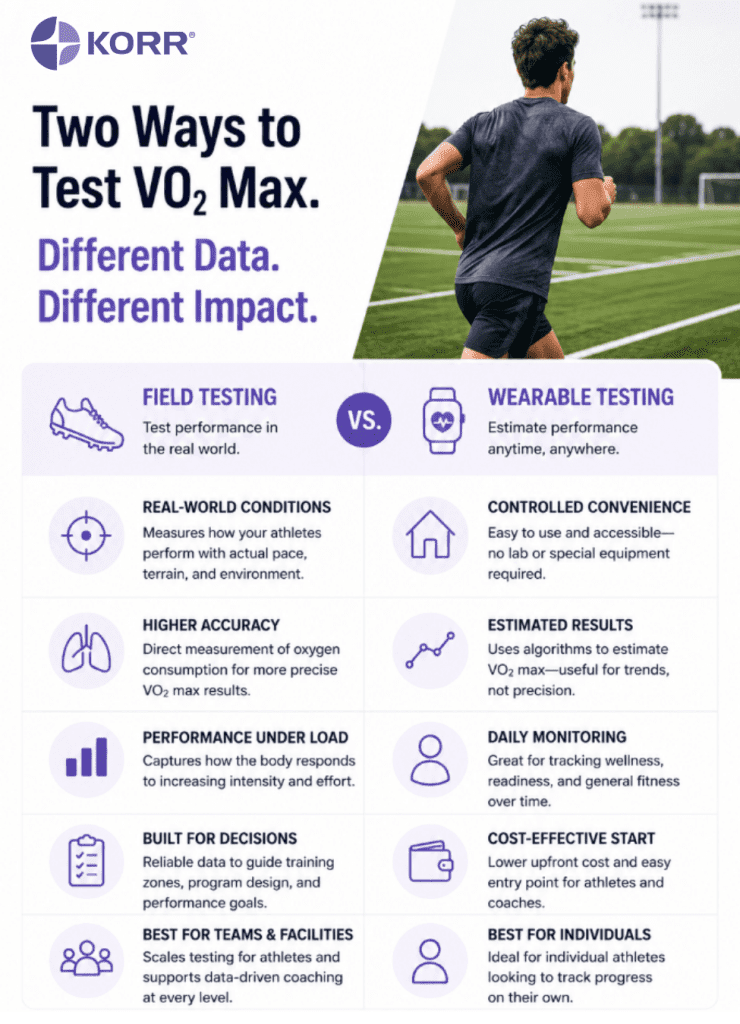
Wearable consumer devices – smartwatches and fitness rings estimate VO2 max from indirect signals including heart rate, pace, power output, and demographic data. These devices do not measure oxygen consumption directly. They apply population-based algorithms to predict what a person’s VO2 max is likely to be based on how their heart rate responds to exercise. The result is an estimate, not a measurement, and the accuracy of that estimate varies significantly depending on the individual’s fitness profile, the device, and the conditions of measurement.
Breath-by-breath portable analyzers measure oxygen and carbon dioxide concentrations in real time with each respiratory cycle. These devices capture gas exchange data directly rather than estimating it from heart rate, making them more accurate than consumer wearables. However, the breath-by-breath methodology requires synchronizing three rapidly changing data streams. Flow, oxygen concentration, and carbon dioxide concentration, in real time, introduce signal noise and alignment challenges that affect measurement consistency, particularly at high exercise intensities or during movement that creates mechanical breathing variability.
Mixing chamber systems collect expired air from multiple breaths into a stabilized sample before analysis. Rather than measuring instantaneous gas concentrations during the inherent variability of individual breaths, mixing chamber systems average expired gases across multiple respiratory cycles, smoothing biological variation through physics rather than algorithmic correction. This approach produces more stable, consistent measurements across operators and testing sessions, which is particularly important for facilities using repeat testing to track physiological change over time.
Understanding these distinctions is the starting point for evaluating which system fits a facility’s testing goals.
Wearable VO2 Max Testing: Benefits and Limitations
Consumer wearables have made VO2 max a mainstream concept for millions of people. That familiarity is a genuine asset for facilities building metabolic testing services. Clients who have seen a VO2 max estimate on their watch arrive already curious about what a real test would show.
The appeal of wearable systems for facility use includes low upfront cost, minimal setup requirements, and the ability to generate a VO2 max number quickly and easily. For applications where a rough directional estimate is sufficient, general wellness tracking, basic fitness level awareness, broad population health screening – wearable estimates provide accessible data with minimal operational overhead.
The limitations become significant when facilities require more from their testing data. Research finds average errors in wearable VO2 max estimates in the range of 5 to 15 percent, with substantially larger individual-level errors possible depending on fitness profile, exercise conditions, and algorithm limitations. For a client whose VO2 max is 45 mL/kg/min, a 10 percent error means the wearable could report anywhere from 40.5 to 49.5. That range spans meaningfully different cardiovascular fitness categories and produces very different training zone prescriptions.
Wearable estimates are also sensitive to factors that have nothing to do with cardiorespiratory fitness: heat, altitude, dehydration, stress, poor sleep, wrist sensor noise, and movement artifacts. A client who tests on a warm day after a poor night of sleep may receive a substantially different estimate than the same client tested under controlled conditions, without any real change in their underlying physiology.
For facilities building testing programs around repeat assessments quarterly check-ins, seasonal benchmarking, longitudinal wellness tracking. This variability is operationally problematic. If a client’s VO2 max estimate fluctuates between sessions due to measurement noise rather than actual physiological change, the tracking program cannot deliver the measurable progress narrative that drives client retention and justifies the service fee.
Why Many Facilities Prioritize Accuracy and Repeatability
The most valuable thing a metabolic testing program can deliver is a reliable answer to a simple question: is my client’s cardiovascular fitness improving?
Answering that question requires measurement consistency across testing sessions. A system that produces results which vary with environmental conditions, operator technique, or signal noise cannot reliably detect the 2 to 5 percent improvements in VO2 max and threshold that represent meaningful physiological adaptation over a training quarter. The client may genuinely be improving. The data may not show it. Or the data may show improvement that is not real. Either outcome undermines the coaching relationship and the perceived value of the testing service.
This is where mixing chamber technology provides a meaningful operational advantage for facilities committed to professional-grade testing. By averaging expired gases across multiple breaths before analysis, mixing chamber systems reduce the breath-to-breath variability inherent in human respiration. The measurement environment for the gas sensors is stable rather than fluctuating. Calibration is consistent rather than operator-dependent.
For facilities tracking clients over months and years, this consistency means that changes in test results reflect actual physiological change rather than measurement artifact. A VO2 max that increases between quarterly assessments represents real adaptation. A ventilatory threshold that shifts upward represents a genuine improvement in aerobic efficiency. The data can be presented to clients and used for programming decisions with confidence.
The repeatability advantage compounds over time. A client who completes four quarterly assessments on a consistent, stable system has four data points that tell a coherent physiological story. A client tested on a system with high measurement variability has four data points that may tell four different stories, none of which can be confidently attributed to training outcomes versus measurement noise.
Operational Considerations Beyond Accuracy
Accuracy is the primary consideration for professional VO2 max testing. It is not the only one. Facilities evaluating testing systems also need to assess how the equipment fits into their day-to-day operations: calibration requirements, throughput capacity, maintenance overhead, and total cost of ownership over the life of the equipment.
Calibration is one of the most underappreciated operational factors in equipment evaluation. Systems that require elaborate calibration procedures involving gas tanks, syringes, or multi-step manual protocols introduce time costs and operator variability into every testing day. Staff under schedule pressure may skip calibration steps. New employees may learn procedures incorrectly. Either outcome compromises data quality in ways that may not be immediately apparent.
The KORR CardioCoach auto-calibrates in approximately 90 seconds using ambient room air. No gas tanks, no syringes, no manual steps that can be performed inconsistently. The system measures barometric pressure, temperature, and humidity automatically and compensates to standard conditions. Human error is engineered out of the calibration process entirely, which means data quality does not depend on which staff member runs the calibration.
Session throughput directly affects revenue potential. Some portable metabolic systems publish maximum session limits and mandatory cooldown periods between tests. For facilities running testing blocks with multiple clients scheduled back-to-back, equipment-imposed scheduling constraints translate directly into lost revenue. The CardioCoach has no documented session limits and no mandatory downtime between tests. A testing event can run as many assessments as the schedule requires without gaps imposed by the equipment.
Ongoing costs are frequently underestimated at the point of purchase. Software subscription fees, annual service contracts, and consumables that require replacement at fixed intervals all compress the margin on testing services over the life of the equipment. KORR charges no ongoing fees for software, reports, or analysis. The oxygen sensor is user-replaceable in under one minute without tools or recalibration. There are no service contracts and no factory send-in requirements for routine maintenance. The total cost of operating a testing program is predictable from day one.
Portability matters for facilities that serve clients in multiple locations or run offsite testing events. The CardioCoach weighs under ten pounds and operates on battery power, making it practical for corporate wellness events, offsite performance testing, and multi-room clinical environments without complex logistics.
Staff training is included free with every CardioCoach purchase. The software interface guides users through the testing process with on-screen prompts, which means new staff can conduct assessments competently after a brief onboarding session without specialist credentials.
Matching the Right Testing System to Your Facility Type
The best VO2 max testing system for a given facility depends on how testing will be used, how often results will be compared across sessions, and what level of measurement precision the facility’s service model requires.
Functional fitness and performance gyms serving competitive athletes need measurement consistency for repeat testing across training blocks. Training zone prescriptions derived from test results need to be stable enough to be trusted as the basis for programming decisions. Mixing chamber technology with hands-free calibration and no session limits fits the high-volume, performance-oriented workflow of these facilities.
Wellness and corporate programs using VO2 max testing for population health monitoring and employee wellness engagement benefit from systems that produce results which can be confidently compared across individuals and over time. Variability in estimates undermines the longitudinal tracking narrative that makes corporate wellness data meaningful to HR leadership.
Clinical and rehabilitation settings using metabolic data to inform medical decisions, return-to-duty clearances, or cardiovascular risk assessments require measurement reliability that consumer estimates cannot provide. The clinical credibility of a testing program depends on the accuracy of the equipment delivering it.
Universities and tactical programs conducting research or standardized fitness assessments need measurement consistency across operators and testing sessions. A system whose results vary with who runs the calibration or what time of day testing occurs cannot support research or standardized assessment purposes.
Boutique fitness studios and personal training facilities adding metabolic testing as a premium service differentiator need equipment that integrates smoothly into existing workflows, requires minimal specialist staff, and generates client-facing reports that justify the testing fee. The CardioCoach produces customizable, branded client reports and integrates with the free CardioCoach mobile app for ongoing client engagement between sessions.
For facilities whose primary use case is occasional single-session assessments without longitudinal tracking, a simpler system may be sufficient. For facilities building structured testing programs where repeat measurements are compared over time, the accuracy and repeatability of professional mixing chamber technology are operational requirements rather than optional upgrades.
The Growing Demand for Professional Metabolic Testing
Consumer wearables have created the demand. Professional metabolic testing fulfills it.
The millions of people who have seen a VO2 max estimate on their smartwatch represent a primed market for facilities offering real metabolic testing. These clients already understand the concept, already believe the metric matters, and already have a number they are curious about validating or improving. A facility that can offer a direct measurement (not an estimate, not an algorithm) is delivering something that no wearable can replicate.
The longevity medicine movement has reinforced this demand. VO2 max is increasingly understood as one of the strongest predictors of all-cause mortality, a health metric that belongs in clinical conversations alongside blood pressure, cholesterol, and blood glucose. Facilities that position metabolic testing as a preventive health tool, not just a performance metric, are accessing a broader market that includes wellness-oriented clients, executive health programs, medical fitness facilities, and concierge medicine practices.
The common thread across all of these growth applications is the same: clients and clinicians who are using VO2 max data to make meaningful health and training decisions need data they can trust. The facilities that build their testing programs on accurate, repeatable measurement systems are the ones positioned to serve this demand credibly and sustainably.
Frequently Asked Questions About Wearable vs Lab VO2 Max Testing
How accurate are wearable VO2 max estimates compared to direct measurement? Research finds average errors in wearable VO2 max estimates in the range of 5 to 15 percent, with substantially larger individual-level errors possible depending on fitness profile, exercise conditions, and the specific device and algorithm used. Direct metabolic testing measures oxygen consumption from expired gases rather than estimating it from heart rate, producing results that are individualized to actual physiology rather than population-based predictions.
What is the difference between breath-by-breath and mixing chamber VO2 max testing? Breath-by-breath systems measure oxygen and carbon dioxide concentrations instantaneously with each respiratory cycle, enabling compact and wireless designs. Mixing chamber systems collect expired air from multiple breaths into a stabilized sample before analysis, smoothing breath-to-breath variability through physics rather than algorithmic correction. Mixing chamber systems produce more consistent measurements across sessions and operators, which is particularly important for facilities using repeat testing to track physiological change over time.
Can wearable VO2 max estimates be used for training zone prescription? Wearable estimates can provide a rough starting point for zone prescription, but the error margins in individual estimates mean zones may not correspond to the athlete’s actual gas-exchange. Direct metabolic testing identifies individualized thresholds that produce more precise zone prescriptions — the difference between easy sessions that are genuinely easy and threshold work that hits the correct intensity.
How often should facilities retest clients with professional metabolic testing? Most facilities structure re-testing quarterly or semi-annually. Quarterly re-testing aligns with natural training cycles and gives coaches regular data to update zone prescriptions and validate programming effectiveness. Semi-annual testing works well for wellness programs focused on longitudinal health monitoring rather than competitive performance optimization.
What equipment do facilities need to offer professional VO2 max testing? Facilities need a professional-grade indirect calorimetry system capable of accurate, repeatable gas exchange measurement. The KORR CardioCoach is a mixing chamber-based metabolic analyzer in use at more than 1,000 facilities worldwide that offers hands-free calibration, no session limits, dual VO2 max and RMR capability, and no ongoing software fees.
Is professional metabolic testing practical for non-clinical gym environments? Yes. Modern professional metabolic testing systems are designed for commercial facility use rather than dedicated laboratory environments. The CardioCoach weighs under ten pounds, auto-calibrates in 90 seconds, requires no gas tanks or specialist staff, and produces client-facing reports formatted for education and engagement. Facilities without exercise physiology credentials on staff can deliver professional-grade testing after a brief onboarding session included free with every purchase.
Choosing the System That Fits Your Service Model
Both wearable and professional VO2 max testing systems have legitimate applications. Consumer estimates are accessible, familiar, and useful for broad directional tracking in populations where precision is not the primary requirement. Professional metabolic testing systems deliver the accuracy, consistency, and operational reliability that facilities building structured, repeat-testing programs need to deliver data their clients and coaches can act on with confidence.
The decision comes down to what the facility is trying to do with the data. If the goal is providing clients with a general fitness awareness number, consumer wearables may be sufficient. If the goal is building a professional testing program where results are compared across sessions, used to prescribe individualized training zones, and presented as a differentiating service that justifies premium pricing, professional mixing chamber technology is the appropriate foundation.
Facilities that have made that investment are not just offering a better testing experience. They are building a service that wearables cannot replicate, that clients trust more deeply, and that sustains engagement over the long term through measurable, credible progress tracking.The KORR CardioCoach is in use at more than 1,000 locations worldwide across gyms, wellness centers, clinical facilities, universities, and corporate wellness programs. To learn how the CardioCoach can support your facility’s metabolic testing program, visit korr.com or call 1-801-483-2080 to schedule a demonstration.