



Preventive health has shifted. The conversation is no longer limited to managing existing conditions. It increasingly centers on identifying and improving the physiological markers that predict how well the body will function over decades and how long it will function at all.
VO2 max and longevity are increasingly discussed together in clinical, wellness, and performance contexts for good reason. Cardiorespiratory fitness, measured directly through VO2 max testing, has emerged as one of the most consistently validated markers of long-term health outcomes in published research. Health professionals who understand how to use this metric and how to measure it reliably are better positioned to deliver preventive care that is objective, personalized, and measurable.
This article provides a practical overview of what VO2 max testing reveals, what the research says about its relationship to long-term health, and how health professionals and wellness facilities can integrate metabolic testing into preventive and wellness-focused programs.
What VO2 Max Measures and Why It Matters
VO2 max is the maximum rate at which the body can consume oxygen during exercise, expressed in milliliters of oxygen per kilogram of body weight per minute. It reflects the integrated efficiency of the cardiovascular, pulmonary, vascular, and muscular systems working together to deliver and utilize oxygen under exercise stress.
A high VO2 max indicates that the heart can pump a large volume of oxygen-rich blood per beat, that the lungs can exchange gases efficiently, that blood can carry oxygen effectively to working muscles, and that muscles can extract and use that oxygen to produce energy aerobically. Each of these physiological capacities contributes to the overall number, which is why VO2 max captures a broader picture of cardiovascular health than any single organ-specific measurement.
For health professionals, this breadth is part of the metric’s clinical value. A standard resting ECG captures heart rhythm. A spirometry test captures lung function. A VO2 max test captures how all of these systems perform together under the physiological stress that most closely approximates the demands of daily life and aging sustained physical exertion.
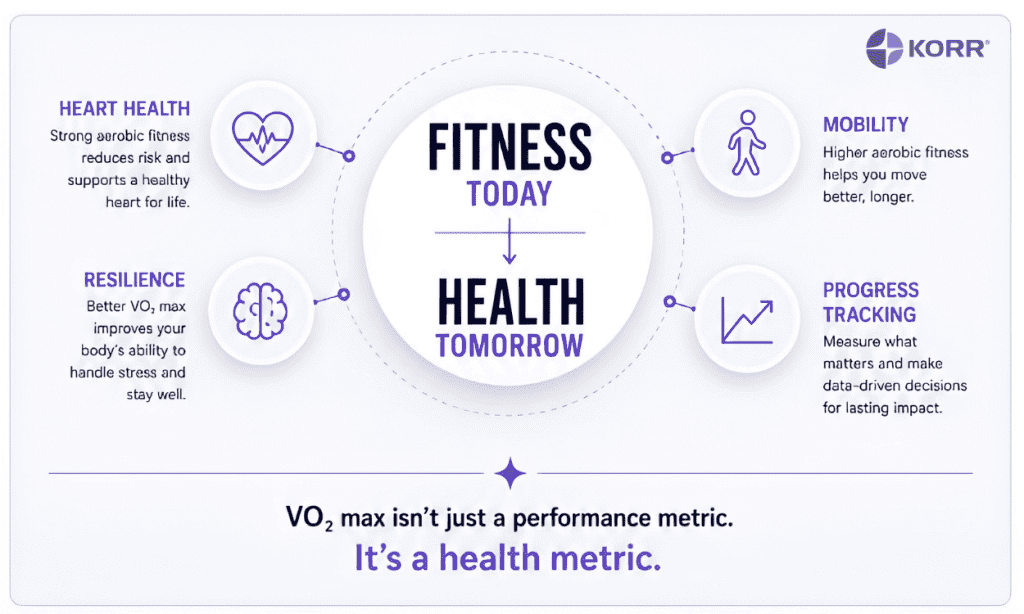
Importantly, VO2 max is a modifiable metric. Cardiorespiratory fitness responds to exercise training in ways that are measurable, progressive, and clinically meaningful. This makes it not just a marker for identifying risk, but a target for intervention that health professionals can track objectively over time.
The Growing Connection Between VO2 Max and Longevity Research
The research connecting cardiorespiratory fitness to long-term health outcomes has grown substantially over the past two decades, and the findings are consistent enough to have influenced clinical guidelines and preventive health conversations at the highest levels of medicine.
Research published in JAMA Network Open found that cardiorespiratory fitness is among the strongest predictors of all-cause mortality, with associations that rival or exceed those of traditional cardiovascular risk factors including hypertension, smoking status, diabetes, and elevated cholesterol. The relationship is dose-dependent: higher fitness levels are associated with progressively better long-term outcomes across the full range of the fitness spectrum, not just at the extremes.
This landmark research by Mandsager and colleagues found that individuals in the lowest fitness fitness category faced significantly higher all-cause mortality risk than those in the highest fitness category — a gap larger than that associated with most individual cardiovascular risk factors. Importantly, one of the largest improvements in survival was seen between the lowest fitness group and the next fitness category,, suggesting that the clinical benefit of improving cardiorespiratory fitness is particularly pronounced for individuals who are currently sedentary or unfit.
Those who had “elite” cardiorespiratory fitness VO2 max levels in the top 2.5 percent for age and sex wereassociated with the lowest mortality risk of any fitness category, with no upper limit of benefit identified. This finding has contributed to the growing clinical interest in VO2 max as a vital sign rather than a performance metric.
These findings do not establish that improving VO2 max directly extends lifespan in a causal sense. The research is largely observational. But the consistency of the association across diverse populations, age groups, and study designs has made cardiorespiratory fitness an increasingly recognized clinical marker in preventive health conversations, exercise prescription guidelines, and wellness program design.
How Health Professionals Are Using VO2 Max Testing
The applications of VO2 max testing in clinical and wellness settings have expanded significantly as the equipment has become more accessible and the research foundation has strengthened.
- Executive wellness programs use VO2 max testing as part of comprehensive health assessments for high-performing individuals who are accustomed to tracking performance metrics and who respond to objective data about their physiological status. For this population, a VO2 max result contextualizes cardiovascular fitness in terms they understand: a number that can be improved, tracked over time, and compared against age-matched norms.
- Preventive health screenings incorporate VO2 max alongside traditional biomarkers as part of a more complete cardiovascular risk assessment. For patients with no obvious disease indicators but sedentary lifestyles or family histories of cardiovascular disease, a low VO2 max provides an objective, motivating finding that can anchor a behavior change conversation more effectively than a mildly elevated cholesterol reading.
- Personalized exercise prescription is perhaps the most immediate clinical application. Exercise guidelines that specify aerobic intensity in terms of a percentage of maximum heart rate or a general descriptor like “moderate” are imprecise at the individual level. VO2 max testing identifies each patient’s actual ventilatory thresholds – the physiological boundaries that define truly aerobic, threshold, and high-intensity exercise for that specific individual. Exercise prescriptions built on these measured thresholds are more precise, more personalized, and more likely to produce the intended cardiovascular adaptation.
- Weight management programs benefit from combining VO2 max testing with resting metabolic rate (RMR) testing. VO2 max data informs exercise intensity prescription for fat oxidation optimization. RMR testing establishes an accurate individual caloric baseline that population formulas frequently miss by meaningful margins. Together, these two measurements create a metabolic foundation for weight management programming that is individualized rather than estimated.
- Cardiac wellness and rehabilitation programs use VO2 max testing to establish functional capacity baselines, monitor cardiovascular improvement during supervised exercise programs, and guide the progression of exercise intensity in patients with known cardiovascular conditions or post-cardiac event histories.
- Active aging programs use cardiorespiratory fitness testing to establish where older adults sit relative to age-matched norms and to track the impact of exercise interventions on functional capacity over time. For older adults, maintaining VO2 max above functional thresholds is associated with preserved independence and quality of life — a clinical outcome that resonates more directly with this population than performance metrics.
- GLP-1 medication monitoring has emerged as a significant new application. Patients on semaglutide, tirzepatide, and other GLP-1 medications lose significant weight, but without adequate nutrition and strength training, a meaningful portion of that weight loss may come from muscle rather than fat alone. RMR testing establishes a metabolic baseline before medication is initiated and monitors for the metabolic adaptation that accompanies muscle loss. VO2 max testing tracks changes in cardiovascular fitness alongside changes in body composition. For clinicians managing patients on GLP-1 medications, these metabolic measurements provide objective data that shapes exercise and nutrition interventions aimed at preserving lean mass during weight loss.
Why Personalized Exercise Programming Matters
Generic exercise recommendations of thirty minutes of moderate activity on at least five days per week are appropriate as public health guidance. They are insufficient as individualized clinical prescriptions.
Part of the confusion comes from how the word “moderate” is used. In public health research, moderate physical activity is often defined by absolute intensity, such as 3–6 METs. That can be useful for population-level recommendations, but it does not tell us exactly how hard that activity is for a specific individual. Physical activity and exercise training are not always the same thing. A 3–6 MET activity may be a comfortable, low-intensity effort for one person and a challenging effort for someone else. That matters when the goal is not just to be more active, but to prescribe training with a specific purpose.
The same activity or workload can represent very different relative intensities for different individuals. For a sedentary middle-aged adult with a low VO₂max, something as simple as brisk walking may push them near or above their first ventilatory threshold, meaning the activity feels “moderate” or even hard and creates a larger physiological stress than expected. For a fit individual with a high VO₂max, that same walking pace may fall well below VT1. That does not mean low-intensity work is useless – far from it – but it may not match the intended training goal. In other words, training intensity is not defined by the activity itself. It is defined by how hard that activity is relative to the individual’s current capacity.
This is where individualized gas-exchange testing becomes valuable. Instead of relying only on broad MET categories, estimated heart-rate formulas, or assumptions about what an activity “should” feel like, real-time VO₂, ventilation, and threshold data help identify how that individual’s body responds across increasing intensities. That allows training zones to be set with more precision, so the prescribed work better matches the intended goal – whether that goal is easy aerobic volume, moderate endurance training, threshold development, or high-intensity conditioning.
For patients who are trying to improve cardiovascular fitness and struggling to understand why generic programs are not producing the expected results, individualized exercise prescription based on metabolic data provides both a more effective intervention and a clearer explanation of why the prescription is designed the way it is. That clarity improves adherence — one of the most consistent predictors of exercise program effectiveness across patient populations.
The Importance of Accurate and Repeatable Testing
Longevity-focused wellness programs depend on longitudinal data. A single VO2 max assessment provides a baseline. The clinical value accumulates through repeat testing that tracks whether fitness is improving, maintaining, or declining over time.
This longitudinal application makes measurement consistency an essential requirement rather than an optional feature. A testing system that produces results which vary with operator technique, environmental conditions, or calibration quality cannot reliably detect the 2 to 5 percent changes in VO2 max that represent clinically meaningful physiological adaptation. Changes that appear in the data may reflect measurement noise rather than real fitness change. Real changes may be missed because they fall within the system’s variability range.
The KORR CardioCoach addresses this requirement through mixing chamber technology, which collects expired air from multiple breaths into a stabilized sample before analysis. Rather than measuring the inherent variability of instantaneous breath-by-breath gas concentrations, the mixing chamber averages expired gases across multiple respiratory cycles, producing a more stable measurement environment for gas analysis. The result is more consistent data across testing sessions, operators, and days — which is what longitudinal health tracking actually requires.
Auto-calibration in approximately 90 seconds using ambient room air removes the operator-dependent variability that manual calibration procedures introduce. No gas tanks, no syringes, no multi-step procedures that can be performed inconsistently. Barometric pressure, temperature, and humidity are measured and compensated for automatically at every calibration cycle.
For clinical and wellness facilities conducting repeat testing across diverse patient populations, additional operational considerations include session throughput, maintenance requirements, and total cost of ownership. The CardioCoach has no mandatory downtime between sessions and no session limits, supporting efficient testing workflows in busy clinical environments. The oxygen sensor is user-replaceable in under one minute without tools or recalibration. There are no ongoing software fees, no service contracts, and free training is included with every purchase.
Expanding Wellness Services with Metabolic Testing
The clinical applications of VO2 max testing create revenue opportunities for health professionals and wellness facilities that extend beyond individual patient assessments.
Premium wellness packages that include annual or semi-annual VO2 max assessments alongside other health metrics create structured, recurring touchpoints that improve client retention and generate consistent revenue. Executive health programs that position metabolic testing as part of a comprehensive performance assessment command higher fees and attract clients who are accustomed to investing in measurable health optimization.
Longevity-focused memberships built around periodic VO2 max and RMR testing create a data-driven wellness narrative that differentiates facilities from those offering generic fitness programs. The CardioCoach’s dual capability supporting both VO2 max and RMR testing through sensors optimized for each application means a single equipment investment enables both assessments without requiring separate devices.
Corporate wellness programs that include VO2 max testing for employee populations generate recurring B2B revenue while providing HR leadership with longitudinal data demonstrating measurable health improvement across the workforce. A 50-person corporate wellness account at $125 to $150 per test represents $6,250 to $7,500 in annual revenue from a single client relationship, with annual retesting creating recurring income.
Integrated fitness and nutrition services that combine VO2 max testing with RMR assessment and nutrition coaching create a more complete metabolic picture for weight management and body composition clients and a more compelling, differentiated service offering than fitness or nutrition alone.
VO2 Max as Part of a Bigger Health Picture
VO2 max is a valuable and increasingly recognized health metric. It is also one metric among many, and responsible clinical use requires interpreting it within the broader context of each patient’s health history, lifestyle, and medical status.
Cardiovascular fitness exists alongside strength, mobility, body composition, sleep quality, stress management, nutrition adequacy, and metabolic health as components of overall physiological resilience. A patient with an excellent VO2 max but poor sleep quality, high psychological stress, or significant nutritional deficits may have a misleadingly optimistic cardiovascular fitness picture. A patient with a low VO2 max who has made significant improvements in sleep, nutrition, and stress management over the same period may be meaningfully healthier than the fitness number alone suggests.
Health professionals integrating VO2 max testing into their practice serve patients best when the metric is positioned as one important input into a comprehensive health assessment rather than a singular indicator of health status. The same principle applies to wellness programs: VO2 max testing is most valuable when it is part of a broader framework of measurable health data, not a standalone product.
This balanced framing does not diminish the clinical value of cardiorespiratory fitness testing. It strengthens the credibility of the health professional or facility offering it and supports the kind of nuanced, individualized care that drives long-term patient engagement and outcomes.
Frequently Asked Questions About VO2 Max and Longevity
Why is VO2 max associated with longevity? Research consistently associates higher cardiorespiratory fitness levels with better long-term health outcomes including lower all-cause mortality risk, reduced cardiovascular disease incidence, and better functional capacity in older age. The association is dose-dependent higher fitness levels are associated with progressively better outcomes and has been observed across diverse populations in multiple large-scale studies. The mechanism is multifactorial, reflecting the cardiovascular, metabolic, and inflammatory benefits of sustained aerobic fitness.
Is VO2 max the most important health metric for longevity? VO2 max is among the most consistently validated markers of long-term health outcomes in published research, with associations that rival or exceed traditional cardiovascular risk factors in some studies. However, it is one metric among many and should be interpreted alongside other health indicators including strength, body composition, metabolic markers, sleep quality, and lifestyle factors.
How does VO2 max testing support preventive health programs? VO2 max testing provides an objective baseline measure of cardiovascular fitness that can be tracked over time, used to personalize exercise prescriptions, and incorporated into cardiovascular risk assessment conversations. It gives health professionals a measurable, modifiable marker to anchor prevention-focused interventions and track the effectiveness of lifestyle and exercise programs.
Can VO2 max be improved at any age? Yes. Cardiorespiratory fitness responds to aerobic exercise training across all age groups. The magnitude of improvement varies with baseline fitness level, age, training volume, and individual factors, but research consistently shows that meaningful VO2 max improvements are achievable across the adult lifespan, including in older adults who were previously sedentary.
How often should health professionals test patient VO2 max? Most preventive health and wellness programs structure VO2 max testing annually or semi-annually. Annual testing provides a longitudinal health record that tracks cardiovascular fitness trends over time and allows health professionals to assess the impact of lifestyle and exercise interventions. More frequent testing may be appropriate in clinical settings where a patient is actively working to improve fitness and tracking adaptation to a structured exercise program.
What equipment do clinical and wellness facilities need for VO2 max testing? Facilities need a professional-grade indirect calorimetry system capable of accurate, repeatable gas exchange measurement. The KORR CardioCoach is a mixing chamber-based metabolic analyzer in use at more than 1,000 facilities worldwide that offers hands-free calibration, no session limits, dual VO2 max and RMR capability, and no ongoing software fees — making it practical for clinical and wellness environments where operational efficiency and longitudinal data quality are both priorities.
Making VO2 Max Testing Part of the Preventive Health Standard
The shift toward preventive health care creates a natural home for VO2 max testing in clinical and wellness practice. A metric that reflects integrated cardiovascular function, responds measurably to intervention, and predicts long-term health outcomes with consistency across the research literature is exactly the kind of objective data that preventive health programs are built to use.
Health professionals who incorporate VO2 max testing into their practice are not adding a performance assessment to a clinical workflow. They are adding a validated cardiovascular health marker that gives patients something concrete to improve, gives clinicians something objective to track, and gives wellness programs a measurable outcome that sustains engagement over the long term.
As the conversation around longevity and preventive health continues to grow – driven by consumer awareness, clinical research, and the expansion of executive and concierge medicine facilities that offer accurate, repeatable metabolic testing are positioned to serve the demand that is already building.
The KORR CardioCoach is in use at more than 1,000 locations worldwide across preventive health clinics, wellness centers, medical fitness facilities, universities, and executive health programs. To learn how the CardioCoach can support your clinical or wellness practice, visit korr.com or call 1-801-483-2080 to schedule a demonstration.