


Your smartwatch buzzes with excitement. “Congratulations! Your VO₂ Max has improved by 3 points this month!” But as you catch your breath after what felt like the hardest workout of your life, you can’t help but wonder: Is this number actually accurate?
If you’ve ever questioned the reliability of your wearable’s fitness metrics, you’re not alone. While smartwatches and fitness trackers have revolutionized how we monitor daily activity, their VO₂ Max estimates tell only part of the story, and sometimes, they tell the wrong story entirely.
Recent studies reveal some eye-opening truths about wearable accuracy1-3. The findings highlight a gap between what your device displays and what’s actually happening inside your body during exercise.
Understanding VO₂ Max
Before diving into the accuracy debate, let’s establish what VO₂ Max measures. VO₂ Max, or maximal oxygen uptake, is the maximum rate at which your body can consume oxygen during intense exercise. Think of it as your cardiovascular system’s horsepower. The higher your VO₂ Max, the more efficiently your heart, lungs, and muscles work together to fuel performance.
This metric serves as one of the strongest predictors of cardiovascular health and endurance capacity4,5. For athletes and fitness enthusiasts, VO₂ Max provides insights into training effectiveness and performance potential. But here’s where accuracy becomes critical: training based on incorrect VO₂ Max data can derail your progress entirely.
When Wearables Get It Wrong
Imagine training for a marathon using heart rate zones calculated from an overestimated VO₂ Max. You might push too hard during easy runs, accumulating fatigue that prevents proper recovery. Conversely, an underestimated VO₂ Max could lead to overly conservative training that fails to sufficiently challenge your cardiovascular system.
When your exercise intensity doesn’t match your fitness level, you risk burnout, injury, or wasted time pursuing ineffective training methods.
Why Wearables Struggle with Accuracy
Understanding the technical limitations of wearable devices helps explain why accuracy remains challenging:
Indirect Measurement Approach: Unlike laboratory testing, wearables never directly measure oxygen consumption. Instead, they use algorithms that estimate VO₂ Max based on heart rate patterns, demographic data, and exercise performance metrics.
Heart Rate Accuracy Challenges: Wrist-based optical sensors struggle with accurate heart rate detection during high-intensity movement. Factors like skin tone, wrist anatomy, and device positioning can all affect readings, creating cascading errors in VO₂ Max calculations.
Population-Based Algorithms: Most devices rely on formulas developed from population studies, applying average relationships between heart rate, age, gender, and fitness level. Your unique physiology may not align with these statistical models.
Environmental and Technical Variables: Factors like ambient temperature, device firmware versions, and even sweat accumulation can influence sensor accuracy, adding variability to VO₂ Max estimates.
Professional VO₂ Max Testing
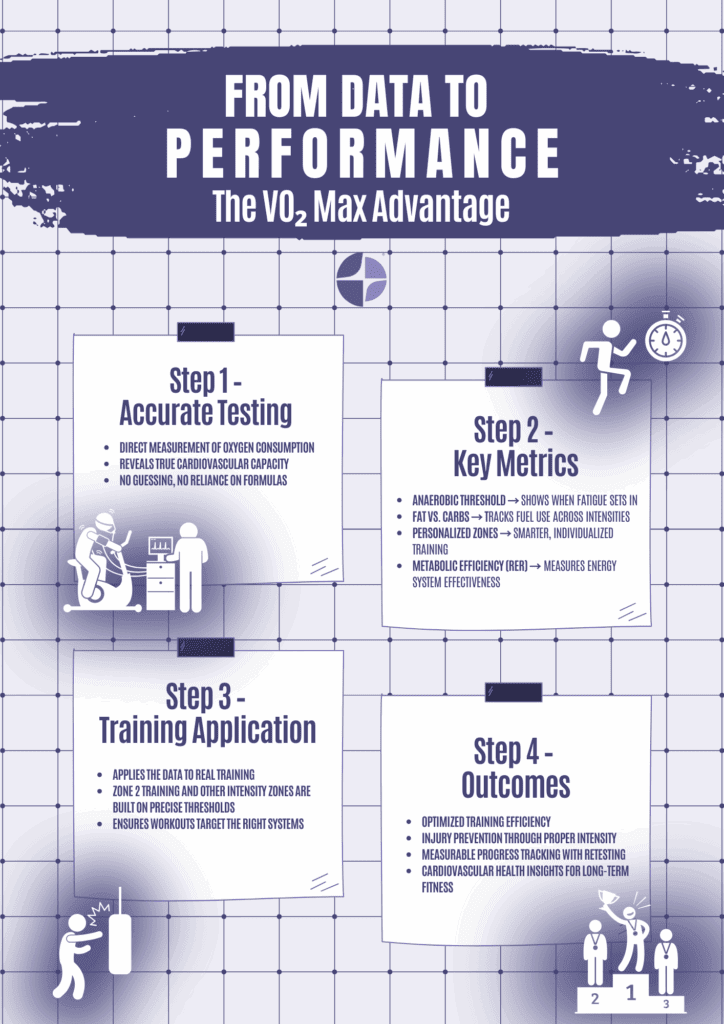
Professional VO₂ Max testing eliminates guesswork by directly measuring your body’s oxygen consumption during progressively intense exercise. This approach provides unmatched accuracy and reveals insights impossible to obtain through wearable estimates.
KORR’s Mixing Chamber Technology Advantage
KORR’s CardioCoach systems utilize mixing chamber technology, considered the gold standard for metabolic testing. This approach offers superior accuracy compared to breath-by-breath systems used by some competitors, providing stable, reliable measurements even at varying exercise intensities.
The mixing chamber design minimizes measurement noise and environmental interference, ensuring consistent results that truly reflect your cardiovascular capacity. This technology has been independently validated at leading research institutions, confirming its accuracy for clinical and performance applications.
Comprehensive Metabolic Insights
Professional testing with KORR equipment reveals more than your maximum oxygen uptake. Key metrics include:
Anaerobic Threshold Identification: Discover the exercise intensity where your body’s lactate production begins to exceed clearance, a clear signal that exhaustion is approaching. This critical point determines optimal training zones for different fitness goals.
Fat vs. Carbohydrate Utilization: Track how your body’s fuel preferences change across exercise intensities. This information proves invaluable for weight management and endurance training strategies.
Personalized Heart Rate Zones: Generate training zones based on your unique physiology rather than age-based formulas. These zones guarantee every workout targets the right energy systems for maximum effectiveness.
Respiratory Exchange Ratio (RER): Monitor the ratio of carbon dioxide produced to oxygen consumed, providing detailed insights into metabolic efficiency and substrate utilization.
The Zone 2 Training Connection
Current fitness trends emphasize Zone 2 Training, exercising at intensities that maximize aerobic efficiency and fat oxidation. This training zone, popularized by endurance athletes and longevity researchers, offers benefits for cardiovascular health and metabolic function.
Determining your Zone 2 requires accurate identification of your aerobic threshold through professional VO₂ Max testing. Wearable estimates misplace this critical training zone, compromising the effectiveness of Zone 2 protocols.
Zone 2 Training serves as the foundation for all other training zones. By improving your aerobic base through properly executed Zone 2 sessions, you enhance performance across the entire intensity spectrum from easy recovery efforts to high-intensity intervals.
Making the Investment in Accurate Data
While wearables provide valuable motivation and general activity tracking, serious athletes and health-conscious individuals benefit enormously from professional VO₂ Max testing. Unlike algorithmic estimates, this approach delivers precise data that can transform the way training is planned and executed.
The investment in accurate data pays dividends through optimized training efficiency, since every workout is based on actual physiological capacity; injury prevention, by ensuring proper intensity distribution and reducing the risk of overtraining; measurable progress tracking, with periodic retesting that objectively demonstrates improvements; and health risk assessment, as VO₂ Max is a powerful predictor of cardiovascular health and longevity, offering insights that go beyond performance optimization.
Your Next Step Toward Accurate Fitness Data
The convenience of wearable technology shouldn’t overshadow the importance of accurate physiological data. While your smartwatch serves as a helpful daily companion, professional VO₂ Max testing provides the precision needed for peak training and health outcomes.
Don’t let inaccurate estimates limit your potential. Discover your cardiovascular capacity and unlock personalized training insights that no wearable device can provide. Your body deserves more than algorithmic guesses—it deserves the gold standard of metabolic testing.
Ready to move beyond estimates and start training with confidence? Experience the difference that accurate VO₂ Max testing makes in your fitness journey.
- Snyder NC, Willoughby CA, Smith BK. Comparison of the Polar V800 and the Garmin Forerunner 230 to Predict V̇o2max. J Strength Cond Res. 2021 May 1;35(5):1403-1409. doi: 10.1519/JSC.0000000000002931. PMID: 30640299.
- Engel FA, Masur L, Sperlich B, Düking P. Validity of V̇O2max estimates from the forerunner 245 smartwatch in highly vs. moderately trained endurance athletes. Eur J Appl Physiol. 2025 Aug 6. doi: 10.1007/s00421-025-05923-x. Epub ahead of print. PMID: 40770433.
- Pearson, Andrew G.; Bastianelli, Brandon; Workman, Andrea D.; Herman, Christopher W.; Schulz, Jeff; Cornett, Andrew; Moore, Rebecca W.. Accuracy Of VO2max Prediction Using A GPS Watch Following A 15-minute And Three Subsequent Runs: 2765 Board #48 June 1 2. Medicine & Science in Sports & Exercise 50(5S):p 674-675, May 2018. | DOI: 10.1249/01.mss.0000538225.71282.a6
- Mandsager K, Harb S, Cremer P, Phelan D, Nissen SE, Jaber W. Association of Cardiorespiratory Fitness With Long-term Mortality Among Adults Undergoing Exercise Treadmill Testing. JAMA Netw Open. 2018;1(6):e183605. Epub 20181005. doi: 10.1001/jamanetworkopen.2018.3605. PubMed PMID: 30646252; PubMed Central PMCID: PMC6324439.
- Joyner MJ, Coyle EF. Endurance exercise performance: the physiology of champions. J Physiol. 2008;586(1):35-44. Epub 20070927. doi: 10.1113/jphysiol.2007.143834. PubMed PMID: 17901124; PubMed Central PMCID: PMC2375555.