


In the fitness world, few metrics carry as much weight as VO2 Max. Considered the gold standard for measuring cardiorespiratory fitness, this value has become more important as science demonstrates its strong correlation with longevity, health outcomes, and athletic performance. But for fitness professionals and clients alike, interpreting these numbers can be challenging. What constitutes a “good” VO2 Max? And how should trainers approach clients with lower scores without discouraging them?
In this guide, we’ll explore what VO2 Max truly measures, what the numbers mean across different demographics, and most importantly, how fitness professionals can use this information to motivate rather than discourage clients on their fitness journey.
Understanding The Basics Of VO2 Max
VO2 Max, or maximal oxygen uptake, measures the maximum amount of oxygen your body can utilize during intense exercise. It’s expressed in milliliters of oxygen consumed per kilogram of body weight per minute (ml/kg/min). Think of it as your body’s engine capacity – the larger the engine, the more oxygen it can consume, and theoretically, the better your endurance performance.
A VO2 Max test requires that the subject breathe into an oxygen consumption analyzer during an all-out effort (usually on a treadmill or bicycle) as part of a graded exercise protocol. These protocols involve increases in the speed and intensity of the exercise until the person reaches complete fatigue.
What Makes VO2 Max So Important?
Before diving into the numbers, it’s worth understanding why VO2 Max has become such a valued metric:
- Strong Predictor of Mortality: Multiple studies show that higher VO2 Max scores correlate with lower risks of all-cause mortality and cardiovascular disease. A rise of just one metabolic equivalent (3.5 ml/kg/min) in VO2 Max has been associated with a 10-25% improvement in survival rates1.
- Performance Indicator: For athletes, VO2 Max establishes a baseline for endurance capacity and helps track improvements over time.
- Efficient Exercise Guidance: A precise VO2 Max assessment identifies target heart rates for various training goals, including fat burning, endurance training, and cardio conditioning.
- Metabolic Insight: The test determines calories burned during every level of exercise intensity, providing valuable data for weight management programs.
- Fat vs. Carb Utilization: When carbon dioxide (CO2) is measured during the test, the resulting Respiratory Exchange Ratio (RER) reveals the proportion of energy coming from carbohydrates versus fats at different exercise intensities.
What Constitutes a “Good” VO2 Max?
Here’s where things get interesting – and potentially confusing. VO2 Max values vary based on several factors:
Age and Gender Differences
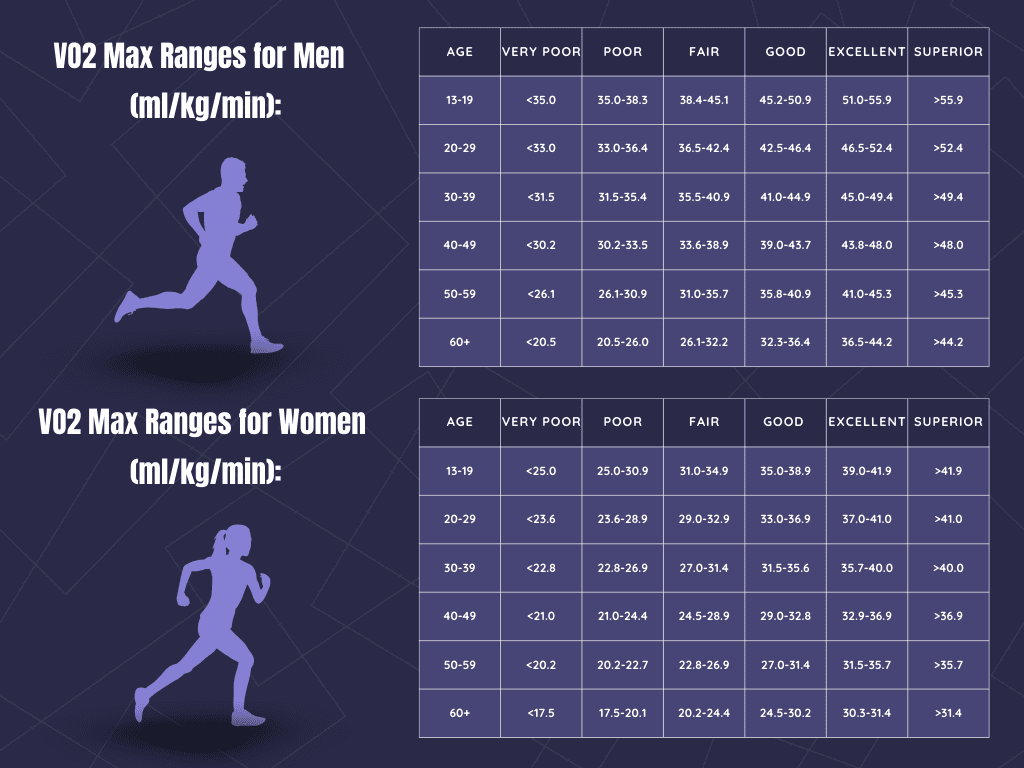
VO2 Max typically peaks in your early 20s and gradually declines with age (about 10% per decade after age 30). Women generally have VO2 Max values approximately 20% lower than men of similar fitness levels due to physiological differences including body composition, hemoglobin levels, and heart size.
Here’s a general breakdown by age and gender:
Athletic vs. General Population Standards
For competitive athletes, these numbers shift dramatically. Elite endurance athletes often have VO2 Max values that are 50-100% higher than age-matched sedentary individuals:
- Elite male endurance athletes: 70-85 ml/kg/min
- Elite female endurance athletes: 60-75 ml/kg/min
- Tour de France cyclists: 70-88 ml/kg/min
- Olympic cross-country skiers: 80-90 ml/kg/min
For context, the highest VO2 Max ever recorded was reportedly 97.5 ml/kg/min in Norwegian cross-country skier Bjørn Dæhlie.
Genetics and Trainability
An often-overlooked aspect of VO2 Max is that approximately 50% of a person’s value is determined by genetics2. Some individuals are naturally gifted with higher baseline values and greater responsiveness to training. The Role of Fitness in Health
One of the most important findings from recent research is that fitness level (as measured by VO2 Max) can modify the health risks associated with body weight. This concept, sometimes called the “fit but fat” paradigm, suggests that maintaining good cardiorespiratory fitness may be more critical than achieving an “ideal” BMI.
A notable meta-analysis3 of almost 400,000 individuals found that:
- Fit individuals (regardless of BMI status) showed no statistically significant increase in cardiovascular disease or all-cause mortality risk compared to normal-weight fit individuals.
- Unfit individuals showed a two-to-threefold increase in mortality risk across all BMI categories compared to fit, normal-weight individuals.
These findings highlight why improving VO2 Max should be a priority regardless of body composition – and why starting from a “low” number isn’t cause for discouragement.
How Trainers Should Address “Bad” VO2 Max Scores
For fitness professionals, how you communicate and address seemingly “bad” VO2 Max scores can significantly impact client motivation and adherence. Here’s a framework for turning these moments into opportunities:
1. Set Proper Context Before Testing
Before conducting a VO2 Max test, prepare clients appropriately. Explain that the main purpose is to establish a personalized baseline, not to compare against elite athletes or other clients. This test will provide unique insights about their physiology that will inform their training program in ways that generic approaches can’t. Make sure they understand that improvements in VO2 Max, regardless of starting point, correlate with health benefits and reduced mortality risk.
2. Focus on Personalized Improvement Over Absolute Values
When discussing results, emphasize that the most relevant comparison is against their future self, not arbitrary age-group charts. Help them understand their current starting point as just that—a beginning. Set realistic improvement goals, aiming for a 5-15% improvement over 8-12 weeks of consistent training. This framing helps clients see their VO2 Max as a dynamic, improvable metric rather than a fixed label.
Explain that even modest improvements translate to meaningful health benefits. Research shows that each 3.5 ml/kg/min increase in VO2 Max (roughly one metabolic equivalent) correlates with a 10-25% reduction in mortality risk—a good motivation regardless of their starting number1.
3. Highlight the More Actionable Insights from Testing
VO2 Max testing provides much more than just a single number. When reviewing results with clients, focus on the wealth of personalized data that can enhance their training:
- Heart rate training zones tailored to their physiology
- Identification of their prime fat-burning zone (using the Respiratory Exchange Ratio)
These physiological markers provide the foundation for personalized training that generic heart rate formulas cannot match. Explain how knowing their Aerobic Threshold (AeT) and Anaerobic Threshold (AT) takes the guesswork out of training intensity. Show them their caloric expenditure data at different intensities, which can be invaluable for weight management goals.
4. Address the Common “Low Score” Scenarios
Different clients may present with different profiles, each requiring a tailored approach to discussing results.
For the sedentary client with low VO2 Max, focus on the gains they stand to make. Studies show that previously sedentary people can increase VO2 Max by 15-20% in 6 months of consistent training, often the largest percentage improvements of any population4. Emphasize the immediate quality-of-life benefits they’ll notice, like less fatigue in daily activities, improved mood, and better sleep.
When working with an active client who shows unexpectedly low VO2 Max, take a different approach. These clients may be frustrated that their exercise efforts haven’t yielded better results. Explain how inefficient exercise habits, like consistently training in the wrong heart rate zones, could be limiting their progress. Position the test as revealing their “hidden potential” for improvement now that they’ll be training smarter.
For weight-conscious clients, share the research showing that fit individuals with higher BMIs often have better health outcomes than unfit individuals with “normal” BMIs3,5,6. Help them understand how improving VO2 Max:
- Optimizes fat burning during exercise through better metabolic efficiency
- Creates health benefits independent of weight changes
- Shifts focus productively toward performance improvements rather than scale fluctuations
5. Develop a Strategic Training Plan Based on Results
Use the data to create a science-based approach that feels motivating and specific to the client. Incorporate Zone 2 training around their aerobic threshold, which is critical for building aerobic capacity and mitochondrial density. This foundation of aerobic fitness supports all other training zones.
Include strategic higher-intensity intervals to push their anaerobic threshold higher, carefully designed based on their test results. Schedule follow-up testing at 8-12 week intervals to demonstrate progress objectively and refine their training zones as they improve. The key is designing workouts that keep clients in their optimal, personalized training zones rather than arbitrary intensity levels that might not produce results.
6. Share Success Stories
Nothing motivates like concrete examples of others who started with similar scores and made improvements. Develop a collection of anonymized client success stories that illustrate realistic progress expectations. Highlight the numerical improvements in VO2 Max and the lifestyle enhancements and performance gains these clients experienced.
When appropriate, share your own fitness journey and testing experiences to build rapport and demonstrate your personal investment in the process. These narratives help clients visualize their path forward and establish confidence in the training approach you’re recommending based on their test results.
The Importance of Zone 2 Training for Improving VO2 Max
Recent research and practice among elite endurance athletes has highlighted the central role of Zone 2 training in improving VO2 Max, especially in the general population7,8. Zone 2 represents the intensity where your body is working aerobically at a sustainable pace – usually around 60-75% of maximum heart rate for many individuals.
The beauty of Zone 2 training is that it:
- Builds mitochondrial density, improving your cells’ ability to utilize oxygen
- Can be sustained for longer durations without excessive fatigue or injury risk
- Improves fat utilization during exercise, preserving glycogen stores
- Enhances capillary density around muscle fibers, improving oxygen delivery
- Creates a strong aerobic foundation that supports higher-intensity training
Most importantly, proper Zone 2 training requires knowing your personal Aerobic Threshold, which is precisely identified during VO2 Max testing. Without this personalized data, most people either train too hard (turning what should be Zone 2 into Zone 3 work) or not hard enough to stimulate adaptation.
The Technology Behind Accurate VO2 Max Testing
Not all VO2 Max testing equipment is created equal. The standard for measurement utilizes mixing chamber technology, which provides superior accuracy across all exercise intensities. This is important for identifying precise training zones and thresholds.
Main elements of quality VO2 Max testing include:
- Breath analysis for real-time data collection
- Precise heart rate monitoring throughout the test
- Mixing chamber technology for consistent and accurate readings
- Standardized protocols appropriate for the individual’s fitness level
- Analysis of oxygen consumption and carbon dioxide production for RER calculations
The Path Forward: Progress Over Perfection
An important message trainers can convey about VO2 Max is that it’s trainable for almost everyone. Research demonstrates improvements of 15-20% are achievable in previously sedentary individuals following structured training programs4.
The rate and magnitude of improvement vary based on:
- Starting fitness level (lower initial values typically show greater percentage improvements)
- Training consistency and program design
- Age (younger individuals generally respond more robustly)
- Genetic factors affecting trainability
- Overall lifestyle factors including sleep, stress, and nutrition
Reframing the Conversation
As fitness professionals, we have the power to transform how clients perceive their VO2 Max scores. Rather than labeling results as “good” or “bad,” we can present them as valuable data points on a continuous improvement journey.
The value of VO2 Max testing lies in:
- The personalized insights it provides for training
- The precise metrics it establishes for measuring future progress
- The scientific foundation it creates for program design
- The motivation it can provide when improvements are documented
By shifting the conversation from comparative evaluation to personalized optimization, we help clients appreciate their unique physiological blueprint and the specific path forward to improved fitness, health, and performance.
In the journey of cardiorespiratory fitness, the most important competition is with yesterday’s self—not with normative charts or other individuals. The “best” VO2 Max is one that continues to improve through consistent, well-designed training based on accurate physiological data.
This article is intended for educational purposes only and should not be used as a substitute for professional medical advice. Always consult with qualified healthcare providers regarding any health concerns or before beginning any exercise program.
References:
- Scribbans TD, Vecsey S, Hankinson PB, Foster WS, Gurd BJ. The Effect of Training Intensity on VO2max in Young Healthy Adults: A Meta-Regression and Meta-Analysis. Int J Exerc Sci. 2016;9(2):230-47. doi: 10.70252/HHBR9374. PubMed PMID: 27182424; PubMed Central PMCID: PMC4836566.
- Hoppeler H. Deciphering V̇(O(2),max): limits of the genetic approach. J Exp Biol. 2018;221(Pt 21). Epub 20181031. doi: 10.1242/jeb.164327. PubMed PMID: 30381476.
- Weeldreyer NR, De Guzman JC, Paterson C, Allen JD, Gaesser GA, Angadi SS. Cardiorespiratory fitness, body mass index and mortality: a systematic review and meta-analysis. Br J Sports Med. 2025;59(5):339-46. Epub 20250220. doi: 10.1136/bjsports-2024-108748. PubMed PMID: 39537313.
- Kenney WL, Wilmore JH, Costill DL. Physiology of Sport and Exercise. Ninth ed: Human Kinetics; 2024. 680 p.
- Ortega FB, Lavie CJ, Blair SN. Obesity and Cardiovascular Disease. Circ Res. 2016;118(11):1752-70. doi: 10.1161/CIRCRESAHA.115.306883. PubMed PMID: 27230640.
- Blair SN, Kohl HW, 3rd, Paffenbarger RS, Jr., Clark DG, Cooper KH, Gibbons LW. Physical fitness and all-cause mortality. A prospective study of healthy men and women. JAMA. 1989;262(1):2395-401. doi: 0.1001/jama.262.17.2395. PubMed PMID: 2795824.
- Stoggl T, Sperlich B. Polarized training has greater impact on key endurance variables than threshold, high intensity, or high volume training. Front Physiol. 2014;5:33. Epub 20140204. doi: 10.3389/fphys.2014.00033. PubMed PMID: 24550842; PubMed Central PMCID: PMC3912323.
- Sitko S, Artetxe X, Bonnevie-Svendsen M, Galán-Rioja MÁ, Gallo G, Grappe F, et al. What Is “Zone 2 Training”?: Experts’ Viewpoint on Definition, Training Methods, and Expected Adaptations. International Journal of Sports Physiology and Performance. 2025:1-4. doi: 10.1123/ijspp.2024-0303.