



HYROX has become one of the fastest-growing competitive fitness formats in the world. Eight one-kilometer runs. Eight functional workout stations. Sled pushes, sled pulls, farmer’s carries, SkiErg intervals, wall balls, burpee broad jumps, sandbag lunges, and rowing. All completed in sequence, under fatigue, against the clock.
The athletes who perform best in HYROX are not simply the strongest or the fastest. They are the ones who can sustain output across both running and functional stations without one compromising the other. That requires aerobic capacity, pacing disciple, movement efficiency, strength-endurance, and a conditioning program built on individual physiology and race demands rather than generalized training templates.
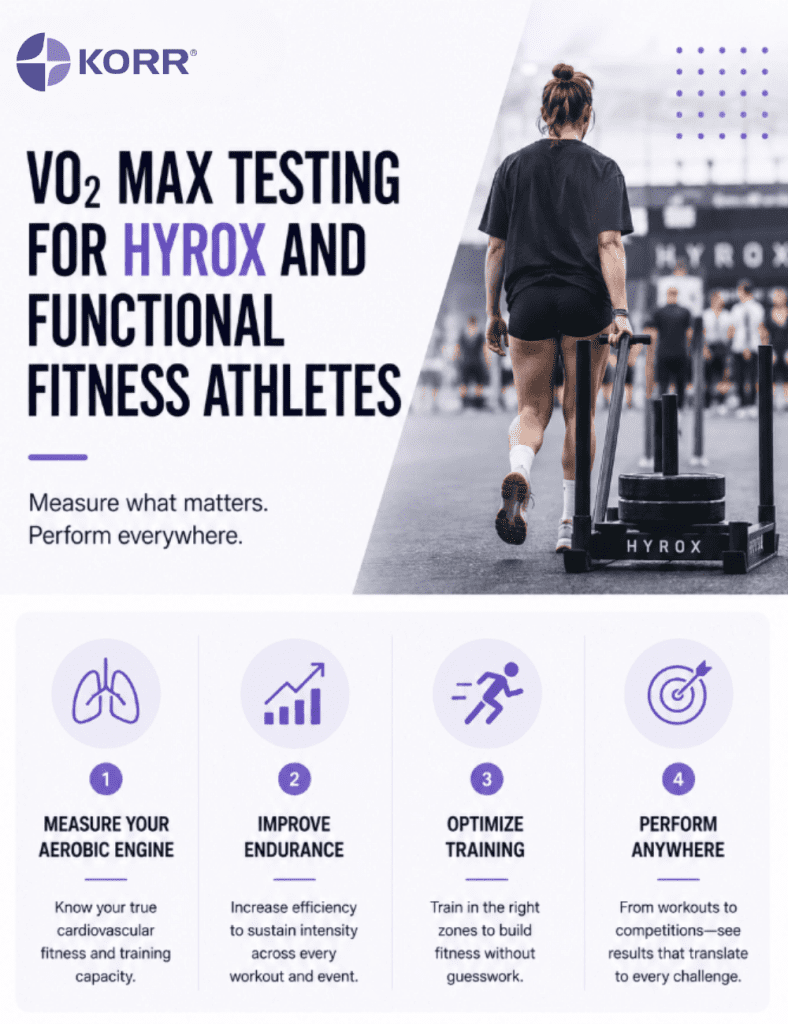
VO2 max testing for HYROX athletes gives coaches the physiological data to build exactly that. It moves programming from estimation toward more precise decision-making and gives athletes a measurable benchmark to train toward, compete against, and improve over time.
Why VO2 Max Matters in HYROX and Functional Fitness
HYROX is widely perceived as a strength-dominant sport. The sleds, the sandbags, farmer’s carries, wall balls, and lunges all require strength and muscular endurance. But the overall race structure tells a more balancedstory. Eight one-kilometer runs account for a significant portion of total race time, and the ability to sustain running pace while managing cumulative fatigue from functional stations is one of the keyseparators between recreational finishes and podium results.
VO2 max measures the maximum rate at which the body can consume oxygen during exercise. It represents the ceiling of aerobic capacity and helps shape how much sustained cardiovascular work an athlete can tolerate. In HYROX, a higher aerobic ceiling can make running segments occur at a lower relative intensity, leaving more reserve for the functional stations. It may also support faster recovery between hard efforts. It means less cardiovascular debt accumulating across the back half of the race when fatigue becomes the dominant performance variable.
But VO2 max alone does not tell the full coaching story for hybrid athletes. The ventilatory thresholds identified during a metabolic test can provide additional insight into how an athlete responds as intensity increases. Ventilatory threshold 1, or VT1, marks the first major shift in breathing and effort as exercise moves from easier aerobic work toward more demanding intensities. Ventilatory threshold 2, or VT2, marks a second major shift, where breathing rises sharply and exercise becomes much harder to sustain for long periods..
For HYROX athletes, understanding where these thresholds sit relative to race-specific heart rates can help guide pacing strategy. An athlete who spends too much time above VT2 early in the race may accumulate fatigue that affects later running segments and station performance. An athlete who remains far below VT1 during the running segments may be leaving time on the table, depending on their goals and division. The useful race intensity for many HYROX athletes likely falls somewhere around their sustainable threshold range, but this must be interpreted alongside strength endurance, station skill, transition efficiency, and the athlete’s ability to tolerate compromised running.
How Metabolic Testing Helps Coaches Personalize Conditioning
Generic conditioning programs produce generic results. For HYROX athletes, whose event combines sustained cardiovascular output with high-force functional movements, the cost of imprecise programming can show up as slower race times, poor pacing, excessive fatigue, or incomplete development of the qualities most needed for performance.
Metabolic testing gives coaches the data that reduces much of the guesswork. Heart rate training zones derived from measured ventilatory thresholds are individualized to each athlete’s actual physiology. They help identify how that specific athlete responds across increasing intensities, which can make it easier to prescribe training that matches the intended goal of the session.
Zone 2 training is used to build aerobic base, improve fat oxidation, cardiovascular efficiency, and recovery capacity. A metabolic test can help identify an athlete’s lower-intensity training range more accurately than broad formulas alone. However, threshold-based zones are not perfect switch-points, and they are not the only valid way to prescribe training. RPE, pace, power, talk test, lactate, performance history, and coach observation can all contribute to good training decisions.
With accurate zones established, coaches can structure conditioning programs around specific physiological goals. Aerobic base work designed to improve durability shift and VT1 upward. Threshold intervals designed to raise VT2 and expand the sustainable working range. High-intensity efforts designed to improve VO2 max, high-intensity tolerance, and cardiovascular ceiling. Each training stimulus is prescribed at the intensity that produces the intended adaptation without drifting into a gray zone that produces additional fatigue without additional benefits
Pacing strategy for race day becomes equally precise. A coach who knows where an athlete’s VT1 and VT2 sit relative to various running paces and heart rate ranges can prescribe a race strategy that maximizes output across all eight kilometers without creating a metabolic deficit that degrades station performance in the back half of the race. This does not replace race-specific practice, station skill, or coaching judgment, but it can help prevent athletes from turning the early race into an effort that costs them heavily later.
Recovery optimization is another direct coaching benefit. VO2, ventilation, and heart-rate responses during the recovery intervals between high-intensity efforts reveals how efficiently an athlete returns to a sustainable working state. Athletes who recover slowly between efforts may benefit from addtion alaerobic base development, pacing changes, or improved recovery strategies. Athletes who recover quickly but fade late in the race may have a different limiter such as muscular endurance, fueling, pacing discipline, or station-specific fatigue.
Identifying Performance Limiters in Hybrid Athletes
One of the most valuable applications of metabolic testing in HYROX and functional fitness coaching is limiter identification: helping determine the which physiological factors are constraining performance. It doesn’t diagnose every limiter by itself, but it can help coaches ask better questions and choose better interventions.
HYROX athletes who plateau despite consistent training often have several possible constraints. A poorly developed aerobic base may mean the running segments are completed at too high a relative intensity, creating cumulative fatigue that compounds across the race. Poor movement economy may mean the athlete is burning more calories per unit of work than a more efficient competitor at the same fitness level. A low VT1 relative to training pace may mean easy efforts are never truly easy. Performance may also be limited by sled strength, grip endurance, fueling, sleep, recovery, or pacing discipline.
Each of these limiters may appear differently in metabolic data. An athlete with limited aerobic development may show elevated heart rate and VO2 at relatively modest workloads. An athlete with poor economy may require high oxygen consumption for a given power or pace output relative to a more efficient athlete. An athlete training above their aerobic threshold may show accumulated fatigue patterns, inconsistent performance across training blocks, and difficulty recovering between sessions.
Without metabolic data, these limiters may look similar on the surface. The athlete is tired. The athlete is not improving. The athlete is working hard but not racing well. With metabolic data, the coach gains another layer of information that can help separate aerobic limitations from other possible constraints. The test does not replace coaching judgment, but it can make that judgment more informed.
This is particularly important for hybrid athletes because the training demands of HYROX already create significant fatigue. Misdiagnosing a limiter and applying the wrong training stimulus wastes the athlete’s limited recovery budget on work that does not address the constraint. Metabolic testing helps reduce that risk by clarifying the aerobic and threshold side of the athlete’s profile, which can then be integrated with strength, skill, recovery, and race-specific performance data.
Why Repeat Testing Matters for Competitive Athletes
A single metabolic test establishes a baseline. The coaching value compounds when testing is repeated over time and interpreted in the context of the athlete’s training plan.
Repeat testing at structured intervals, typically every 6 to 12 weeks during a training season, creates a longitudinal record of physiological adaptation that validates or challenges the programming decisions made since the last test. If VT1 has shifted upward, aerobic base development is working. If VT2 has moved toward a higher heart rate, threshold training is producing the intended adaptation. If VO2 max has increased, cardiovascular ceiling has expanded.
If none of these markers have moved, that information is still useful. It may suggest that something in the training program is not producing the intended physiological stimulus, that recovery is insufficient, that the testing protocol needs review, or that the athlete’s adaptiation is showing up more in performance measures than lab markers. The value is not simply in seeing numbers improve. It’s in using the data to evaluate whether the current training approach is working, without wasting valuable training time.
For HYROX athletes preparing for competition, a metabolic test in the final preparation phase can help confirm whether the prescribed race strategy remains appropriate for the athlete’s current physiological state. Athletes who have improved significantly since their last test may need an updated pacing strategy. Athletes who have not adapted as expected may need changes to training load, taper strategy, or race expectations.
Off-season conditioning benchmarks establish where each athlete enters the next training cycle, allowing coaches to build progressive programs from a more objective starting point. Return-to-training evaluations after injury or extended rest can help determine whether cardiovascular capacity has recovered to the level required for full training loads. Each of these applications adds measurable value to a testing program that would not be available from observation or performance metrics alone.
Operational Benefits for Functional Fitness Facilities
The coaching benefits of metabolic testing are well established. The business benefits for functional fitness facilities are equally compelling.
HYROX has created a new category of athlete who is actively seeking coaching support that goes beyond general fitness programming. These athletes are goal-oriented, competition-focused, and willing to invest in services that demonstrate measurable impact on their performance. Metabolic testing is exactly the kind of premium, data-driven service this population responds to.
The KORR CardioCoach delivers the measurement accuracy this application requires. Mixing chamber technology collects expired air from multiple breaths into a stabilized sample before analysis, producing measurements that are consistent across operators and testing sessions. For coaches using repeat testing to track adaptation across a training season, this consistency is essential. Results that vary with operator technique or calibration quality cannot reliably detect the threshold shifts that represent meaningful adaptation.
Auto-calibration in approximately 90 seconds using ambient room air means no gas tanks, no syringes, and no multi-step procedures that introduce operator-dependent variability. There are no mandatory cooldown periods between sessions and no session limits, which means a facility can run multiple athletes through testing in a single day without scheduling constraints imposed by the equipment. The system weighs under ten pounds, operates on battery power, and is portable enough to move between rooms or travel to competition venues without complex logistics.
There are no ongoing software fees, no service contracts, and the oxygen sensor is user-replaceable in under one minute without tools or recalibration. Free training is included with every purchase. The total operational cost of running a metabolic testing program is predictable and contained, which means the revenue generated from testing services directly improves facility margins rather than being offset by hidden ongoing costs.
For facilities already serving HYROX athletes, adding metabolic testing creates a premium service tier that supports higher-value coachine packages and generates repeat revenue through structured re-testing programs. For facilities considering the HYROX market, a testing program is a differentiator that generic gyms without the equipment cannot replicate.
Expanding Testing Services in Functional Fitness Gyms
The operational infrastructure for metabolic testing, once established, supports a range of program structures that extend beyond individual athlete assessments.
Athlete onboarding assessments give new members an immediate experience of the facility’s data-driven coaching approach and establish the baseline against which all future progress is measured. Quarterly performance re-testing creates a recurring revenue stream while giving athletes scheduled milestones to train toward. Premium coaching packages that include structured testing intervals command higher price points and create longer membership tenure.
Competition prep programs built around metabolic testing give HYROX athletes a structured, science-backed preparation framework that justifies premium pricing and produces measurable performance outcomes. Small-group testing days create a community dimension that reinforces facility loyalty — athletes who train together, test together, and track progress together develop accountability structures that sustain engagement.
Hybrid athlete development programs that combine VO2 max testing with resting metabolic rate assessment through the CardioCoach’s dual flow sensor capability provide a more complete metabolic picture. An athlete whose training zones are set from VO2 max data and whose nutritional strategy is informed by an accurate RMR baseline has a genuinely individualized program that competitors without the same equipment cannot offer.
Facilities that position metabolic testing as a core service rather than an occasional add-on build a more differentiated and defensible coaching offering in a fitness market where generic programming is increasingly commoditized.
Frequently Asked Questions About VO2 Max Testing for HYROX
Why is VO2 max important for HYROX athletes? VO2 max measures aerobic capacity which is the ceiling of cardiovascular output that constrains sustained performance across all eight running kilometers and functional stations. Higher aerobic capacity means running segments are completed at a lower relative intensity, leaving more reserve for strength stations and improving recovery between efforts. Early HYROX research and performance analysis suggest that endurance capacity is a major contributor to performance, even though strengh-endurance, station skill, pacing, and movement efficiency also play important roles.
How does metabolic testing improve HYROX pacing strategy? Metabolic testing identifies ventilatory thresholds and heart rate ranges where the athlete’s physiological response begins to change. . Race pacing built around these measured thresholds is individualized to the athlete’s actual physiology, allowing coaches to prescribe running intensities that maximize output without creating a metabolic deficit that degrades station performance in the back half of the race.
How often should HYROX athletes be tested? Most coaches structure metabolic testing at the start of a training block, at 6 to 12 week intervals during preparation, and in the final pre-competition phase. Re-testing validates whether conditioning programs are producing the intended physiological adaptations and allows coaches to update training zones and pacing strategies as the athlete’s fitness evolves.
Can metabolic testing be done in a gym setting for HYROX athletes? Yes. Professional metabolic testing systems like the KORR CardioCoach are designed for commercial facility use. The system weighs under ten pounds, auto-calibrates in 90 seconds, and has no session limits or mandatory downtime between clients. Gyms can run multiple athlete assessments in a single testing day without scheduling constraints.
What does metabolic testing reveal that wearables cannot? Wearables estimate VO2 max from heart rate and external workload data with error margins that can be substantial at the individual level. A direct metabolic test measures oxygen consumption, ventilatory thresholds, and movement economy from the athlete’s actual expired gases, producing data that is individualized to their specific physiology rather than calculated from population-based algorithms.
How does VO2 max testing support HYROX training program design? Test results establish accurate heart rate training zones, help identify specific physiological limiters like aerobic base deficiency or poor movement economy, and provide a baseline against which training adaptations can be measured over time. This data allows coaches to prescribe conditioning at the correct intensity for each athlete rather than applying generic programming that may not address the specific constraints holding performance back.
Data-Driven Training Is the Competitive Edge in Hybrid Fitness
HYROX rewards athletes who train efficiently, pace precisely, and recover effectively. These are not qualities that emerge from working harder on a generic conditioning template. They are qualities that develop when training is built on accurate physiological data and adjusted based on measured outcomes rather than subjective feel.
VO2 max testing for HYROX athletes gives coaches the data infrastructure to build programs that address individual limiters, prescribe precise intensities, and validate adaptation over time. It gives athletes a concrete number to improve and a measurable record of progress that sustains motivation through the long training cycles that competitive hybrid fitness demands.
Facilities that integrate metabolic testing into their HYROX and functional fitness coaching are not just offering a better service. They are building a more defensible competitive position in a market where the athletes most willing to invest in premium coaching are actively seeking facilities that can back their programming with science.
The KORR CardioCoach is in use at more than 1,000 locations worldwide across performance facilities, coaching programs, and sports science centers. To learn how the CardioCoach can support your facility’s HYROX and functional fitness testing program, visit korr.com or call 1-801-483-2080 to schedule a demonstration.