


Metabolic testing has moved well beyond the exclusive domain of elite athletes and university research labs. Today, weight management clinics, fitness facilities, physical therapy practices, and corporate wellness programs recognize that accurate VO2 max and Resting Metabolic Rate (RMR) data can transform client outcomes.
The challenge for practitioners isn’t whether to offer metabolic testing, it’s choosing the right equipment for their specific environment.
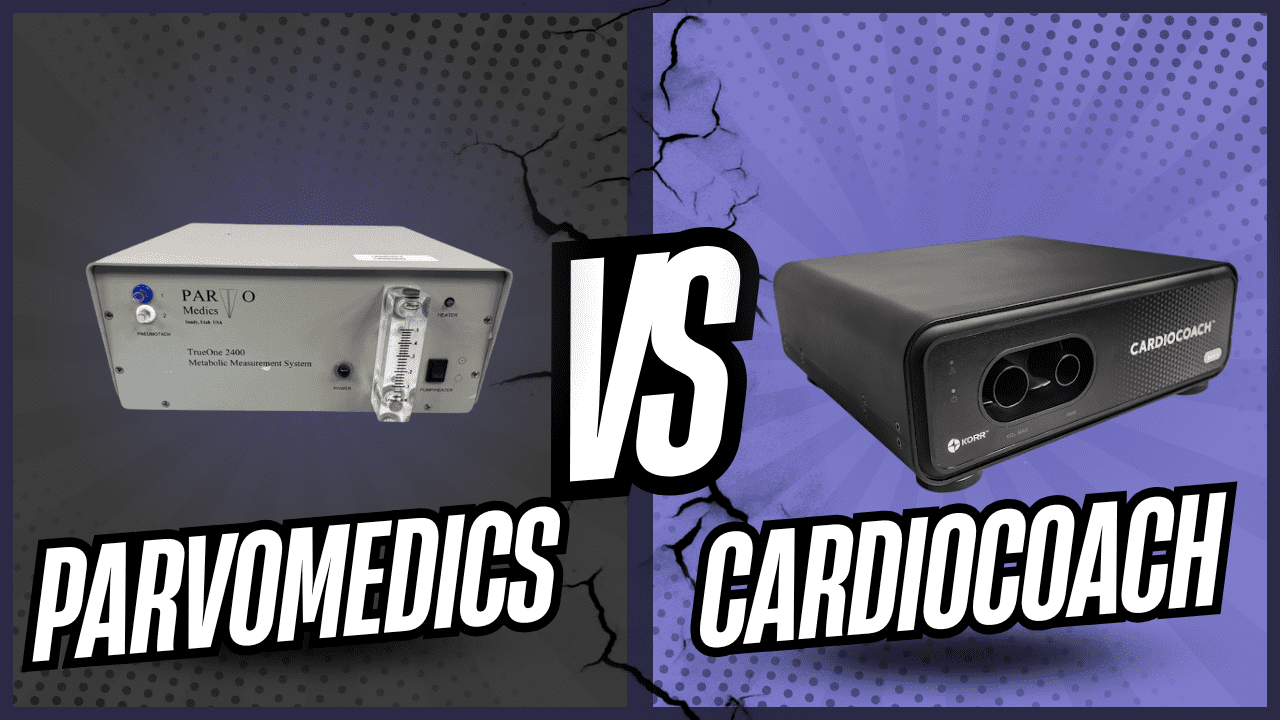
Two systems frequently appear in these conversations: the KORR CardioCoach and the ParvoMedics TrueOne 2400. Both are capable metabolic analyzers with validated accuracy. But they’re designed for fundamentally different use cases, and selecting the wrong category of equipment leads to operational friction, underutilized features, and frustrated staff.
This comparison examines both systems across the metrics that actually matter to clinical and fitness professionals: calibration workflow, portability, user experience, infection control, total cost of ownership, and real-world implementation.
Our goal isn’t to declare a universal winner, it’s to help you identify which system fits your practice.
Design Philosophy: Clinical Efficiency vs. Research Precision
Before examining specific features, it’s worth understanding the design intent behind each system. This context explains why certain features exist and helps practitioners evaluate which philosophy aligns with their operations.
CardioCoach PRO: Built for the Clinic
KORR has spent over 30 years refining metabolic testing equipment for clinical and fitness applications. The CardioCoach PRO reflects this focus: it’s designed to move patients through efficiently, produce outputs that aid patient education, and operate simply enough that any staff member can run a test with minimal training.
TrueOne 2400: Built for the Research Lab
ParvoMedics positions the TrueOne 2400 as “the standard for metabolic measurements,” and its customer base reflects that claim. The system is used by large training facilities, including TOSH (The Orthopedic Specialty Hospital) for the U.S. Ski Team and Winsport for Canadian Olympic athletes.
This is equipment designed for controlled research environments with trained technicians, where the priority is publishable data quality and the ability to test elite athletes at extreme workloads. The TrueOne 2400 excels in these settings, but those settings look nothing like a busy weight management clinic or personal training studio.
Why This Distinction Matters
Neither system is objectively “better.” A Formula 1 car is an extraordinary machine, but you wouldn’t use it to teach driving lessons. Similarly, the TrueOne 2400’s research capabilities become liabilities in clinical settings where simplicity and throughput matter more than granular data export options.
The question isn’t which system has more features, it’s which system’s features match your actual needs.
Calibration and Daily Operations
Calibration is where the clinical vs. research divide becomes most apparent. The process you perform before every test, or multiple times per day, directly impacts staff time, training requirements, and the potential for human error.
CardioCoach: Hands-Free Auto-Calibration
The CardioCoach PRO self-calibrates without requiring a syringe, calibration gas tanks, or manual processes. During each calibration cycle, the system automatically measures and compensates for barometric pressure, temperature, and humidity, variables that directly affect VO2 measurement accuracy. Results are automatically adjusted to standard (STPD) conditions.
KORR estimates this approach saves 5–10 minutes per test compared to traditional manual calibration. Over a day of testing, that time adds up. More importantly, it removes the opportunity for calibration errors, no incorrect syringe strokes, no expired calibration gas, and no staff members who “usually” perform calibration correctly.
Oxygen sensor replacement follows the same philosophy: it’s tool-free and requires no recalibration after installation. Routine maintenance doesn’t require a service call or specialized knowledge.
TrueOne 2400: Flow Calibration Protocol
The TrueOne 2400 uses a traditional calibration approach appropriate for research settings. Flow calibration requires a 3-liter syringe with a specific protocol: five detection and flushing strokes followed by five calibration strokes at varying speeds (approximately 50, 100, 150, 200, and 250 L/min). ParvoMedics recommends repeating this process until low, high, and average volumes are within 1% of the previous calibration.
Gas calibration uses an E-cylinder with a 2-stage regulator. ParvoMedics notes that gas calibration itself takes approximately 40 seconds, though the complete calibration workflow, including syringe calibration, system warm-up, and verification, requires more time.
For whole-day testing protocols, ParvoMedics recommends calibrating once at the start of the morning and once at the start of the afternoon. This is standard practice in research environments where a dedicated technician manages the equipment.
Operational Impact
The calibration difference affects more than just time. Consider the downstream implications:
- Staff training: CardioCoach’s auto-calibration means any staff member can prepare the system for testing. TrueOne’s manual calibration requires training on proper syringe technique and an understanding of when recalibration is necessary.
- Consumable costs: Calibration gas is an ongoing expense. E-cylinders require replacement, and the 2-stage regulator adds to initial and replacement costs.
- Error potential: Manual calibration introduces human variability. Auto-calibration doesn’t eliminate all error sources, but it removes the ones attributable to technique variation between staff members and errors due to outdated calibration equipment.
Nadeem Ashraf, owner of Redkore Fitness, specifically cited this factor when explaining his choice of CardioCoach. His previous experience with VO2 max testing “had yielded positive data, but had burdened trainers with overly complicated test methods.” He found that with CardioCoach, “very little of his time with new personnel is spent training to use the equipment.”
Dual Flow Sensor Technology
A technical distinction that directly impacts measurement accuracy across different test types: KORR uses two different flow sensors to ensure both low flow rates (during RMR testing) and high flow rates (during VO₂ max testing at high intensities) are measured accurately.
The CardioCoach offers two ports—a smaller port optimized for RMR and a larger port for VO₂ max—but the differentiation goes beyond port size. Each port connects to a different flow sensor with different tolerances, ensuring accurate measurement across the full range of respiratory rates encountered in clinical practice.
Most competing devices, including the TrueOne 2400, use only one flow sensor. Some manufacturers attempt to address this limitation with adapters that focus air movement, but adapters don’t resolve the fundamental issue: a single sensor optimized for one flow range will be less accurate at the extremes. A sensor calibrated for the high ventilation rates of maximal exercise testing may lack precision at the low flow rates characteristic of resting metabolic measurement, and vice versa.
For practices offering both RMR and VO₂ max testing, this dual-sensor approach provides confidence that accuracy is maintained regardless of test type.
Infection Control and Patient Safety
Both systems include infection control measures, but the implementation differs in ways that affect clinical workflow.
CardioCoach: Disposable Component System
The CardioCoach uses a one-way valve system that prevents rebreathing of contaminants. The mask, valve, and hose are completely disposable, each client uses new components, eliminating cleaning requirements between tests.
KORR provides multiple mask and valve options, giving test administrators flexibility based on their operational preferences and budget:
- Hans Rudolph 2-way non-rebreathing valve with reusable mask: The mask requires thorough cleaning between clients, but the system does not rely on filters and has no small moving parts that can trap particulates.
- Hans Rudolph 2-way non-rebreathing valve with single-patient-use mask: This option eliminates any cross-contamination concerns between masks while maintaining the proven Hans Rudolph valve system.
- KORR disposable neoprene mask and disposable 2-way non-rebreathing valve: A completely disposable solution for exercise testing. While there is a modest cost-per-test (less than $10), the time saved in cleaning and the confidence in infection control is worth it for many practitioners.
- KORR disposable mouthpiece and hose for RMR testing: Designed to eliminate any concern of cross-contamination between clients and to allow for rapid testing in busy clinics.
This approach has practical advantages beyond infection control. There’s no cleaning protocol to train staff on, no disinfection time between patients, and no risk of improper cleaning compromising safety. For high-throughput environments, the time savings compound throughout the day.
Patient perception matters too. In a post-COVID environment, visible single-use components provide immediate reassurance that the equipment is clean.
TrueOne 2400: Two-Way Non-Rebreathing Valve
The TrueOne 2400 includes a Rudolph two-way non-rebreathing valve, which is standard equipment in research metabolic carts. The system meets infection control requirements and includes disposable mouthpieces and nose clips.
Both systems provide adequate infection control. The difference is in workflow integration: CardioCoach’s fully disposable approach eliminates steps, while TrueOne’s approach follows traditional research lab protocols.
Portability and Physical Configuration
Physical design determines where and how you can use each system, a factor that becomes increasingly important as practices look for flexibility in service delivery.
CardioCoach PRO: Portable by Design
The CardioCoach PRO weighs under 10 pounds and includes battery power options. It’s designed to move: between rooms in a multi-location practice, to corporate wellness sites, to health fairs, or anywhere testing needs to happen.
Fitness Formula Clubs capitalized on this portability by taking their CardioCoach on “road shows,” offering metabolic testing at remote locations and providing annual checkups at off-site facilities. The ability to bring testing to clients, rather than requiring clients to come to a fixed testing location, opened revenue opportunities that wouldn’t exist with stationary equipment.
TrueOne 2400: Cart-Based Laboratory Equipment
The TrueOne 2400 is a cart-based system. The analyzer module measures 12″ × 10″ × 5″, the mixing chamber adds 5″ × 15″ × 5″, and the mobile cart measures 24″ × 30″ × 35″. While the cart has wheels for repositioning within a facility, this isn’t equipment designed for regular transport.
For a dedicated exercise physiology lab or research facility, the cart-based design is appropriate, the equipment stays in one location where environmental conditions are controlled. For practices that need flexibility, it’s a limitation.
Practical Implications
Consider your actual use cases:
- Do you test in multiple rooms?
- Do you offer on-site corporate testing?
- Do you attend community health events?
- Do you have limited storage space?
If yes to any of these, portability becomes a meaningful differentiator. If you have a dedicated testing room that never changes, cart-based equipment may be acceptable.
User Experience and Report Output
Software design reflects target users. Research software prioritizes data export and analysis capabilities; clinical software prioritizes ease of use and patient communication.
CardioCoach: Patient Education Focus
CardioCoach’s interface is designed for minimal staff training. The software prompts users through each test as data comes in, indicating when adjustments need to be made. KORR’s position is that “any trainer can learn to perform a test in minutes.”
Reports are structured for patient comprehension, clearly displaying heart rate zones, fitness level, recovery data, and key metrics. Practices can customize reports with their logo and add personalized recommendations.
A distinctive feature is substrate utilization display, the ratio of fats versus carbohydrates burned at each heart rate level during testing. For weight management and endurance training applications, this information directly informs training zone recommendations. Results can be uploaded to the CardioCoach mobile app, giving clients ongoing access to their data and workout guidance.
Dr. Garber chose CardioCoach specifically because it allows him to “interpret the results, then customize them for my own patients” without the system tailoring results to a particular program. This flexibility in how data is presented and applied was a deciding factor.
Zoning Methodology: Flexibility vs. Fixed Outputs
A critical difference in how the two systems approach workout zone creation: CardioCoach offers multiple zoning methodology options, while the TrueOne 2400 does not create workout zones at all.
KORR provides the following zoning methods:
- Percentage of VO₂ max
- Percentage of maximum heart rate
- Percentage of heart rate at anaerobic threshold
- Anaerobic threshold-based zones (with both metabolic and ventilatory threshold options)
- Manual zone setting.
For percentage-based methods, practitioners can even adjust the specific percentages used. The zoning methodology can be changed for each individual test, allowing practitioners to select the method that best fits each client’s goals and training approach.
The TrueOne 2400, by contrast, does not generate workout zones. This reflects its design intent: the TrueOne is built for research and medical diagnostics, not for advising clients on fitness programming. Practitioners using TrueOne for clinical applications must create workout zones manually from the raw data—an additional step that adds time and requires expertise in exercise prescription.
For fitness and weight management applications where actionable training zones are the primary deliverable, this distinction is significant. CardioCoach produces the output clients need; TrueOne produces data that must be translated.
RMR Analysis Methods
For practices offering resting metabolic rate testing, KORR provides flexibility in how RMR data is analyzed. Practitioners can select the analysis method that best represents each individual client’s true resting state:
- Best 5 minutes (the most stable 5-minute period during the test)
- Last 5 minutes (assuming the client has reached steady state by test end)
- Douglas Bag method.
This flexibility matters because not every client settles into a resting state at the same point during testing. Some clients relax quickly; others take longer to reach steady state. Without the ability to select the analysis window, practitioners may end up with outputs that don’t accurately reflect the client’s true resting metabolic rate—potentially leading to incorrect caloric recommendations.
TrueOne 2400: Research Data Management
The TrueOne 2400 runs on OUSW-4.3 Windows O2 Uptake Software, designed for research applications. Features include real-time O2, CO2, and flow signal graphic display; scrollable results display during testing;; events charting and editing during and after testing; and a filing system for results tracking and patient lookup.
These capabilities serve research needs: the ability to mark events during testing and export data in formats compatible with statistical analysis software. For clinicians focused on patient outcomes rather than research publication, many of these features go unused.
The Patient Communication Gap
In clinical and fitness settings, the test is only valuable if patients understand and act on the results. Reports that display technical metrics without context don’t drive behavior change. CardioCoach’s explicit focus on patient-friendly outputs addresses this reality; TrueOne’s research-oriented reporting assumes users will translate data themselves.
Accuracy and Validation
Both systems are validated for accurate metabolic measurement, this is table stakes for professional equipment. The question isn’t whether they’re accurate, but whether the accuracy level matters for your application.
TrueOne 2400 Validation
The TrueOne 2400 has been validated against the criterion Douglas bag method in published research. A study in the European Journal of Applied Physiology found the TrueOne 2400 “was not significantly different from the DB at rest or any work rate for VE, VO2, or VCO2.” Reliability between days showed a coefficient of variation of 4.7–5.7% for VO2 and VCO2—comparable to the Douglas bag itself.
The TrueOne 2400 appears frequently in academic literature because it’s standard equipment in university exercise physiology labs. This publication record reflects its market positioning, not necessarily superior accuracy compared to other validated systems.
CardioCoach Validation
The CardioCoach has been independently validated at the University of Southern California and Oregon State University. A validation study published in the Journal of Strength and Conditioning Research concluded that “the CardioCoachCO2 is a valid device for testing VO2 at submaximal and maximal levels,” supporting it “as a feasible and convenient method for testing participants” in field or clinic settings.
Clinical Accuracy vs. Research Precision
Both systems provide accurate VO2 measurements validated against gold-standard methods. The relevant question for practitioners is whether incremental precision differences—if any—would change clinical decisions. For weight management programming, fitness zone training, and patient education, both systems provide data that supports effective practice.
Total Cost of Ownership
Equipment cost extends beyond the purchase price. Ongoing expenses, hidden fees, and revenue potential all factor into the true cost of ownership.
Upfront Investment
The CardioCoach PRO is priced below $18,000 for a complete setup including cart, operating system, and accessories.
ParvoMedics does not publicly disclose TrueOne 2400 pricing. However, the system typically exceeds $24,000. Research-grade equipment commands research-grade prices.
Ongoing Costs
CardioCoach has no hidden fees for software, reports, analysis, or service contracts. The purchase price includes the complete system with ongoing software access.
TrueOne 2400 requires calibration gas (E-cylinder consumables) and may involve software licensing or service agreements depending on the purchase structure. These costs vary but should be factored into multi-year budgeting.
Training and Support
CardioCoach includes free training by credentialed personnel with each purchase. TrueOne 2400 also includes training, though the more complex calibration and operation procedures mean longer initial training and potentially more ongoing support needs.
Both companies provide warranties: All KORR devices include a 2-year warranty with free shipping in the USA; ParvoMedics offers a 3-year standard warranty.
Revenue Potential and ROI
Lower equipment costs accelerate ROI. KORR provides ROI calculators showing that facilities performing just 5 tests per week can add $40,000 or more to their bottom line annually. At a $99–$150 price point per test, the CardioCoach pays for itself within months rather than years.
Nadeem Ashraf’s Redkore Fitness grossed $42,000 from VO2 max testing in a single year. Fitness Formula Clubs reports an average yearly revenue of $114,432 from metabolic testing services. These numbers reflect the CardioCoach’s accessibility: when equipment is affordable and easy to operate, practices are more likely to integrate testing into their standard offerings.
Important Note
Neither the CardioCoach nor the ParvoMedics TrueOne 2400 is FDA-cleared for medical use. Testing performed with these devices cannot be submitted for insurance reimbursement. These systems serve the fitness, performance, and wellness markets where practitioners charge directly for testing services.
Comprehensive Comparison Table
| Feature: | Clinical Significance | KORRCardioCoach PRO | ParvoMedicsTrue One |
| Mixing ChamberTechnology | Gold Standard for Precise Gas Sampling,decreasing algorithm errors | ✓ | ✓ |
| Hands Free Calibration | Auto-calibrates without syringe,calibration tanks, or manual processes | ✓ | ✗ |
| Simple O2 SensorReplacement | No tools or calibration required forroutine oxygen sensor replacement | ✓ | ✓ |
| Minimal Risk of DiseaseTransmission | One-Way Valve preventsre-breathing of contaminants | ✓ | ✓ |
| No ongoing fees | No hidden charges for software,reports, analysis or service contracts | ✓ | ✓ |
| Intuitive UX Design | User interface designed for minimal stafftraining and easy data management | ✓ | ✗ |
| Lightweight, portable | Less than 10 lbs with battery power options | ✓ | ✗ |
| Training included withpurchase | Free training by credentialed personnelwith each purchase | ✓ | ✗ |
| Designed for Clinic Use | Designed to move patients through efficiently with robust equipment and little down time.Outputs that aid patient education. | ✓ | ✗ |
| Priced below $18K | Price of full set-up: cart, operating systemand accessories | ✓ | ✗ |
Choosing the Right Tool
The ParvoMedics TrueOne 2400 is an excellent metabolic cart for its intended purpose: university research labs, Olympic training centers, and facilities with dedicated technicians who need publication-grade data and extensive analysis capabilities. It has earned its reputation in those environments.
The KORR CardioCoach is purpose-built for a different reality: clinical practices, fitness facilities, and wellness programs where accurate metabolic data needs to integrate seamlessly into existing operations. Its auto-calibration, portability, patient-friendly reports, and accessible price point address the actual constraints these environments face.
If you’re running a weight management clinic, personal training studio, physical therapy practice, or fitness facility, and you need metabolic testing that your staff can operate without specialized training, that produces reports your patients will understand, and that pays for itself quickly, the CardioCoach is designed specifically for you.
To see the CardioCoach in action and discuss how it fits your specific practice, contact KORR at 1-801-483-2080 or visit korr.com to schedule a demo.