



Think of the world’s most elite endurance athletes—Olympic marathoners, Tour de France cyclists, and Ironman champions—spend roughly 80% of their training time moving at what most would consider a surprisingly easy pace. It’s a fact that flies in the face of conventional wisdom, yet study after study shows that top-performing athletes across endurance disciplines consistently follow this pattern, regardless of nationality, coaching philosophy, or sport.1-3
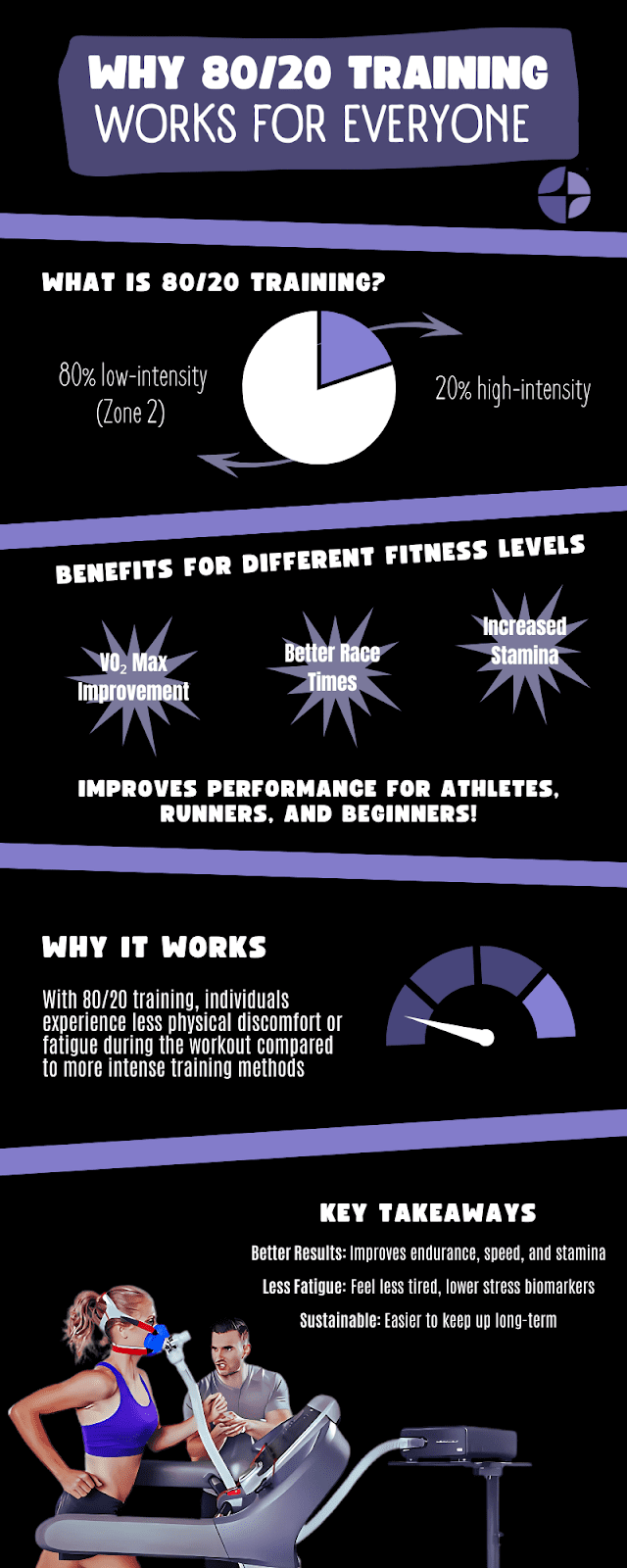
The 80/20 rule, first observed by pioneering exercise physiologist Dr. Stephen Seiler, represents a training distribution where approximately 80% of your training volume occurs at low intensity (primarily Zone 2), while only 20% is performed at moderate to high intensity (Zones 3-5). This means the vast majority of training time is spent at an intensity where athletes can easily hold a conversation—a level that many recreational athletes and their clients often mistake as “too easy” to produce meaningful results.
What makes this approach so fascinating isn’t just its widespread adoption among the elite. The 80/20 method is uniquely substantiated by physiological research and real-world performance outcomes. Studies examining the training patterns of world-class performers across multiple decades reveal this ratio isn’t coincidental but rather a physiological approach that maximizes adaptations while minimizing injury and burnout. As a trainer, understanding this principle could be the difference between clients who plateau and those who progress toward their performance goals—whether they’re preparing for their first 5K or aiming for Boston Marathon qualification times.
The 80/20 Principle Explained
The “80” in the 80/20 principle refers to the substantial portion of training time spent in low-intensity exercise, mainly in what’s known as Zone 2. But what exactly constitutes Zone 2 training? This isn’t simply “easy” training—it’s precisely calibrated, biologically significant work that serves as the foundation for all endurance development.
Zone 2 training occurs at an intensity where your body is working aerobically (typically between 60-75% of your maximum heart rate). These percentage-based estimates can be highly inaccurate. True Zone 2 is defined as the intensity just below your first ventilatory threshold—the point where your breathing remains controlled and you can still maintain a conversation. Physiologically, this zone represents the sweet spot where your body maximizes fat oxidation while maintaining carbohydrate stores, improves mitochondrial function, enhances capillary density, and strengthens cardiac output without accumulating significant fatigue.
For trainers, it’s crucial to understand that Zone 2 isn’t determined by perceived effort or simplistic formulas. It’s a personalized physiological state uniquely calibrated to each individual’s metabolism. This is where precision testing becomes invaluable—a properly administered VO2 Max test can identify the exact heart rate range where your clients achieve peak Zone 2 training effects.
When programmed correctly, this 80% of training volume builds the aerobic foundation that supports all other training intensities. It’s patient, consistent work that might feel deceptively easy but drives the most important long-term adaptations: enhanced fat metabolism, improved oxygen utilization, and better recovery capacity.
Defining the “20”: Strategic High-Intensity Work
The remaining 20% of training encompasses work at moderate to high intensities—specifically Zones 3, 4, and 5. Unlike the steady-state nature of Zone 2 training, this higher-intensity work typically involves structured intervals that push your clients beyond their aerobic comfort zone.
Zone 3 represents “tempo” efforts where lactate accumulates—training that feels challenging but sustainable for 30-60 minutes. Zone 4 approaches or reaches the anaerobic threshold, where breathing becomes labored and talking becomes difficult. Zone 5 pushes beyond this threshold into VO2 Max territory, where efforts can only be sustained for 3-5 minutes before requiring recovery.
The purpose of this higher-intensity 20% is multi-faceted:
- It improves anaerobic capacity and lactate buffering
- It increases maximum oxygen uptake (VO2 Max)
- It enhances neuromuscular recruitment patterns
- It stimulates adaptations that low-intensity work alone cannot provide
Strategically, this 20% should be programmed as quality work with full recovery—not randomly inserted hard efforts. For trainers, this means carefully structured interval sessions, tempo runs, or threshold workouts that target specific physiological systems.
The Evolution of 80/20 Training
The 80/20 approach wasn’t invented—it was discovered through careful observation of elite performers. In the early 2000s, Dr. Stephen Seiler conducted groundbreaking research examining the training patterns of world-class endurance athletes across multiple sports. His findings revealed a remarkably consistent pattern: regardless of sport, nationality, or coaching philosophy, elite endurance athletes naturally gravitated toward this 80/20 distribution.
Prior to this research, many coaches and athletes assumed that more high-intensity training would yield better results—after all, races are performed at high intensities, so training should match that demand, right? Seiler’s work highlighted the physiological wisdom of elite athletes who had intuitively discovered this training distribution through decades of trial and error.
What’s interesting is that this pattern emerged independently across different sporting cultures. Norwegian cross-country skiers, Kenyan runners, and European cyclists all converged on strikingly similar training distributions despite having little direct influence on one another’s methods. This suggests that the 80/20 principle isn’t merely a coaching philosophy but rather reflects fundamental human physiology.
Further research has continued to validate this approach. Studies comparing different training intensities consistently show that the 80/20 distribution optimizes performance gains while minimizing injury risk and psychological burnout.4,5 It’s not just about what works for elite athletes—it’s about what works with our biology.
Understanding this history provides valuable context for trainers working with clients at any level. The 80/20 approach isn’t a trend or fad but rather a time-tested methodology supported by scientific inquiry and practical results across generations of endurance athletes. By implementing this approach with your clients, you’re connecting them to principles consistently producing excellence in human performance.
The Science Behind 80/20 Training
The 80/20 training approach is backed by research spanning decades. Most compelling is a 2013 study published in the International Journal of Applied Physiology that compared different training distributions.6 Researchers took recreational runners with similar fitness levels and divided them into two groups: one following an 80/20 low-intensity/high-intensity distribution and another following a more traditional 50/50 low-intensity/moderate-intensity split. After 10 weeks, the 80/20 group showed significantly greater improvements in 10K performance, VO2max, and running economy.
This isn’t an isolated finding. A review published in Frontiers in Physiology analyzed over 30 studies examining training intensity distribution among elite endurance athletes across multiple disciplines. The pattern showed successful athletes spending 75-85% of their training time below their first ventilatory threshold (VT1)—essentially Zone 2—with the remainder divided between moderate and high intensities.
For trainers working with clients, understanding this research provides a strong scientific foundation. A 2018 study in the Journal of Sports Physiology and Performance demonstrated that even among recreational athletes, those who more closely adhered to the 80/20 distribution showed superior performance gains compared to those who trained more intensely.7 What makes this research valuable is its consistency across populations. From elite Olympic athletes to middle-aged beginners, the physiological benefits of the 80/20 approach appear to transcend age, gender, and baseline fitness levels. This universality makes it an invaluable tool for trainers working with diverse client populations.
Physiological Benefits of Zone 2 Training
Zone 2 training might feel easy, but beneath the surface, it triggers profound adaptations that transform the body’s ability to produce and sustain energy. At this intensity, several physiological processes occur:
1. Mitochondrial Biogenesis and Function
The biggest adaptation to Zone 2 training is the enhanced function of mitochondria—your cells’ power plants. Sustained Zone 2 training increases mitochondrial density and the activity of aerobic enzymes. For your clients, this means greater capacity to generate ATP aerobically, delaying fatigue and improving endurance.
2. Fat Oxidation Maximization
Zone 2 represents the intensity where fat oxidation reaches its peak. A landmark study in the Medicine & Science in Sport & Exercise established what’s now known as the “fatmax” concept—the exercise intensity where fat contribution to energy production is highest.8 This intensity aligns precisely with properly measured Zone 2 training. By training in this zone, you’re teaching the body to spare glycogen and rely more heavily on virtually unlimited fat stores.
3. Capillarization
Regular Zone 2 training stimulates angiogenesis—the formation of new capillaries around muscle fibers. Research in the Journal of Vascular Research shows that this increased capillary density enhances oxygen and nutrient delivery to working muscles while improving waste product removal.9 For your clients, this translates to better performance and faster recovery.
4. Cardiac Adaptations
The heart responds dramatically to Zone 2 training. Endurance training at this intensity increases stroke volume (the amount of blood pumped per beat), enhances ventricular compliance, and improves cardiac efficiency. These adaptations occur most effectively in Zone 2, where the heart is challenged to adapt without the strain of higher intensities.
What makes Zone 2 relevant is that these adaptations occur with minimal fatigue accumulation. This allows for consistent training volume—the true driver of endurance improvements—without the recovery demands of higher-intensity work.
How Zone 2 Builds the Foundation for All Training Zones
Zone 2 training doesn’t exist in isolation—it creates the physiological foundation that supports all other training intensities. Think of it as building a bigger engine before adding a turbocharger.
The relationship between Zone 2 and higher intensities works through several mechanisms:
1. Enhanced Recovery Capacity
A well-developed aerobic system accelerates recovery between high-intensity efforts. Research in Sports Medicine demonstrates that athletes with superior aerobic development clear lactate more efficiently during recovery intervals. For your clients, this means they can perform higher-quality work during interval sessions and recover more completely between hard training days.
2. Improved Substrate Utilization
Zone 2 training enhances the body’s ability to conserve carbohydrates during all exercise intensities. Research shows that endurance-trained athletes utilize more fat at all exercise intensities compared to untrained individuals.10 This spares glycogen stores for when they’re most needed—during high-intensity efforts or late-race surges.
3. Greater Work Capacity
Zone 2 training helps build the cardiovascular and muscular foundation your clients need to handle more overall work. As their aerobic capacity improves, they’re able to recover faster and get more out of high-intensity sessions. In short, the better developed their Zone 2, the more effective their hard training becomes.
4. Neuromuscular Efficiency
Consistent Zone 2 training improves movement through neuromuscular adaptations. Research suggests that prolonged submaximal training enhances motor unit recruitment patterns.11 This improved efficiency manifests across all training zones, making every effort more economical.
5. Psychological Sustainability
One of the most overlooked benefits of Zone 2 training is how it supports long-term mental sustainability. When training programs rely too heavily on moderate or high-intensity work, clients often burn out or lose motivation. Incorporating more low-intensity sessions through an 80/20 approach helps create a more enjoyable, manageable routine—keeping clients consistent, engaged, and progressing over time.
The critical insight for implementing this approach is recognizing that Zone 2 must be precisely identified. Generic formulas and perceived effort are notoriously unreliable for determining true Zone 2. A properly administered VO2 Max test using mixing chamber technology identifies exact training zones, ensuring your clients reap the full benefits of this approach.
Common Mistakes in Training Distribution
The “No Man’s Land” of Training
One of the biggest errors in endurance training is falling into what coaches and exercise physiologists call the “no man’s land” or “gray zone”—that problematic middle ground where athletes train too hard on days meant for recovery and too easy on days designed for intensity. What exactly is this no man’s land? It’s typically an intensity between 75-85% of maximum heart rate—hard enough to create fatigue and suppress the parasympathetic nervous system, yet not intense enough to drive the powerful adaptations from true high-intensity work. It sits between the first and second ventilatory thresholds—too hard for optimal fat oxidation and mitochondrial development, yet too easy for optimal VO2 Max improvements or lactate tolerance enhancement.
For trainers, recognizing this pattern is crucial. Your clients might report feeling like they’re working “moderately hard” on most days, never truly recovering but also never pushing to their limits. The training diary shows remarkably similar heart rates and perceived efforts day after day, regardless of the intended purpose of each session.
Thus, athletes tend to default to a training intensity that is too high on easy days and too low on hard days, converging on a moderately hard intensity for most training. This convergence creates a compromise where the body never receives clear adaptive signals in either direction.
The Consequences of Improper Training Distribution
Training predominantly in the no man’s land creates a cascade of negative outcomes that undermine performance and health:
1. Chronic Fatigue and Overtraining
When athletes train too hard on easy days, recovery becomes incomplete. Over time, this accumulates into what sports scientists term “non-functional overreaching”—a precursor to full overtraining syndrome characterized by persistent fatigue and performance decrements.
2. Plateaued Performance
What frustrates clients is the performance plateau that follows improper intensity distribution.Engaging in a moderate intensity dominant distribution tends to lead to more plateaus. Evidence indicates that polarized training (~80/20 low:high-intensity) is more effective in eliciting significant improvements in key endurance performance metrics, thereby reducing the likelihood of performance plateaus.4
3. Increased Injury Risk
Those who emphasize high-intensity training at the expense of low-intensity work may face a heightened risk of injury. Greater time spent at moderate-to-high intensities can lead to increased injury rates, likely due to higher mechanical stress and reduced tissue recovery between sessions.12 In contrast, maintaining an 80/20 distribution—favoring low-intensity training—appears to support better recovery, consistent performance improvements, and may reduce injury risk over time.
4. Psychological Burnout
Improper training balance can take a serious toll on motivation. When too much time is spent in the moderate-intensity zone, athletes may experience mental fatigue, burnout, and a drop in motivation. In contrast, a well-structured 80/20 approach keeps training mentally refreshing and sustainable, helping clients stay consistent and enjoy the process long-term.
5. Underdeveloped Fat Metabolism
One of the biggest missed opportunities in skipping true Zone 2 training is the lack of optimal fat metabolism development. The body’s ability to efficiently burn fat is built during longer, low-intensity sessions—the very type of training that often gets neglected when people default to moderate effort. Without this foundation, clients may struggle with endurance, energy management, and overall metabolic health.
The solution to these mistakes begins with proper physiological assessment. A professionally administered VO2 Max test provides the precise, individualized zone boundaries that make proper training distribution possible. Without this measurement, clients remain vulnerable to the errors that lead them into the no man’s land of training.
Benefits of 80/20 Training
The 80/20 approach to training delivers tangible benefits that transform performance and health outcomes. When properly implemented with precise zone identification, this distribution creates a cascade of positive adaptations that extend beyond improving endurance.
Improved Endurance
The core benefit most clients seek from training is higher endurance—the ability to sustain effort over prolonged periods. Properly balancing low and high-intensity, as in the 80/20 approach, ensures clients optimize performance without straying into overtraining. The 80/20 method excels at developing this capacity through multiple mechanisms:
- Mitochondrial Function13
- These cellular powerhouses determine how efficiently muscles can utilize oxygen, effectively raising the ceiling on sustainable performance.
- Increased capillarization14
- Training drives the formation of new capillaries, enhancing oxygen delivery to the working muscles. This means more energy with less fatigue
- Increased blood volume15
- This has a number of positive effects, including:
- The ability to pump more blood per beat, improving oxygen delivery and reducing the work performed by the heart
- Aids in heat regulation and reduces risk of dehydration
- This has a number of positive effects, including:
- Increased hemoglobin16
- Endurance training drives an increase in hemoglobin, increasing the ability of the circulatory system to transport and deliver oxygen, enhancing performance, and increasing time to fatigue
Another of the main advantages of an 80/20 training approach is that the aerobic gains stick around longer, even during breaks or lighter training periods. Unlike fitness built mostly through high-intensity work, the aerobic foundation developed with proper low-intensity training is more resilient. This means clients are less likely to lose progress if life gets busy or they need to scale back for a few weeks.
Reduced Injury Risk
Clients who follow an 80/20 training approach—spending most of their time in low-intensity Zone 2—are far less likely to experience overuse injuries than those constantly pushing into moderate or high-intensity zones. This is because Zone 2 sessions place less mechanical stress on the body, making them more sustainable and gentler on joints, muscles, and connective tissues over time.
Biomechanically, Zone 2 training produces lower impact forces compared to threshold or interval efforts. For example, the force production during a Zone 2 run is less than during harder sessions, reducing strain on key structures like the knees, hips, and Achilles tendons. This makes Zone 2 ideal for building endurance without wearing the body down.
The 80/20 split naturally builds in more recovery between intense sessions, giving the body time to repair and adapt. When the body is allowed to fully recover, athletes are less likely to accumulate micro-damage that can spiral into more serious issues. This recovery window is often skipped in intensity-heavy training programs, leading to unresolved fatigue and tissue trauma over time.
For trainers and coaches, this injury prevention is a massive win. Fewer injuries mean fewer missed sessions—and that kind of training consistency is the foundation of long-term success. With an 80/20 approach, clients don’t just feel better in the short term—they’re also more likely to stick with the program, stay motivated, and reach their goals.
Enhanced Fat Metabolism
Zone 2 training creates the best environment for fat metabolism enhancement. Research demonstrates that training at this intensity maximizes the activity of enzymes responsible for mobilizing and oxidizing fat.8 Over time, this creates a shift in metabolic flexibility—the body’s ability to switch between carbohydrate and fat as fuel sources.
This enhanced fat metabolism delivers both performance and health benefits. Improved fat utilization preserves precious glycogen stores during endurance events, delaying fatigue. From a health perspective, enhanced metabolic flexibility has been linked to improved insulin sensitivity, better weight management, and reduced cardiometabolic risk factors.17,18
For clients focused on fat loss, the 80/20 approach offers a smarter, more sustainable path. Intense training can trigger the body to conserve energy, making fat loss harder over time. But by keeping most workouts low-intensity, the 80/20 method avoids that metabolic slowdown.
This approach helps maintain energy, supports better recovery, and keeps hunger and hormones in check. Clients feel better and stay more consistent—which ultimately leads to better, longer-lasting results.
Performance Gains Across All Zones
The 20% of training spent at higher intensities becomes productive when supported by a solid Zone 2 foundation. These higher intensities drive beneficial changes like improved speed, power, and ability to use and buffer lactate.
The 80/20 approach also benefits strength performance. Endurance athletes following this method tend to maintain strength better when combining strength and endurance training. The reduced stress and improved recovery from low-intensity work allow the body to adapt more effectively to strength training, avoiding the burnout that comes with more intense endurance-focused regimens.
For trainers working with clients across various goals and disciplines, the 80/20 approach provides a versatile framework that supports diverse performance outcomes. Whether preparing for a marathon, improving general fitness, or enhancing sport-specific performance, this scientifically-validated distribution creates the optimal balance of stimulus and recovery.
The critical factor in realizing these benefits is precision. Generic heart rate formulas and perceived effort are notoriously unreliable for identifying true training zones. A VO2 Max test using mixing chamber technology provides the exact zone boundaries that make proper training distribution possible. With this precise information, trainers can confidently guide clients toward the remarkable benefits that come from training smarter, not harder.
Small Changes, Big Results
The 80/20 training principle represents the rare intersection of science, elite practice, and practical sustainability. By spending ~80% of training time in precisely calibrated Zone 2 and 20% at higher intensities, your clients gain improved endurance, reduced injury risk, enhanced metabolism, superior recovery, and performance gains across all aspects of fitness. The key to unlocking these benefits lies in precision—knowing exactly where each individual’s true training zones lie, not relying on generic formulas or subjective perception.
This is where KORR’s advanced VO2 Max testing with mixing chamber technology becomes invaluable. By providing your clients with their exact, personalized training zones based on their unique physiology, you elevate your training services from generic to truly personalized. Don’t let your clients continue training in the counterproductive “no man’s land” or miss the substantial benefits of proper intensity distribution. Partner with KORR today to access the best in metabolic testing technology and transform your training approach from guesswork to precision.
References:
- Stöggl TL, Sperlich B. The training intensity distribution among well-trained and elite endurance athletes. Front Physiol. 2015;6:295. Epub 20151027. doi: 10.3389/fphys.2015.00295. PubMed PMID: 26578968; PubMed Central PMCID: PMC4621419.
- Seiler S. What is best practice for training intensity and duration distribution in endurance athletes? Int J Sports Physiol Perform. 2010;5(3):276-91. doi: 10.1123/ijspp.5.3.276. PubMed PMID: 20861519.
- Seiler KS, Kjerland G. Quantifying training intensity distribution in elite endurance athletes: is there evidence for an “optimal” distribution? Scand J Med Sci Sports. 2006;16(1):49-56. doi: 10.1111/j.1600-0838.2004.00418.x. PubMed PMID: 16430681.
- Stoggl T, Sperlich B. Polarized training has greater impact on key endurance variables than threshold, high intensity, or high volume training. Front Physiol. 2014;5:33. Epub 20140204. doi: 10.3389/fphys.2014.00033. PubMed PMID: 24550842; PubMed Central PMCID: PMC3912323.
- Garcin M, Mille-Hamard L, Devillers S, Delattre E, Dufour S, Billat V. Influence of the type of training sport practised on psychological and physiological parameters during exhausting endurance exercises. Percept Mot Skills. 2003;97(3 Pt 2):1150-62. doi: 10.2466/pms.2003.97.3f.1150. PubMed PMID: 15002859.
- Neal CM, Hunter AM, Brennan L, O’Sullivan A, Hamilton DL, De Vito G, Galloway SD. Six weeks of a polarized training-intensity distribution leads to greater physiological and performance adaptations than a threshold model in trained cyclists. J Appl Physiol (1985). 2013 Feb 15;114(4):461-71. doi: 10.1152/japplphysiol.00652.2012. Epub 2012 Dec 20. Erratum in: J Appl Physiol. 2013 May 15;114(10):1490. PMID: 23264537.
- Kenneally M, Casado A, Santos-Concejero J. The Effect of Periodization and Training Intensity Distribution on Middle- and Long-Distance Running Performance: A Systematic Review. Int J Sports Physiol Perform. 2018 Oct 1;13(9):1114-1121. doi: 10.1123/ijspp.2017-0327. Epub 2018 Oct 18. PMID: 29182410.
- Achten J, Gleeson M, Jeukendrup AE. Determination of the exercise intensity that elicits maximal fat oxidation. Med Sci Sports Exerc. 2002;34(1):92-7. doi: 10.1097/00005768-200201000-00015. PubMed PMID: 11782653.
- Hudlicka O, Brown MD. Adaptation of skeletal muscle microvasculature to increased or decreased blood flow: role of shear stress, nitric oxide and vascular endothelial growth factor. J Vasc Res. 2009;46(5):504-12. Epub 20090626. doi: 10.1159/000226127. PubMed PMID: 19556804.
- Holloszy JO, Coyle EF. Adaptations of skeletal muscle to endurance exercise and their metabolic consequences. J Appl Physiol Respir Environ Exerc Physiol. 1984;56(4):831-8. doi: 10.1152/jappl.1984.56.4.831. PubMed PMID: 6373687.
- MacDonell CW, Gardiner PF. Mechanisms and functional implications of motoneuron adaptations to increased physical activity. Appl Physiol Nutr Metab. 2018;43(11):1186-93. Epub 20180601. doi: 10.1139/apnm-2018-0185. PubMed PMID: 29856929.
- Gabbett TJ. The training-injury prevention paradox: should athletes be training smarter and harder? Br J Sports Med. 2016;50(5):273-80. Epub 20160112. doi: 10.1136/bjsports-2015-095788. PubMed PMID: 26758673; PubMed Central PMCID: PMC4789704.
- Mølmen KS, Almquist NW, Skattebo O. Effects of Exercise Training on Mitochondrial and Capillary Growth in Human Skeletal Muscle: A Systematic Review and Meta-Regression. Sports Med. 2025;55(1):115-44. Epub 20241010. doi: 10.1007/s40279-024-02120-2. PubMed PMID: 39390310; PubMed Central PMCID: PMC11787188.
- Gliemann L. Training for skeletal muscle capillarization: a Janus-faced role of exercise intensity? Eur J Appl Physiol. 2016 Aug;116(8):1443-4. doi: 10.1007/s00421-016-3419-6. Epub 2016 Jun 24. PMID: 27342704.
- Convertino VA. Blood volume: its adaptation to endurance training. Med Sci Sports Exerc. 1991;23(12):1338-48. PubMed PMID: 1798375.
- Montero D, Breenfeldt-Andersen A, Oberholzer L, Haider T, Goetze JP, Meinild-Lundby AK, et al. Erythropoiesis with endurance training: dynamics and mechanisms. Am J Physiol Regul Integr Comp Physiol. 2017;312(6):R894-r902. Epub 20170405. doi: 10.1152/ajpregu.00012.2017. PubMed PMID: 28381454.
- Palmer BF, Clegg DJ. Metabolic Flexibility and Its Impact on Health Outcomes. Mayo Clin Proc. 2022;97(4):761-76. Epub 20220311. doi: 10.1016/j.mayocp.2022.01.012. PubMed PMID: 35287953.
- Goodpaster BH, Sparks LM. Metabolic Flexibility in Health and Disease. Cell Metab. 2017;25(5):1027-36. doi: 10.1016/j.cmet.2017.04.015. PubMed PMID: 28467922; PubMed Central PMCID: PMC5513193.