



Picture yourself at your doctor’s office, and they decide to check your blood pressure. But instead of using the systolic and diastolic readings, they only measure one number and call it complete. You’d probably question that approach, right?
The same logic applies to VO2 max testing.
Most people think VO2 max testing is only about oxygen: how much your body can consume during peak exercise. And while oxygen consumption is crucial, focusing only on oxygen is like reading only half the story. The other half? Carbon dioxide production. Together, these measurements unlock the complete picture of your metabolic efficiency, fuel utilization, and training potential.
Yet many testing systems in the market today focus solely on oxygen measurement, leaving you with incomplete data that could be misleading your training efforts. Here’s why CO2 matters more than you might think—and how it can transform your approach to fitness and performance.
The Oxygen-Only Trap
Walk into most fitness facilities offering VO2 max testing, and you’ll likely encounter systems that prioritize oxygen measurement above all else. Some competitors even market themselves as “mastering oxygen” but why bother testing if you don’t know what fuel you’re burning?
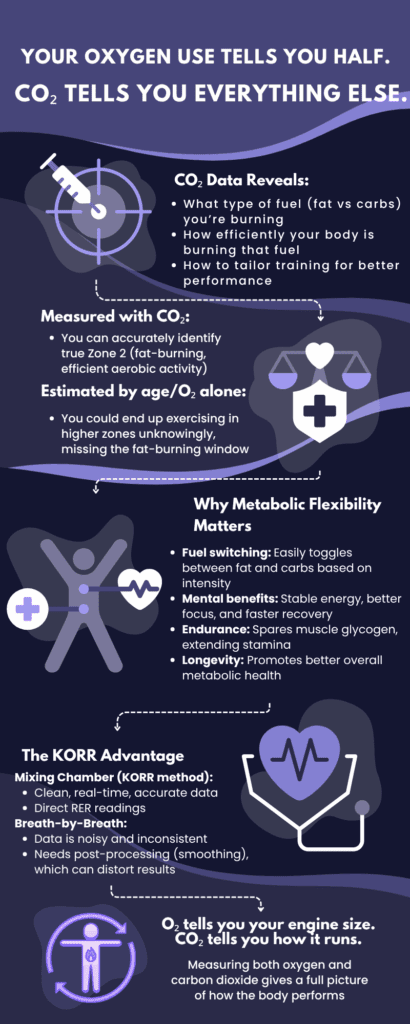
When you exercise, your body consumes oxygen and produces carbon dioxide as a byproduct of cellular respiration. This ratio of O2 intake to CO2 production is a direct indicator of which fuel source your body is using. Higher CO2 production indicates more carbohydrate burning, while lower CO2 production suggests more fat burning. This ratio between them reveals your metabolic efficiency.
Without measuring CO2, you’re flying blind when it comes to understanding your body’s fuel preferences, metabolic flexibility, and training zones. Imagine you’re training in what you think is your “fat-burning zone” based on incomplete oxygen-only data. You might actually be burning predominantly carbohydrates, which means you’re not optimizing fat oxidation, your training zones are inaccurate, and you’re missing opportunities to improve metabolic efficiency.
This is why comprehensive VO2 max testing—measuring both oxygen consumption AND carbon dioxide production is essential for anyone serious about performance optimization. The data from CO2 measurement changes how you should approach training and performance development.
The Science Behind CO2
To understand why CO2 measurement is so crucial, let’s dive into the science, but we’ll keep it applicable to your training goals.
Respiratory Exchange Ratio
The Respiratory Exchange Ratio (RER) is calculated by dividing the volume of CO2 produced by the volume of O2 consumed during exercise. This ratio reveals profound insights about your metabolism that oxygen-only testing can’t provide.
An RER of 0.70 indicates that fat is the predominant fuel source —your body is maximizing fat oxidation and operating at peak efficiency. At 0.85, you’re using a mixed fuel approach, which represents the top of the optimal endurance training zone. When RER reaches 1.00, carbohydrates become the dominant fuel, indicating high-intensity effort where energy demands are rapidly increasing. Values above 1.00 suggest significant anaerobic contribution, where lactate accumulation and buffering lead to excess CO2 production, indicating unsustainable intensity levels.
The Metabolic Crossover Point
As exercise intensity increases, your body gradually shifts from burning primarily fat to burning mainly carbohydrates. This transition point called the metabolic crossover is best identified through O2 and CO2 measurement.
The crossover point usually occurs around your Zone 2 training threshold, the intensity where you’re maximizing fat oxidation while maintaining aerobic efficiency. Training just below this point builds your aerobic base, improves fat oxidation capacity, and enhances metabolic flexibility. This is why Zone 2 training has become so popular among endurance athletes and health-conscious individuals.
Consider this real-world example: Two athletes with identical VO2 max values might have completely different metabolic profiles. Athlete A might be an efficient fat burner who can maintain fat oxidation at higher intensities, while Athlete B might be carb-dependent with early crossover to glucose metabolism. Without CO2 data, these athletes may receive identical training recommendations. With CO2 measurement, we discover that Athlete A can train at higher intensities while remaining aerobic, while Athlete B needs more base-building work to improve fat oxidation capacity.
How CO2 Data Transforms Your Training
Understanding your CO2 production patterns changes how you should approach training and performance optimization.
Precision Zone 2 Training
Zone 2 training has gained massive popularity because it improves mitochondrial function, enhances fat oxidation capacity, builds aerobic base for all other training zones, and supports metabolic health and longevity. But here’s the catch: If accuracy matters to you, then the best way to determine yourZone 2 heart rate range is through a VO2 max test that measures CO2.
Generic heart rate formulas might put you in Zone 3 or Zone 4 when you think you’re in Zone 2, completely defeating the purpose of this crucial training methodology. When you’re truly in Zone 2, your body is maximizing fat oxidation while maintaining steady-state aerobic metabolism. For this information, it’s crucial to have accurate RER data.
The beauty of proper Zone 2 training extends beyond just Zone 2 itself. A strong aerobic base built through accurate Zone 2 training enhances your performance in all other zones. Zone 1 recovery becomes more effective, Zone 3 tempo efforts become more sustainable, Zone 4 threshold work improves, and Zone 5 neuromuscular power benefits from better recovery between efforts.
Metabolic Flexibility Assessment
CO2 measurement helps to reveal your metabolic flexibility, your body’s ability to switch between fuel sources efficiently. This concept has profound implications for endurance athletes who need to preserve glycogen stores during long efforts, general fitness enthusiasts who want to optimize fat loss and metabolic health, and tactical athletes who require sustained energy across varied intensities.
When your metabolic flexibility is optimized, you can access fat stores more readily during lower-intensity efforts, preserve precious glycogen for when you need it, recover more quickly between high-intensity efforts, and maintain steady energy levels throughout the day.
Training Zone Optimization Through Data
With complete O2 and CO2 data, you can optimize all your training zones with precision. Zone 1 recovery efforts can be calibrated to make sure you’re recovering with minimal metabolic stress. Zone 2 aerobic base training can maximize fat oxidation and aerobic development. Zone 3 tempo work can help you find the sweet spot between aerobic and anaerobic metabolism. Zone 4 threshold training can target your metabolic crossover point. Zone 5 neuromuscular efforts can develop maximal power and speed.
This level of precision transforms training from guesswork to science. Instead of following generic protocols, you’re following your body’s physiological responses.
The KORR Advantage: Complete Metabolic Assessment
While many competitors focus on oxygen measurement alone, KORR’s mixing chamber technology provides the complete metabolic picture by measuring O2 consumption and CO2 production together.
Why Mixing Chamber Technology Matters
KORR’s mixing chamber technology offers several advantages over breath-by-breath systems used by many competitors. The mixing chamber approach eliminates the noise and fluctuations common in breath-by-breath systems, providing stable, reliable measurements across all exercise intensities while reducing environmental interference that can skew results.
Breath-by-breath systems produce noisy data that requires extensive algorithmic smoothing to interpret. This processing can introduce errors and mask important metabolic transitions. In contrast, mixing chamber technology provides cleaner data that reveals metabolic patterns without artificial smoothing or interpretation.
The mixing chamber approach also enables O2 and CO2 measurement with clinical-grade accuracy. This means you get real-time RER calculation, precise metabolic crossover identification, and detailed fuel utilization analysis that simply isn’t possible with systems that prioritize oxygen measurement alone.
What Complete CO2 Measurement Provides
When you choose KORR’s testing approach, you receive precise heart rate zones based on your metabolic responses rather than generic formulas. You get fat burn optimization data that identifies where you burn fat most efficiently. You receive a metabolic flexibility assessment that reveals your body’s fuel utilization patterns. You obtain data that helps structure your training phases effectively. You gain performance prediction insights that reveal your potential for different types of athletic performance.
This approach transforms VO2 max testing from a fitness assessment into a complete metabolic profile that guides every aspect of your training strategy.
From Data to Performance
Understanding the theory is one thing—applying it practically is where the magic happens. Here’s how CO2 data translates into real-world performance improvements across different populations and goals.
For Endurance Athletes
Consider a marathon runner who discovers through CO2 analysis that their “easy” training pace has been above their most effective fat oxidation zone. This revelation completely transforms their training approach. By adjusting their easy run pace to stay in true Zone 2, they improve fat oxidation capacity over 8-12 weeks, reduce carbohydrate dependence during long runs, and enhance race-day performance and recovery.
The implications extend beyond just pacing. Understanding metabolic crossover points helps with race strategy, fueling protocols, and training periodization. An athlete might discover they can maintain fat oxidation at higher intensities than expected, allowing for more aggressive race pacing. Conversely, they might learn they need more aerobic base development before pursuing high-intensity training.
For Fitness Enthusiasts
A fitness enthusiast wanting to optimize body composition might discover through CO2 analysis that their “fat-burning” workouts are actually too intense to maximize fat oxidation. This insight leads to establishing true fat-burning heart rate zones, restructuring workout intensity distribution, improving metabolic flexibility through targeted training, and achieving better body composition results.
The metabolic flexibility component is important for general fitness goals. Many people struggle with energy crashes, difficulty losing weight, or poor recovery between workouts. CO2 data helps reveal whether these issues stem from metabolic inflexibility—an inability to efficiently switch between fuel sources.
For Military & First Responders
Military personnel and first responders face unique demands that require sustained energy across varied intensities. CO2 analysis might reveal metabolic inefficiencies that impact operational readiness. This data helps develop metabolic flexibility for mission demands, optimize fueling strategies for different scenarios and enhance readiness.
The unpredictable nature of tactical operations means these individuals need metabolic flexibility. They might need to perform sustained low-intensity movement followed by explosive high-intensity efforts, all while maintaining cognitive function and decision-making capability.
For Health Optimization
Health-conscious individuals use CO2 data to improve metabolic health markers. This might involve enhancing insulin sensitivity through precisely calibrated Zone 2 training, improving mitochondrial function and energy production, optimizing metabolic health biomarkers, and supporting longevity and healthspan goals.
The connection between metabolic flexibility and health reaches beyond athletic performance. Research suggests that metabolic flexibility is associated with better insulin sensitivity, improved cardiovascular health, enhanced cognitive function, and healthy aging.
Why Testers Choose Complete Assessment
As a fitness professional, coach, or healthcare provider, providing incomplete metabolic data does a disservice to your clients. Medical professionals and exercise physiologists understand that metabolic assessment requires both sides of the equation.
Clinical Accuracy and Professional Standards
CO2 measurement provides improved accuracy for investigating metabolic disorders, treatment monitoring for metabolic conditions, performance optimization for athletes and patients, and research validity for clinical studies. This level of precision is essential for professionals who need to make evidence-based recommendations.
The clinical implications of incomplete testing extend beyond just training recommendations. Understanding metabolic efficiency can help identify early signs of metabolic dysfunction, monitor treatment effectiveness for metabolic conditions, and provide objective measures of health improvement.
Client Value and Outcomes
When clients invest in VO2 max testing, they deserve complete information. CO2 data provides actionable insights for training modification, personalized recommendations based on individual physiology, progress tracking beyond simple VO2 max improvements, and competitive advantage through optimized training zones. The value proposition is clear: clients receive more precise and personalized information that translates to better outcomes.
Professional Differentiation
Offering complete metabolic assessment sets you apart from competitors who provide oxygen-only testing. This differentiation leads to higher value from comprehensive data, better client outcomes through precise recommendations, professional credibility through scientific accuracy, and referral generation from better results.
Complete Testing for Complete Results
In the world of VO2 max testing, oxygen consumption tells you about your cardiovascular capacity, but CO2 production reveals how well you’re using that capacity. Together, they provide the complete metabolic picture necessary for optimizing performance and training effectiveness.
The difference between oxygen-only testing and complete metabolic assessment is the difference between knowing your engine’s horsepower and understanding how well that engine uses fuel at different operating levels. Both pieces of information are crucial, but only one tells you how to optimize performance in real-world conditions.
Why This Matters for Your Goals
Whether you’re an elite athlete chasing podium finishes, a fitness enthusiast optimizing health, or a professional providing testing services, CO2 measurement transforms training precision from guesswork to science, performance outcomes from good to exceptional, health optimization from general to personalized, and professional services from basic to comprehensive.
The metabolic insights provided by CO2 measurement enhance your understanding and change your approach to training, nutrition, recovery, and performance optimization. This is the difference between following generic protocols and following your body’s physiological responses.
Ready to Experience Complete VO2 Max Testing?
Don’t settle for half the story. Discover how KORR’s metabolic assessment—measuring both O2 consumption and CO2 production—can transform your training approach and unlock your performance potential.
Experience the difference that complete metabolic data makes. Your body produces both oxygen consumption and carbon dioxide production during exercise—shouldn’t your testing measure both?
Understanding your complete metabolic profile isn’t just about having more data—it’s about having the right data to make informed decisions about your training, health, and performance goals. The question isn’t whether you need VO2 max testing, but whether you need complete VO2 max testing that includes the metabolic insights only CO2 measurement can provide.
Contact us today to find a KORR testing location near you and discover what you’ve been missing with oxygen-only testing.