



You’ve pushed through the final stages of a graded exercise test, breathing hard, legs burning, and then you see it: the notification that your anaerobic threshold has been flagged. That single data point tells you exactly where your body shifts from sustainable aerobic effort to high-intensity anaerobic work. But what if that notification never appears? Understanding how anaerobic threshold (AT) detection works—and why it sometimes doesn’t—can transform how you approach testing and training.
What is Anaerobic Threshold?
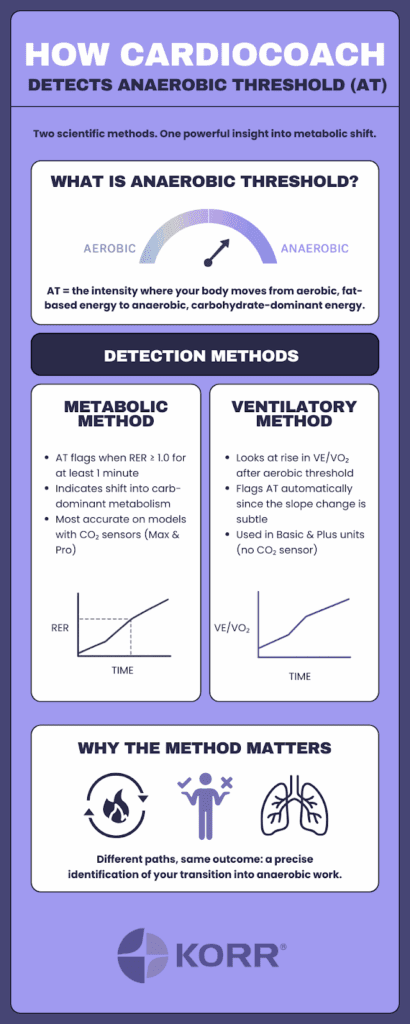
Anaerobic threshold marks the exercise intensity at which your body transitions from primarily aerobic metabolism to increased reliance on anaerobic energy production. Below this point, your body efficiently clears lactate and relies heavily on fat for fuel. Above it, lactate accumulates faster than it can be processed, and carbohydrate metabolism dominates.
Knowing your exact AT allows you to train smarter. It defines the upper boundary of your sustainable endurance pace and serves as the foundation for establishing personalized heart rate training zones. When Zone 2 training has become so central to endurance development, understanding where AT sits relative to your aerobic capacity helps you calibrate your efforts, recovery, and base-building work.
How CardioCoach Detects Anaerobic Threshold
CardioCoach uses two main methods to detect AT during a graded exercise test. The method you use depends on your equipment model and testing preferences.
Metabolic Method
The metabolic method flags AT when your Respiratory Exchange Ratio (RER) reaches or exceeds 1.0 and remains at or above that level for at least one full minute. RER compares the amount of carbon dioxide you produce to the oxygen you consume. When RER hits 1.0, it indicates you’ve crossed into predominantly carbohydrate metabolism—a reliable marker of anaerobic threshold.
The one-minute sustained requirement helps ensure the reading reflects a true physiological shift rather than a brief fluctuation or breathing artifact. If RER dips below 1.0 at any point during that minute, the counter resets.
Ventilatory Method
The ventilatory method uses the ventilatory equivalents graph (VE/VO₂ vs. Time) to identify AT. With this approach, AT is flagged when the VE/VO₂ slope continues to rise consistently after the aerobic threshold (AeT) has been crossed. This pattern signals a shift toward anaerobic energy production and an increased ventilatory drive to expel excess CO₂.
When using the ventilatory method, an “AT detected” pop-up appears on screen because this threshold isn’t as visually obvious as watching RER climb above 1.0.
For CardioCoach Max and Pro models, you can select your preferred detection method in Settings under Thresholds. Basic and Plus units use only ventilatory detection since they lack the CO₂ sensor required for RER calculation.
Requirements for Valid AT Detection
Regardless of which method you use, AT detection requires a properly executed graded exercise protocol. The following conditions must be met:
- Continuously increasing level of exertion throughout the test
- A starting intensity well below AT and a final intensity well above AT
- Test duration between 6 and 24 minutes
- Ventilation of at least 900 ml/kg/minute at the time of detection
These requirements make sure the body has adequate time to progress through distinct metabolic phases while maintaining a clear trajectory toward maximal effort.
Why AT Might Not Be Reached
When a client completes a VO₂ test without AT being flagged, several factors could be responsible.
Submaximal effort is the most common culprit. Clients may stop due to discomfort, unfamiliarity with pushing to true exhaustion, or lack of motivation. Without reaching the necessary intensity, the metabolic shift simply won’t occur.
Medications can also interfere. Beta-blockers and other medications that blunt heart rate or exertion response may prevent clients from reaching the intensity required to cross AT, even with full effort.
Low fitness levels sometimes limit the ability to sustain effort long enough to reach threshold. In these cases, fatigue may force test termination before AT occurs.
Protocol issues matter as well. Workload increases that are too gradual can extend the test beyond optimal duration, while increases that are too aggressive can cause premature fatigue before AT is reached.
Highly trained individuals present a unique challenge. Their AT may occur at a very high percentage of VO₂ max, requiring near-maximal effort to detect. If the test ends just slightly before true max, AT may not be flagged.
Tips to Improve AT Detection
A few practical strategies can increase your success rate with AT detection.
Monitor the data table near the end of the test. Keeping it visible allows you to confirm that RER stays above 1.0 for a full minute and that VO₂ is still trending upward or holding steady. This real-time awareness helps you know when to encourage a final push.
Target RER beyond 1.0. While the software flags AT at an RER of 1.0, most individuals reach true VO₂ max at an RER of 1.1 or higher. If it’s safe and the client is capable, encouraging them to push just a bit longer helps ensure AT is captured clearly.
Time your mask removal carefully. It’s generally fine to remove the mask once recovery begins, but first reduce the equipment workload, click to start recovery, and mark the effort in the software. Then remove the mask. This sequence keeps your test data complete and clean.
Consider a familiarization session for first-time testers. Anxiety and unfamiliarity can limit performance. A practice session reduces these barriers and can result in better data on the actual test day.
Screen for interfering medications before testing. Knowing about beta-blockers or similar medications ahead of time helps you set appropriate expectations and consider alternative zone calculation methods if needed.
What to Do if AT Isn’t Reached
When AT doesn’t flag, you still have options. You can repeat the test with better preparation, seeing that the client understands the goal, is properly motivated, and follows an appropriate protocol.
Alternatively, you can use a different method to calculate training zones. On the individual test screen, click “Edit Zone Method” and select an approach that doesn’t rely on AT:
- %VO₂ Max
- %HR Max
- Manual Selection
These options still generate personalized heart rate zones for your client, so they walk away with actionable training data even when AT detection wasn’t achieved.
Frequently Asked Questions
What’s the difference between metabolic and ventilatory AT detection?
The metabolic method relies on RER reaching 1.0 or higher for at least one minute, directly measuring the shift in fuel utilization. The ventilatory method tracks the relationship between breathing volume and oxygen uptake, flagging AT when the VE/VO₂ ratio shows a sustained rise after the aerobic threshold. Both identify the same physiological transition but use different markers to detect it.
What should I do if my client doesn’t reach AT?
First, determine the likely cause – was it effort, protocol, medications, or fitness level? Then either repeat the test with adjustments or use an alternative zone calculation method (%VO₂ Max, %HR Max, or Manual Selection) to generate useful training data from the test you completed.
How long does AT need to be sustained to be flagged?
When using the metabolic method, RER must remain at or above 1.0 for at least one full minute. This requirement filters out brief fluctuations and ensures the flagged point shows a true metabolic shift. If RER drops below 1.0 during that minute, the timer resets.
Can medications affect AT detection?
Yes. Beta-blockers and other medications that limit heart rate or dampen exertion response can prevent clients from reaching the intensity required to cross AT. If you know a client takes these medications, screen for this before testing and consider whether alternative zone calculation methods may be necessary.
Precision matters when it comes to training at the right intensity. Knowing exactly where your anaerobic threshold sits rather than estimating based on age or generic formulas allows you to train in the zones that drive adaptation.
Discover how precision VO₂ testing with CardioCoach can help you identify your exact training thresholds and build training zones based on your unique physiology.