



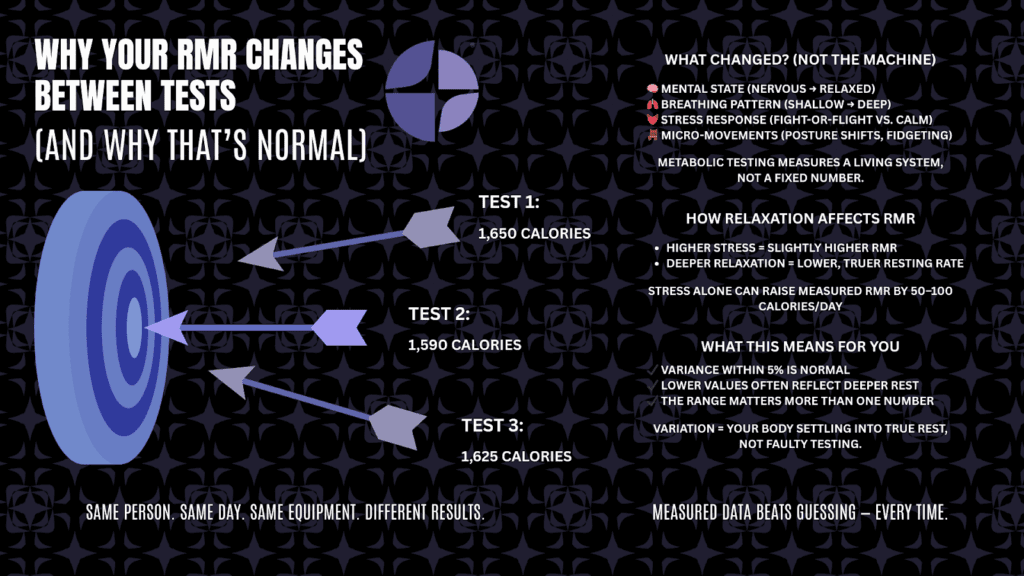
You settle into the chair for your resting metabolic rate test, breathe normally for 10 minutes, and receive your result: 1,650 calories per day. Curious about consistency, you take a second test immediately afterward. This time: 1,590 calories. A third test yields 1,625. Three consecutive tests, three different numbers. Before you question the accuracy of metabolic testing altogether, understand this: variance between tests is completely normal and reveals something important about how your body responds to testing conditions.
The Reality of Multiple Measurements
Let’s examine what happens when you conduct three consecutive RMR tests under identical conditions. You haven’t eaten differently, your body composition hasn’t changed, and the equipment hasn’t malfunctioned. Yet the results vary by 60 calories or more between tests.
Test one might show 1,650 calories. You were slightly nervous, your breathing was a bit shallow as you adjusted to the mouthpiece and nose clip. Your mind wandered to your afternoon schedule, creating subtle tension you didn’t consciously notice.
Test two yields 1,590 calories. You’ve settled in now, more comfortable with the equipment and the process. Your breathing deepened naturally as you relaxed. Your mind quieted. Your body approached true rest.
Test three measures 1,625 calories. You’re completely comfortable but maybe slightly bored. Your attention drifted and you shifted position slightly. These tiny movements and mental engagement elevated your metabolic rate just enough to register.
Why Variance Occurs: The Human Factor
Metabolic testing measures a biological system influenced by countless variables, many of which change from moment to moment. Understanding these factors helps you interpret your results with appropriate context.
Relaxation Levels
True resting metabolic rate requires genuine physical and mental rest. Achieving this state proves harder than it sounds. Even sitting quietly, your mind might race with thoughts, your muscles might hold subtle tension, or you might feel self-conscious about the testing process itself.
Stress activates your sympathetic nervous system, the fight-or-flight response that elevates heart rate, breathing rate, and metabolic rate. You don’t need to feel panicked for this activation to occur. Simple awareness that you’re being measured can trigger enough arousal to increase your metabolic rate by 50 to 100 calories per day.
As you become more comfortable during subsequent tests, your body settles into deeper rest. Your heart rate drops slightly, your breathing becomes more efficient, and your measured metabolic rate decreases. This isn’t measurement error, it’s your body achieving a more restful state.
Breathing Patterns
Breathing mechanics directly affect metabolic measurements because the test calculates caloric burn from oxygen consumption. Shallow, rapid breathing moves air quickly through your lungs but may not facilitate optimal oxygen exchange. Deep, slow breathing maximizes oxygen uptake per breath.
Most people breathe somewhat artificially when first connected to testing equipment. The mouthpiece feels foreign, the nose clip creates awareness of breathing, and conscious attention disrupts your natural rhythm. Over several minutes, as novelty fades, your breathing pattern typically normalizes.
Variations in breathing depth and rate between tests can account for 30 to 60 calories of difference in measured RMR. Neither pattern is wrong, they simply represent different moments in your body’s adaptation to the testing setup.
Anxiety and Mental State
Your mental state during testing influences results more than you might expect. Anxiety increases cortisol and adrenaline, hormones that mobilize energy and elevate metabolic rate. This response evolved to prepare your body for action, but it also means that nervousness during testing can artificially inflate your measured RMR.
Conversely, deep relaxation or near-sleep states can slightly suppress metabolic rate below your typical resting level. The ideal testing state falls between these extremes: awake and alert but genuinely relaxed, neither anxious nor drowsy.
Achieving this state consistently proves challenging, especially during initial testing experiences. Most people find their results become more consistent as they grow familiar with the process and equipment.
The Precision Advantage
Understanding test variance becomes more meaningful when you consider the alternative: predictive equations. Generic formulas like Harris-Benedict estimate your RMR based on age, sex, height, and weight, with typical accuracy ranging from 10 to 30% variance from your actual metabolic rate.
This means a predictive equation might estimate your RMR as 1,600 calories when your true rate is anywhere from 1,120 to 2,080 calories. That 960-calorie range makes precise nutrition planning impossible.
KORR’s metabolic analyzer maintains accuracy within ±3% of your true metabolic rate under proper testing conditions. Even accounting for test-to-test variance from biological factors, your measured RMR falls within a much narrower range than any formula-based estimate.
Consider our earlier example where three consecutive tests yielded 1,650, 1,590, and 1,625 calories. The 60-calorie spread represents approximately 3.7% variance from the middle value. This precision far exceeds what predictive equations offer, even with the natural biological variation between tests.
Interpreting Your Results
When you receive multiple test results with slight variations, several strategies help you interpret and apply the data effectively.
Use the Most Relaxed Test
If you conduct multiple tests in one session, the lowest value typically represents your truest resting state, assuming you didn’t fall asleep or become unusually lethargic. This result captures your metabolism when your body achieved its deepest rest during testing.
Average Multiple Tests
If variance between tests remains modest (within 5%), averaging the results provides a reliable middle ground. Three tests showing 1,590, 1,625, and 1,650 calories average to 1,622. This approach smooths out momentary fluctuations while respecting that all measurements contain valid information.
Consider the Context
If you tested while unusually stressed, tired, or recently caffeinated despite preparation instructions, the results may not represent your typical resting state. Retesting on a different day under better conditions often provides more representative results.
Focus on the Range
Rather than fixating on a single precise number, recognize that your resting metabolic rate occupies a narrow range. Whether your RMR is 1,590 or 1,650, your nutrition planning changes minimally. Both values place you in the same general caloric target zone for weight management.
The Bigger Picture: Precision Versus Perfection
Metabolic testing provides remarkable precision compared to estimation methods, but it measures a dynamic biological system, not a fixed constant. Your metabolic rate fluctuates slightly throughout the day based on stress, activity, food intake, hydration, and countless other factors.
The goal of RMR testing isn’t to capture one perfect unchanging number. It’s to establish your metabolic baseline with far greater accuracy than formulas allow, then use that information to set realistic nutrition targets.
Even with 60 calories of variance between tests, you gain invaluable insight into your actual metabolic rate. You discover whether your metabolism runs fast, slow, or average compared to predictions. You learn your true caloric needs rather than relying on population averages that may not reflect your physiology.
Frequently Asked Questions
Is it normal to get different RMR values in the same session?
Yes, completely normal. Variations of 50 to 100 calories between consecutive tests reflect natural changes in relaxation level, breathing patterns, and mental state. Your body isn’t a machine producing identical outputs, it’s a living system responding to subtle internal and external factors.
Which result should I use?
If tests vary within 5%, use the average. If one test seems like a clear outlier due to coughing, movement, or unusual circumstances, exclude it and average the remaining tests. Generally, the lowest value from quality tests represents your truest resting state.
How accurate is The Reevue compared to equations?
The Reevue maintains ±3% accuracy under proper testing conditions, while predictive equations show 10 to 30% variance from actual metabolic rate. This means measured RMR provides roughly 3 to 10 times better precision than formula-based estimates.
Should I average multiple tests?
Averaging works well when tests show modest variation within 5%. If results vary more widely, consider which test best represented true rest and use that value, or retest on another day when you can achieve more consistent relaxation.
Move Beyond Guesswork
Small variations between tests don’t diminish the value of metabolic measurement. Even with natural biological variance, RMR testing reveals your actual caloric needs with precision no formula can match. The difference between 1,590 and 1,650 calories matters far less than the difference between measured data and generic estimates that could be off by hundreds of calories.
Trust measured data over estimates. Schedule your RMR test today with a KORR provider and discover your true metabolic rate. Whether you’re planning weight loss, optimizing athletic nutrition, or simply curious about your metabolism, tested data provides the foundation for informed decisions about your health.