


You’re a dedicated trainer who takes pride in delivering results for your clients. But lately, you’ve been facing a familiar challenge: Sam, one of your most committed clients, has been following his training plan religiously for months, yet his endurance gains have stalled. He’s frustrated, and honestly, so are you. You know he’s capable of more, but the generic heart rate zones you’ve been using just aren’t cutting it anymore.
Sound familiar? As a fitness professional, you’ve likely encountered this scenario more times than you’d care to count. You understand that effective training requires personalized data, not cookie-cutter formulas. The question is: which metabolic test will give you and your clients the insights needed to break through plateaus and achieve breakthrough results?
This is where the science of metabolic testing becomes your most powerful tool. When you can pinpoint exactly where your client’s body transitions between energy systems, identify their fat-burning zones, and determine their cardiovascular capacity, you transform from a good trainer into an exceptional one. But here’s the critical decision you face: submaximal testing or VO2 Max testing?
Both approaches promise to assess cardiovascular fitness, but they deliver very different levels of insight and accuracy. For trainers who are serious about providing evidence-based, individualized programming, understanding these differences is essential for your professional credibility and your clients’ success.
What is Submaximal Testing?
Submaximal testing is what it sounds like—a cardiovascular assessment that doesn’t push your clients to their absolute limits. Instead of requiring maximum effort, this approach evaluates fitness by measuring how your client’s heart rate responds to progressively increasing, but moderate, exercise intensities.
How Submaximal Testing Works
The premise is straightforward: submaximal tests measure your client’s heart rate response at various workloads below their maximum capacity, then use predictive equations to estimate their VO2 Max and other fitness markers. Think of it as taking a sample of data and extrapolating to predict the full picture.
During a typical submaximal test, your client might start walking on a treadmill at a comfortable pace. The intensity gradually increases through predetermined stages—maybe increasing speed or incline every few minutes—while their heart rate is continuously monitored. The test continues until they reach a target heart rate (usually around 85% of their age-predicted maximum) or complete the predetermined protocol stages.
The key here is that your client never reaches the point of exhaustion or maximum effort. Instead, mathematical formulas analyze the relationship between their heart rate and the exercise intensity to predict what their maximum values would be.
Common Submaximal Protocols
Several standardized protocols are widely used in fitness settings:
Step Tests: Your client steps up and down on a platform at a specific cadence for a set duration, with heart rate measured during and after the activity.
Bike Ergometer Tests: Using a stationary bike, resistance increases in stages while monitoring heart rate response at each level.
Walking/Running Tests: Treadmill protocols that gradually increase speed or incline without pushing to maximum effort.
Who Usually Uses This Approach?
Submaximal testing appeals to trainers and facilities for several practical reasons. It’s less intimidating for clients who may be apprehensive about pushing themselves to complete exhaustion. Many general fitness facilities and corporate wellness programs choose this approach because it requires less specialized equipment and supervision compared to maximal testing.
You’ll see submaximal testing used often with older adults, individuals with certain health conditions, or clients who are new to fitness testing. It’s also popular in large-scale fitness assessments where time efficiency is a priority over precision.
As a trainer focused on delivering optimal results, it’s important to understand that this convenience comes with limitations in the accuracy and depth of information you’ll receive—factors that directly impact your ability to create personalized training programs.
What is VO2 Max Testing?
While submaximal testing relies on predictions and estimations, VO2 Max testing takes a different approach—one that provides direct, real-time measurement of your client’s cardiovascular performance. This is where precision meets practicality for trainers who look for accurate data.
The Gold Standard: Mixing Chamber Technology
True VO2 Max testing utilizes mixing chamber technology, which is the gold standard in metabolic measurement. Unlike breath-by-breath systems that can produce noisy, inconsistent data, mixing chamber technology collects and analyzes all expired air in a controlled environment. This approach delivers the most accurate and reliable results available, giving you confidence in the data you’re using to design your client’s training program.
The mixing chamber system automatically calibrates in just 90 seconds—no syringes, no gas tanks, no complicated setup procedures that eat into your valuable training time. You simply turn on the device, and it’s ready to deliver clinical-level accuracy.
Direct Measurement vs. Guesswork
Here’s where VO2 Max testing differs from submaximal approaches: instead of using mathematical formulas to estimate what might be happening in your client’s body, you’re measuring exactly what is happening. Your client exercises to their maximum capacity while wearing a mask that captures every breath. The system analyzes oxygen consumption and carbon dioxide production in real-time, providing direct measurement of their cardiovascular system’s actual performance.
This maximal effort approach reveals critical physiological markers that no prediction formula can accurately estimate because every individual’s cardiovascular response is unique.
The Treasure Trove of Training Data
A comprehensive VO2 Max test doesn’t just give you one number—it unlocks multiple performance markers:
VO2 Max: Your client’s peak oxygen uptake, indicating their maximum cardiovascular capacity and endurance potential.
Anaerobic Threshold: The precise point past which your client builds up lactate faster than it can be produced—vital for designing interval training and race strategies.
Fat Burn Zones: Real-time data showing when and at what heart rate your client burns fat most efficiently, eliminating guesswork from weight management programs.
Personalized Heart Rate Zones: Individual training zones based on physiological responses, not generic age-based formulas.
The Zone 2 Training Revolution
Zone 2 training has emerged as one of the most valuable training methods for improving all training zones. Zone 2 shows the highest intensity at which your client can maintain mostly aerobic metabolism—their peak fat-burning and aerobic base-building zone.
Zone 2 is best determined through VO2 Max testing. Generic formulas and fitness tracker estimations are educated guesses at best. When you know your client’s true Zone 2 heart rate, you can design training that enhances their aerobic engine, which in turn improves their performance in all other training zones—from recovery sessions to high-intensity intervals.
This is the difference between training your clients based on assumptions and training them based on their physiological blueprint.
Head-to-Head Comparison: The Numbers Don’t Lie
When you’re investing in metabolic testing for your clients, you need to understand what you’re getting for that investment. Let’s break down how these two approaches stack up where it matters most.
Accuracy & Precision: Direct vs. Estimated
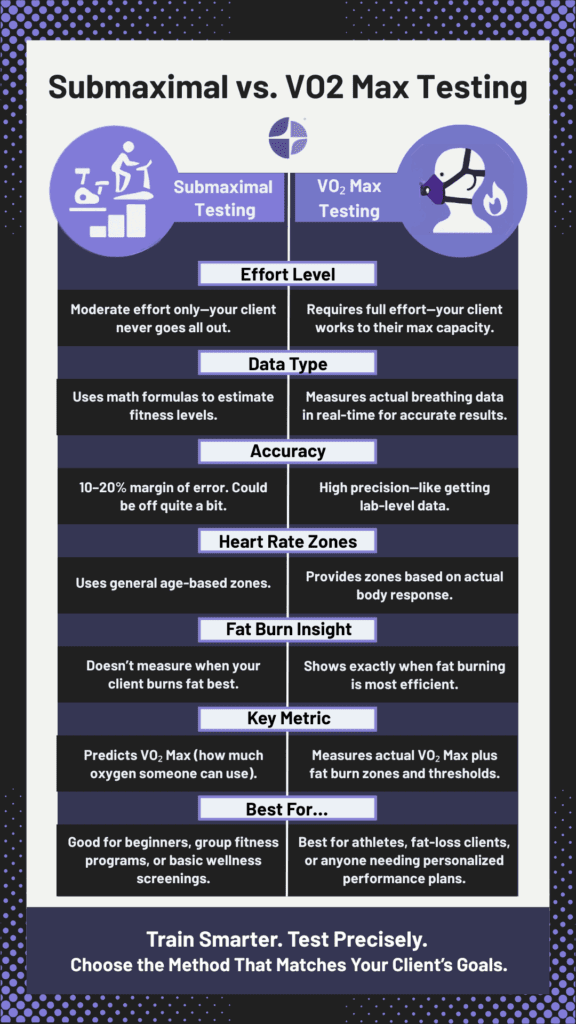
Submaximal Testing: Uses predictive equations with error margins that can range from 10-20%. Your client’s actual VO2 Max could be much higher or lower than the estimated value, which means the heart rate zones you’re prescribing might be completely off-target.
VO2 Max Testing: Provides direct measurement with clinical-level accuracy. The mixing chamber technology eliminates the guesswork entirely—you’re seeing exactly how your client’s cardiovascular system performs under stress, not what a formula thinks it should be doing.
Surface-Level Information vs. Complete Picture
Submaximal Testing gives you basic estimates—a predicted VO2 Max value and general heart rate zones based on age formulas. You’ll get a fitness level assessment, but you may miss key insights into the nuances of your client’s metabolic profile.
Testing Experience: Comfort vs. Commitment
Submaximal Testing offers a gentler experience. Your clients won’t be pushed to exhaustion, making it appealing for those who are anxious about maximal testing. The protocols take 15-20 minutes and feel more like a moderate workout than an assessment.
VO2 Max Testing requires your client to give maximum effort for 10-15 minutes. Yes, it’s challenging, but here’s what many trainers don’t realize: most motivated clients prefer knowing they’ve given their absolute best effort. They leave understanding their capabilities rather than wondering “what if I had pushed harder?”
Plus, with modern mixing chamber technology, setup is incredibly fast—you can go from device off to test complete in under 20 minutes.
Here’s the real test: what can you actually do with the data?
Submaximal Testing provides general fitness categories and broad heart rate ranges. You’ll know if your client is “above average” or “excellent” for their age group, and you can assign them to general training zones.
VO2 Max Testing transforms your programming capabilities entirely. You can:
- Design Zone 2 training sessions that target your client’s aerobic system
- Create interval workouts based on their anaerobic threshold
- Develop fat-loss programs using their precise fat-burning heart rate ranges
- Track meaningful improvements in specific physiological markers over time
- Explain to clients why they’re training at specific intensities
In short, submaximal testing tells you approximately where your client stands, while VO2 Max testing shows you exactly how to get them where they want to go.
Matching the Right Tool to Your Client’s Needs
As a trainer, you know that different clients have different needs, comfort levels, and goals. While VO2 Max testing delivers superior accuracy and insights, understanding when each approach makes sense will help you guide your clients to the right decision.
When Submaximal Testing Might Be Considered
The Hesitant Beginner: If you have a client who is anxious about physical exertion or has never been tested before, submaximal testing can serve as a stepping stone. It provides basic fitness information without the intimidation factor of maximal effort.
Large-Scale Assessments: Corporate wellness programs or fitness challenges involving dozens of participants might opt for submaximal testing because of time constraints and the need for basic fitness categorization rather than precision training data.
Specific Medical Limitations: Some clients with certain cardiac conditions or those in cardiac rehabilitation programs may be restricted from maximal testing by their physicians. In these cases, submaximal testing provides some fitness information while staying within medical guidelines.
Budget-Conscious Scenarios: Facilities operating on extremely tight budgets might choose submaximal testing as a starting point, though the limited data often makes this a poor long-term strategy.
When VO2 Max Testing is the Clear Choice
Here’s the reality: for the vast majority of your clients, VO2 Max testing delivers exponentially more value than submaximal alternatives.
Serious Athletes and Competitors: Anyone training for races, competitions, or peak performance needs the precision that only VO2 Max testing provides. Estimations aren’t sufficient when performance margins matter.
Weight Loss Focused Clients: If fat loss is the main goal, your clients need to know their fat-burning zones. Submaximal testing can’t provide this information—only VO2 Max testing reveals the precise heart rate ranges where fat oxidation is maximized.
Plateau Breakers: Clients who have hit training plateaus need detailed metabolic insights to break through. VO2 Max testing identifies where their current limitations are and how to overcome them.
Zone 2 Training Enthusiasts: Anyone interested in building their aerobic base or improving metabolic efficiency requires accurate Zone 2 identification—something only VO2 Max testing can provide.
Results-Driven Individuals: Clients who want measurable progress and are willing to invest in their health deserve the most accurate data possible. These are usually your best clients, and they expect professional-grade assessments.
The Professional Advantage
Choosing VO2 Max testing positions you as a serious professional who invests in the best tools available. When you can show clients their fat-burning zones, explain exactly why they’re training at specific heart rates, and track meaningful physiological improvements over time, you demonstrate a level of expertise that sets you apart from trainers relying on guesswork and formulas.
The investment in VO2 Max testing technology pays dividends through improved client results, higher retention rates, and the ability to charge premium rates for truly personalized service. In an industry where anyone can become a “trainer,” precision metabolic testing becomes your competitive advantage.
The Zone Training Connection
If you’ve been following the latest developments in exercise science, you’ve likely heard about the Zone 2 training revolution. But here’s what many trainers don’t understand: Zone 2 isn’t just another training intensity—it’s the foundation that makes all other training zones more effective.
Understanding the Complete Zone System
Before diving into Zone 2’s importance, let’s establish the complete picture. Heart rate training zones reflect the use of different energy systems and physiological responses:
Zone 1 (Active Recovery): Very light intensity for recovery and warm-up, primarily fat burning with minimal stress.
Zone 2 (Aerobic Base): The highest intensity where your client can maintain primarily aerobic metabolism—their optimal fat-burning and mitochondrial development zone.
Zone 3 (Aerobic Threshold): Moderate intensity where lactate begins to accumulate, transitioning between aerobic and anaerobic systems.
Zone 4 (Lactate Threshold): High intensity at or near anaerobic threshold, where lactate production equals lactate clearance.
Zone 5 (Neuromuscular Power): Maximum intensity efforts that develop peak power and speed.
Each zone serves a specific purpose, but Zone 2 acts as the engine that powers improvement in all others.
Why Zone 2 is the Game-Changer
Zone 2 training creates the aerobic foundation that enhances every aspect of your client’s fitness. When you improve their aerobic capacity through proper Zone 2 training, several things happen:
Enhanced Recovery Between High-Intensity Efforts: A stronger aerobic system clears lactate more efficiently, allowing your clients to perform better in Zone 4 and Zone 5 intervals and recover faster between efforts.
Improved Fat Oxidation: Zone 2 training teaches the body to burn fat more efficiently, sparing glycogen stores for when they’re needed during higher-intensity efforts.
Mitochondrial Development: This zone targets mitochondrial biogenesis, growing more of the cellular powerhouses that produce energy aerobically.
Metabolic Flexibility: Regular Zone 2 training improves your client’s ability to switch between fat and carbohydrate fuel sources based on demand.
Your clients can train harder in their high-intensity zones, recover faster, and maintain their pace longer during endurance efforts. Zone 2 helps to build the engine that makes everything else possible.
The Critical Accuracy Problem
Here’s where most training programs fail: determining Zone 2 requires precision that generic formulas can’t provide. Age-based heart rate calculations, fitness tracker estimates, and submaximal testing predictions can be off by 10-30 beats per minute or more.
Consider this scenario: Your client’s actual Zone 2 heart rate is 135 bpm, but generic formulas suggest 150 bpm. Training at 150 bpm pushes them into Zone 3, where lactate begins accumulating and the primary training adaptations change entirely. They’re not building their aerobic base—they’re inadvertently doing tempo or threshold work, missing the benefits Zone 2 provides.
The Compound Benefits of Precise Zone 2 Training
When you can accurately identify and train your client’s Zone 2, the benefits compound across their entire fitness program:
Sustainable Fat Loss: Training in true Zone 2 maximizes fat oxidation while remaining sustainable for longer durations, creating an ideal environment for body composition changes.
Enhanced Endurance Performance: A stronger aerobic base raises the ceiling for all other training intensities, allowing higher sustainable paces in races and competitions.
Improved Recovery: Better aerobic development accelerates recovery between training sessions and within interval workouts.
Metabolic Efficiency: Zone 2 training teaches the body to extract more energy from each oxygen molecule consumed, improving overall metabolic efficiency.
Reduced Injury Risk: The sustainable nature of proper Zone 2 training allows for higher training volumes without the stress and breakdown associated with excessive high-intensity work.
The Professional Impact
For trainers, understanding and implementing Zone 2 training gives you a competitive advantage. You can explain to clients why they’re training at specific heart rates, show them measurable improvements in their aerobic capacity over time, and design periodized programs that build their fitness foundation.
This level of precision and explanation builds client trust, demonstrates your expertise, and delivers results that keep clients engaged long-term. When clients understand the science behind their training and see the systematic improvements in their Zone 2 capacity, they become advocates for both the training method and your professional expertise. Zone 2 training is only as effective as the accuracy of Zone 2 identification. Without VO2 Max testing, you’re building programs on assumptions rather than physiological facts.
Elevate Your Training Practice with Precision
The choice between submaximal testing and VO2 Max testing helps you define your professional standard and your commitment to delivering exceptional results for your clients.
While submaximal testing might seem adequate for basic fitness evaluations, the reality is clear: in today’s competitive fitness landscape, your clients deserve more than estimations and educated guesses. They deserve the precision that only mixing chamber VO2 Max testing can provide. When you can identify their exact fat-burning zones, pinpoint their true Zone 2 heart rate, and design training programs based on their unique physiological blueprint, you transform from a good trainer into an indispensable performance partner.
Think about your most committed clients—the ones who invest their time, energy, and trust in your expertise. They’re not looking for generic programming based on age-old formulas. They want measurable results, scientific precision, and the confidence that every training session is made for them. VO2 Max testing gives you the tools to deliver.
The trainers who thrive in today’s market are those who embrace cutting-edge technology and evidence-based methods. They understand that precision metabolic testing is essential for delivering the kind of transformative results that build lasting client relationships and referral-based businesses.
Your Gateway to Metabolic Excellence
KORR’s mixing chamber technology is the standard in metabolic testing, trusted by performance professionals who demand accuracy and reliability. Our CardioCoach systems don’t just measure VO2 Max—they unlock the complete metabolic profile that allows you to design personalized training programs.
With auto-calibration in just 90 seconds, intuitive operation that requires no specialized certification, and the most accurate metabolic data available, KORR technology integrates seamlessly into your practice while elevating your professional capabilities.
Ready to transform your training practice and deliver the precise results your clients are seeking?
Discover how KORR’s VO2 Max testing technology can become your competitive advantage. Contact our team today to learn about our CardioCoach systems, schedule a demonstration, and take the first step toward offering your clients the most advanced metabolic testing available. Because when you invest in precision, your clients invest in results—and that’s a partnership that builds successful careers and transforms lives.