



When you invest in VO₂ Max testing equipment, you’re making a commitment to precision. But here’s what many fitness professionals discover too late: the accuracy of your test results depends on the cardio equipment you pair with your metabolic analyzer. A high-quality VO₂ testing system like the CardioCoach can deliver incredible insights, but only when connected to the right bike or treadmill. Let’s explore what you need to know about equipment selection to ensure your clients receive the most accurate, reliable data possible.
Why Equipment Choice Matters for Test Accuracy
VO₂ Max testing measures your body’s maximum oxygen consumption during intense exercise. To get meaningful results, the test must follow a graded protocol where workload increases systematically. This is where your choice of cardio equipment becomes critical.
Traditional exercise bikes use resistance levels, which create inconsistent workload from person to person. A resistance level of “10” challenges a 150-pound cyclist differently than a 200-pound athlete. This variability makes it impossible to standardize testing protocols or compare results across different clients.
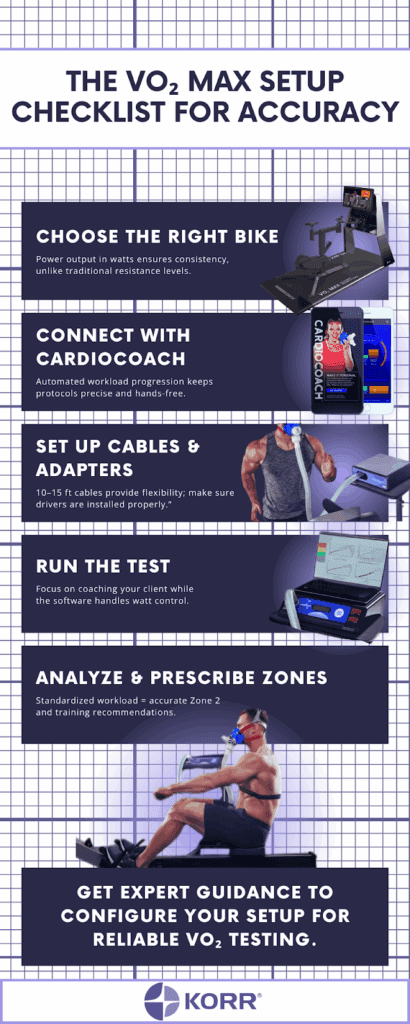
Professional-grade bike ergometers solve this problem by measuring power output in watts. When you program a test at 150 watts, every client works against precisely 150 watts regardless of their size, strength, or pedaling style. This standardization is essential for accurate VO₂ Max assessment and meaningful progress tracking over time.
Understanding ANT+ Connectivity
The CardioCoach connects directly to compatible bike ergometers through ANT+ wireless technology or wired RS232 connections. This integration allows the software to control workload automatically during testing, adjusting watts at predetermined intervals based on your chosen protocol.
ANT+ is a wireless communication protocol specifically designed for fitness equipment. When your bike ergometer has ANT+ capability, it can send real-time data about power output, cadence, and heart rate directly to the CardioCoach software. More importantly, the software can send commands back to the bike, telling it exactly what wattage to maintain at each stage of the test.
This automated control eliminates manual adjustments and ensures protocols run exactly as designed. Your role shifts from managing equipment to coaching your client through the test, monitoring their form, and providing encouragement when they need it most.
Recommended Bike Ergometers
Lode Corival CPET
The Lode Corival CPET is the standard in clinical exercise testing. With a price point around $7,000, this medical-grade ergometer delivers pharmaceutical-level precision in workload control. Research facilities and high-performance training centers favor the Corival for its exceptional accuracy and durability.
The Corival excels in clinical settings where precise metabolic data guides treatment decisions. Its electromagnetic braking system maintains exact wattages regardless of pedaling cadence, making it ideal for testing populations with varying fitness levels. While the investment is substantial, facilities conducting high-volume testing or working with elite athletes find the Corival’s reliability justifies the cost.
Wattbike Atom
At approximately $3,000, the Wattbike Atom offers an excellent balance of accuracy, connectivity, and value. Originally designed for serious cyclists and training facilities, the Atom provides precise power measurement and seamless integration with the CardioCoach software.
The Atom’s electromagnetic resistance system delivers smooth, accurate wattage control throughout your testing protocol. Its compact design makes it practical for smaller facilities, while its robust build quality ensures years of reliable service. Many personal trainers and boutique fitness studios choose the Atom as their go-to testing platform.
Wahoo KICKR
The Wahoo KICKR, priced around $4,000, brings professional-grade power accuracy to VO₂ testing. Wahoo built its reputation in the cycling world, and that expertise translates directly to metabolic testing applications. The KICKR’s precise electromagnetic resistance and ANT+ connectivity make protocol execution effortless.
What sets the KICKR apart is its versatility. Between testing sessions, you can use it for virtual training rides, making it a multi-purpose investment for your facility. Clients appreciate the smooth, road-like feel, which helps them maintain natural pedaling mechanics during testing.
Essential Setup Requirements
Connecting your bike ergometer to the CardioCoach requires specific cables and adapters, depending on your chosen equipment. Most professional ergometers use RS232 serial connections, which provide rock-solid communication between devices.
Here’s what you’ll need:
RS232 Cables: These serial cables link your ergometer to your computer. Cable length depends on your testing space layout, but 10-15 feet provides flexibility for most setups.
USB Adapters: Modern computers lack serial ports, so you’ll need a USB-to-RS232 adapter. Choose adapters with proven driver support for your operating system to avoid connectivity issues.
Drivers: Proper driver installation ensures smooth communication between all components. KORR provides comprehensive setup support, including driver recommendations and troubleshooting assistance.
The initial setup takes time, but once configured correctly, your system runs seamlessly test after test. KORR’s technical support team walks you through every step, ensuring your equipment communicates perfectly with the CardioCoach software.
Why Standardized Workload Creates Better Results
Standardized workload control transforms VO₂ testing from subjective to scientific. When you know how many watts your client produces at each heart rate, you can pinpoint their Zone 2 training range with precision. This accuracy is impossible with resistance-based equipment.
Consider two clients performing a VO₂ test on traditional bikes at resistance level 8. One might generate 120 watts while the other produces 180 watts, yet both would receive identical-looking results. With watt-controlled ergometers, you capture each person’s true metabolic response to specific power outputs.
This precision matters for Zone 2 training, which requires exercising at specific intensities to maximize fat oxidation and build aerobic capacity. VO₂ testing remains the only accurate method to identify each individual’s Zone 2 heart rate range. When your test equipment maintains exact wattages, your clients receive personalized training zones they can trust.
Frequently Asked Questions
Do I need a bike that connects to the software?
For accurate VO₂ testing, yes. Software-connected bikes allow automated workload progression, ensuring your protocols run precisely as designed. Manual adjustments introduce timing errors and workload inconsistencies that compromise test validity.
What’s the difference between resistance levels and watts?
Resistance levels represent mechanical difficulty but don’t account for individual differences in power production. Watts measure actual work performed, providing an objective standard across all clients regardless of their size or strength.
Can I use a Peloton or other smart bike?
Unfortunately, most consumer smart bikes lack the precise workload control and connectivity required for professional VO₂ testing. Peloton and similar bikes excel at group fitness but don’t provide the watt-level accuracy needed for metabolic assessment.
Where can I get the necessary cables and adapters?
KORR provides guidance on sourcing all required cables and adapters. We work with you to identify exactly what your specific equipment setup needs, including part numbers and trusted suppliers.
Ready to Optimize Your Testing Setup?
Choosing the right bike ergometer is an investment in accuracy, professionalism, and client outcomes. Whether you’re launching a new testing service or upgrading existing equipment, KORR’s team helps you select and configure the perfect setup for your needs.
Contact KORR today to discuss which bike ergometer best fits your facility, budget, and testing goals. Our metabolic testing specialists will guide you through equipment options, connectivity requirements, and setup procedures to guarantee you’re delivering the most accurate VO₂ testing possible.