



The fitness industry is experiencing a dramatic shift away from one-size-fits-all training approaches. Today’s clients are seeking personalized solutions backed by scientific data to optimize their fitness journey. According to recent research, this trend toward personalization is revolutionizing how successful fitness facilities operate and retain clients1.
Why Metabolic Testing Matters Now
While most training facilities can offer basic fitness assessments, metabolic testing provides a level of precision that transforms how clients train and achieve results. This testing gives trainers and clients access to individual-specific data that’s impossible to obtain through traditional assessment methods. Instead of relying on general formulas or perceived effort, metabolic testing reveals exactly how each person’s body responds to exercise.
The biggest advancement in fitness personalization comes from precise metabolic data collection through VO2 Max testing. Using this technology, facilities can determine:
- Exact heart rate training zones unique to each client
- Individual fat vs. carbohydrate utilization rates during exercise
- True Zone 2 training ranges for optimal endurance development
- Accurate metabolic efficiency measurements
Beyond Basic Assessments
Traditional fitness assessments often rely on estimation formulas that can be wildly inaccurate for individual clients. Many people training at what they believe to be their optimal heart rate zones are working outside their most effective ranges. Only through precise metabolic testing can trainers identify the exact intensities where clients will achieve their best results.
The fitness industry is seeing several key trends that make metabolic testing valuable:
- Zone 2 Training Focus: There’s growing recognition of the importance of Zone 2 training for athletes and fitness enthusiasts. The best way to determine true Zone 2 heart rate is through VO2 Max testing.
- Data-Driven Decision Making: Clients expect evidence-based approaches to their fitness programs. Metabolic testing provides objective data that can be used to track progress and adjust programs accordingly.
- Efficiency-Focused Training: With busy lifestyles, clients want a guarantee that their exercise time is optimally spent. Metabolic testing helps identify the most efficient training zones for each individual’s goals.
The Transformation of Training
When facilities implement metabolic testing, they transform how clients approach their fitness goals. Rather than following generic programs, clients receive precisely targeted training zones based on their physiological responses. This leads to:
- More efficient workouts
- Better progress tracking
- Increased client motivation through measurable results
- Enhanced program adherence
- Improved client outcomes
These changes in how training is approached represent an advancement in the fitness industry’s ability to deliver personalized programs for every client.
Why Offer Metabolic Testing?
The Power of Science-Backed Decision Making
Metabolic testing transforms how fitness facilities make decisions for their clients. Rather than relying on generic formulas, metabolic testing provides precise, individual-specific data that guides training decisions. Training at the right intensity is vital for the best results – and the best way to determine these training zones is through accurate metabolic testing.
Studies show that most overweight individuals actually have normal or above-average metabolic rates, contrary to common belief2. With RMR testing, facilities can provide concrete evidence to clients about their true metabolic function, removing barriers and excuses while providing motivation through data.
Standing Out in a Crowded Market
In the competitive fitness world, facilities need differentiation. Offering metabolic testing using mixing chamber technology – considered the “Gold Standard” for VO2 Max measurements – positions your facility as a leader in evidence-based fitness. This advanced technology, previously limited to research departments and professional athletes, is now accessible to forward-thinking fitness facilities.
Data-Driven Client Retention
The research shows that unmet expectations contribute to significant client drop-outs from fitness programs3. Metabolic testing addresses this directly by:
- Providing realistic, personalized expectations based on actual metabolic data
- Allowing precise progress tracking through periodic retesting
- Enabling trainers to make data-backed adjustments to programs
- Demonstrating concrete results through objective measurements
Building Market Leadership
Implementing metabolic testing positions your facility as a market leader in several ways:
Advanced Technology
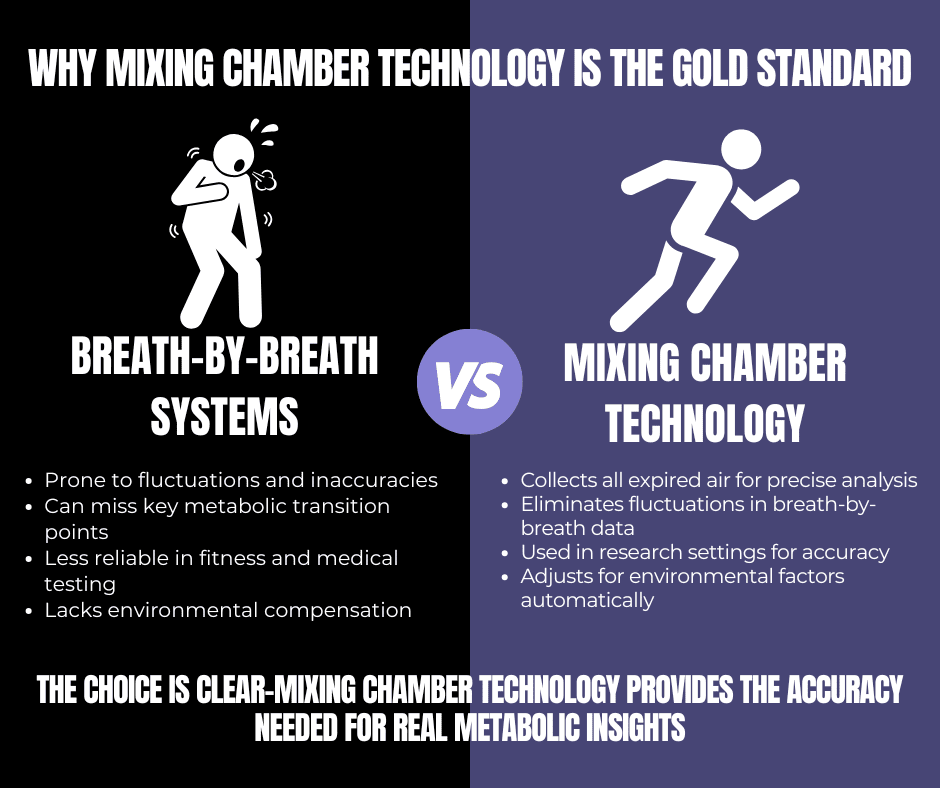
The use of mixing chamber technology demonstrates a commitment to accuracy. Unlike basic breath-by-breath systems, mixing chamber technology provides measurements previously available only in research settings4.
Precision Training Zones
Your facility can offer something most competitors cannot: precise heart rate training zones based on metabolic data. This is especially valuable for Zone 2 training, which has gained significant popularity but requires exact heart rate parameters for peak results.
Comprehensive Client Understanding
Metabolic testing offers a deeper understanding of the body’s energy use, surpassing basic fitness assessments. It provides precise data on fat and carbohydrate utilization rates, accurately measures caloric expenditure during exercise, and determines true aerobic and anaerobic thresholds. It also evaluates individual metabolic efficiency, helping to tailor nutrition and training strategies for prime performance.
Real-World Impact
The competitive advantage goes beyond having the technology—it lies in the results you can deliver. Metabolic testing allows facilities to validate training approaches by showing clients how their bodies respond to different intensities. It enables the creation of targeted training zones, optimizing program design for individual needs. Objective measurements help demonstrate progress over time, reinforcing the effectiveness of training methods. Whether the goal is weight loss or performance enhancement, metabolic data provides the insights needed to tailor programs for maximum success.
By offering metabolic testing, facilities demonstrate a commitment to evidence-based fitness that attracts serious clients and supports long-term success. This investment in precision and personalization creates a strong competitive advantage in an increasingly crowded fitness market.
Understanding the Technology
Mixing Chamber Technology
Mixing chamber technology represents the highest standard in metabolic testing. Unlike basic breath-by-breath systems, mixing chamber technology, as used in KORR’s CardioCoach®, provides accurate measurements that were previously only available in research settings. This technology has been independently validated at prestigious institutions including the University of Southern California and Oregon State University5.6.
How Mixing Chamber Technology Works
The science behind mixing chamber technology is based on a fundamental principle: burning 1 calorie (Kilocalorie) requires 208.06 milliliters of oxygen. This relationship between caloric burn and oxygen consumption allows for extremely precise measurements of VO2 Max and metabolic rate. Let’s explore how this system operates:
Collection of Expired Air:
The process begins as the client breathes through a mouthpiece connected to the mixing chamber. This collection method is crucial for accuracy, as it captures the total volume of air the person exhales while they rest quietly or exercise. The chamber is designed to maintain consistent conditions (avoiding the inconsistent and fluctuating data that comes from breath-by-breath systems) while gathering this vital respiratory data.
Oxygen Concentration Analysis:
Once collected in the chamber, the air undergoes precise oxygen concentration analysis. The system uses sophisticated oxygen sensors to measure the exact amount of oxygen in the expired air compared to the amount in inspired air. This differential is important for calculating how much oxygen the body is consuming during rest or exercise. The precision of these measurements is what makes the mixing chamber technology the gold standard for metabolic testing.
Air Flow Measurement:
The system incorporates high-precision air flow sensors that measure the exact volume of expired air. These sensors can detect minimal changes in air flow, providing detailed data about breathing patterns and volume. This level of precision is essential for accurate metabolic calculations and helps create reliable test results across multiple sessions.
Environmental Compensation:
The KORR® system automatically adjusts for environmental factors that could affect measurement accuracy. Before each test, it calibrates to account for:
- Current barometric pressure, which affects air density
- Ambient temperature, which influences gas volume
- Relative humidity, which impacts oxygen concentration. This automatic calibration ensures accurate results regardless of testing conditions or location.
Data Conversion and Analysis:
The final step transforms the collected physiological data into practical training metrics. The system processes the raw data about oxygen consumption, air flow, and environmental conditions to generate:
- Precise heart rate training zones
- Accurate caloric expenditure calculations
- Detailed metabolic efficiency measurements
- Specific anaerobic and aerobic thresholds
These calculations provide trainers and clients with clear information that can be applied to training programs. The results are presented in easy-to-understand reports that show exactly where a client should train for the best results, whether their goal is fat burning, endurance improvement, or fitness enhancement.
This process makes mixing chamber technology superior to simpler measurement systems, providing the accuracy needed for precise metabolic testing in fitness and medical settings.
Equipment Durability and Maintenance
The CardioCoach® system brings commercial-grade durability together with simple maintenance requirements. The equipment is designed for continuous use in busy fitness facilities while requiring minimal technical intervention. Rather than needing complex maintenance procedures, the system primarily requires only routine oxygen sensor replacement, which can be performed on-site by facility staff. The self-calibrating nature of the system eliminates the need for frequent technical adjustments, making it ideal for commercial fitness environments.
Real-Time Data Collection and Analysis
During testing, the system continuously monitors oxygen consumption while tracking heart rate in real time. This simultaneous data collection allows for the immediate detection of crucial metrics like anaerobic threshold and metabolic efficiency. The technology measures VO2 Max and Sub Max capabilities while precisely determining both Aerobic Threshold (AeT) and Anaerobic Threshold (AT). This data collection enables the creation of precisely targeted heart rate zones and accurate calculations of calories burned during exercise.
User-Friendly Design
Despite its sophisticated technology, the CardioCoach® system features an intuitive interface that doesn’t require specialized certification to operate. The wireless connectivity and straightforward testing protocols make it accessible for any fitness professional to administer tests and interpret results. The system integrates with a user-friendly app that simplifies client tracking and progress monitoring, making it practical for daily use in a fitness facility.
The system generates detailed reports that translate complex physiological data into clear insights. These reports provide a complete picture of each client’s current fitness status and progress over time, including visual representations that make it easy for trainers and clients to understand the results and their implications for training. This ability to communicate complex data helps facilities demonstrate the value of their services and justify premium pricing for metabolic testing and related training programs.
Types of Testing
KORR’s CardioCoach® revolutionizes performance testing through comprehensive VO2 Max assessment. Unlike generic heart rate formulas that can lead to ineffective training, CardioCoach’s mixing chamber technology provides exact measurements of how your body utilizes oxygen during exercise.
Using KORR’s mixing chamber technology, the CardioCoach system defines exact training zones based on physiological responses. When a client performs a VO2 Max test, the system measures how their body responds to increasing exercise intensity, identifying specific heart rate ranges for:
- Fat Optimization Zone: Where the body maximizes fat utilization for energy
- Aerobic Endurance Zone: Optimal range for building cardiovascular fitness
- Anaerobic Threshold Zone: The point where lactate begins to accumulate
- Peak Performance Zone: Maximum oxygen utilization capacity
This precision ensures every workout targets the right energy system, making training more efficient and results more achievable.
The Power of Zone 2 Training
Zone 2 training has emerged as a focus in fitness and endurance training, and KORR’s technology provides the best way to determine true Zone 2 heart rates. Training in this zone significantly enhances mitochondrial function, which is the cornerstone of cellular energy production. As clients train in their precise Zone 2, their bodies become more efficient at utilizing oxygen and burning fat for fuel, creating a stronger foundation for all types of physical activity.
Enhanced fat utilization during exercise is another major benefit of proper Zone 2 training. When clients train in their accurately measured Zone 2, their bodies learn to maximize fat oxidation while preserving valuable glycogen stores. This metabolic efficiency carries over into daily activities and higher-intensity workouts, allowing for better performance in Zones 3, 4, and 5.
The benefits of Zone 2 training extend beyond the aerobic system. By building a solid aerobic base through precise Zone 2 training, clients improve their body’s ability to recover during high-intensity intervals. This recovery capacity allows for more effective training in higher zones, leading to better overall performance gains. When an athlete performs high-intensity intervals in Zone 4 or 5, their ability to recover during rest periods is directly related to their Zone 2 fitness level.
Proper Zone 2 training creates the physiological adaptations necessary for success in all other training zones. It increases capillary density, improves mitochondrial function, and enhances the body’s ability to clear lactate – all of which are crucial for performance in higher zones. The improved aerobic efficiency gained through Zone 2 training means athletes can work at higher intensities while maintaining lower heart rates, raising their anaerobic threshold.
KORR’s precision in identifying true Zone 2 is essential because this zone has a relatively narrow window. Training just slightly too high can shift the body out of optimal aerobic development and into a more glycolytic state, while training too low won’t provide enough stimulus for adaptation. Only through accurate metabolic testing can this crucial zone be properly identified and monitored as fitness improves.
Understanding Energy Utilization
KORR’s CardioCoach® provides detailed insights into how the body uses different fuel sources during exercise through its mixing chamber technology. The system reveals exact substrate utilization patterns that transform how training programs are designed. This precision identifies when a client is burning fat versus carbohydrates and exactly how efficiently they’re using each fuel source.
The system’s ability to pinpoint the precise heart rate where maximum fat oxidation occurs is crucial for endurance athletes and weight management clients. This isn’t just about finding a “fat-burning zone” – it’s about understanding how energy system development in one zone affects performance in others. Improving fat oxidation efficiency through properly targeted training allows athletes to spare glycogen stores for high-intensity efforts, enhancing overall performance.
The metabolic efficiency analysis provided by CardioCoach® also reveals how well an individual transitions between energy systems. This transition efficiency is key for performance, because it indicates how smoothly someone can shift from aerobic to anaerobic metabolism and back. By understanding these transition points, trainers can design programs that improve metabolic flexibility, allowing clients to better handle varying intensity demands in training and competition.
Performance Enhancement
CardioCoach’s metabolic mapping goes beyond basic VO2 Max testing by providing a complete picture of how an individual’s body responds to increasing exercise intensity. This analysis includes:
Anaerobic threshold identification that’s precise and reliable. This threshold is a training metric that, when accurately identified, allows for proper intensity distribution in training programs. Knowing the exact point where lactate accumulation accelerates enables trainers to design intervals that build threshold power while avoiding excessive fatigue.
VO2 measurements provide more than a maximum number – they reveal the entire progression of oxygen utilization efficiency. This allows trainers to understand how much oxygen a client can use and how efficiently they use it at different intensities. This information is vital for designing progressive training programs that develop capacity.
Recovery rate analysis provides insight into how quickly a client returns to baseline after exertion. This metric becomes more important at higher training intensities and helps trainers design appropriate work-to-rest ratios for interval training. The faster recovery rates achieved through proper zone training directly translate to improved performance in high-intensity activities.
Understanding RMR Testing
The science of metabolic rate testing has evolved far beyond simple calorie counting. KORR’s metabolic analyzers have transformed how we approach weight management and metabolic health through precise measurement technology.
Breaking Through Weight Loss Plateaus
Most experienced trainers have encountered clients who struggle to lose weight despite seemingly doing everything right. KORR’s RMR testing often reveals surprising insights into these situations. Research shows that many overweight individuals actually have normal or above-average metabolic rates – a finding that completely shifts the conversation around weight management.
This precise measurement becomes even more pivotal during weight loss journeys. As clients lose weight, their metabolic rate naturally adjusts. KORR’s technology tracks these changes, allowing trainers to make proactive program adjustments rather than waiting for progress to stall. This scientific approach helps prevent the frustrating plateaus that often lead to client discouragement or abandonment.
The Metabolic Foundation of Performance
While many view RMR testing solely as a weight management tool, its implications for performance are equally valuable. Consider an endurance athlete trying to maintain peak performance while managing weight. Without knowing their precise RMR, they risk:
- Under-fueling, which compromises recovery and adaptation
- Over-fueling, which impacts power-to-weight ratio
- Improper nutrient timing, affecting both training quality and recovery
KORR’s metabolic analyzers provide the exact data needed to optimize nutrition for body composition and performance goals. This precision becomes especially significant when combined with VO2 Max testing data, allowing for metabolic profiling that guides training and nutrition strategies.
Revolutionizing Program Design Through Data
The impact of accurate RMR testing extends throughout the entire training process. Rather than relying on generalized formulas, trainers can create truly personalized programs based on measured metabolic data. This scientific approach transforms how facilities:
Design Initial Programs Understanding a client’s true metabolic rate allows for precise initial programming that builds confidence through early success. The data helps explain why previous approaches may have failed and provides a clear pathway forward.
Monitor Progress Regular metabolic testing reveals how the body adapts to training and nutrition changes. These insights allow for proactive program adjustments based on objective data rather than subjective measures.
Adjust Long-term Strategies As clients progress, their metabolic needs evolve. KORR’s technology tracks these changes, enabling trainers to maintain momentum through evidence-based program modifications.
The Power of Integration
When combined with VO2 Max testing, RMR data creates a complete metabolic profile that guides every aspect of client programming. This approach:
- Guides training intensity distribution
- Informs nutrition timing strategies
- Optimizes recovery protocols
- Enhances performance outcomes
By understanding resting metabolism and exercise efficiency, trainers can create synergistic programs that maximize results through precisely targeted training and nutrition strategies.
The Science of Success
The sophistication of KORR’s technology doesn’t require complex implementation. Through thoughtful design and automation, the CardioCoach® system transforms laboratory-grade testing into a straightforward process that any fitness facility can master.
Transforming Data into Action
What sets KORR’s approach apart is how it translates complex physiological data into actionable training insights. Consider the evolution of a typical client’s program:
Phase 1: Baseline Establishment
The initial testing provides precise metabolic markers that challenge common assumptions. Clients who believed they were training in their fat-burning zone frequently discover they’ve been working too hard or not hard enough.
Phase 2: Program Implementation
Armed with exact training zones, programs become more targeted and efficient. Clients experience the satisfaction of training with purpose, knowing each session is designed for their physiology.
Phase 3: Progress Tracking
Regular retesting reveals concrete improvements that might otherwise go unnoticed. Seeing proof of progress becomes a powerful motivator for continued engagement.
Maximizing Value in Fitness Programs
Creating a successful fitness program goes beyond workouts; it involves personalization, data-driven tracking, and continuous engagement to help clients achieve lasting results. By designing individualized programs, combining testing with personal training, and implementing structured progress tracking, fitness professionals can enhance client experience and outcomes.
A well-structured program starts with understanding each client’s unique needs, goals, and physical capabilities. Personalized training ensures that workouts align with individual strengths and weaknesses while incorporating assessments to measure progress effectively. Regular retesting helps trainers make data-driven adjustments, keeping clients motivated and on track. Education is also vital in maximizing client value. When individuals understand the reasoning behind their training methods, they are more likely to stay committed. Providing insights on exercise techniques, recovery strategies, and nutrition helps clients make informed decisions beyond their training sessions.
Getting Started with KORR
Transform your facility’s capabilities with KORR’s support system. Our team provides everything you need to successfully implement metabolic testing.
Our metabolic testing specialists begin with a free initial training session for your team, ensuring everyone understands how to operate the equipment and interpret results. We offer courses on metabolic testing science for those who want to deepen their knowledge. Our ongoing technical support guarantees that you’re never left with questions, and we provide regular updates on industry developments to keep you at the forefront of fitness technology.
Ready to elevate your facility with precision metabolic testing? Connect with a KORR specialist to discover how our CardioCoach® can transform your business. Whether you’re new to metabolic testing or looking to upgrade your current capabilities, we’ll help you implement testing protocols that drive client results and facility growth. Learn how easy it is to bring the gold standard in metabolic testing to your facility.
References:
- Newsome ANM, Reed R, Sansone J, Batrakoulis A, McAvoy C, W. Parrott M. 2024 ACSM Worldwide Fitness Trends: Future Directions of the Health and Fitness Industry. ACSM’s Health & Fitness Journal. 2024;28(1):14-26. doi: 10.1249/fit.0000000000000933. PubMed PMID: 00135124-202401000-00007.
- Ravussin E, Burnand B, Schutz Y, Jéquier E. Twenty-four-hour energy expenditure and resting metabolic rate in obese, moderately obese, and control subjects. Am J Clin Nutr. 1982;35(3):566-73. doi: 10.1093/ajcn/35.3.566. PubMed PMID: 6801963.
- Grave RD, Suppini A, Calugi S, Giulio M. Factors Associated with Attrition in Weight Loss Programs. International Journal of Behavioral Consultation and Therapy. 2006;2(3):341-53. doi: 10.1037/h0100788.
- Beijst C, Schep G, Breda E, Wijn PF, Pul C. Accuracy and precision of CPET equipment: a comparison of breath-by-breath and mixing chamber systems. J Med Eng Technol. 2013;37(1):35-42. Epub 20121031. doi: 10.3109/03091902.2012.733057. PubMed PMID: 23110656.
- Dieli-Conwright CM, Jensky NE, Battaglia GM, McCauley SA, Schroeder ET. Validation of the CardioCoachCO2 for submaximal and maximal metabolic exercise testing. J Strength Cond Res. 2009;23(4):1316-20. doi: 10.1519/jsc.0b013e3181a3c5e8. PubMed PMID: 19528838.
King N, Leet A, McDonald J, et al. Validity Of The Cardiocoach Metabolic System For The Determination Of Vo2 Peak. International Journal of Exercise Science Proceedings. 2015;8(3)