



Corporate wellness has evolved. The generic step-count challenges and biometric screenings that defined the category a decade ago are giving way to something more substantive: objective, individualized health data that actually changes behavior and outcomes. VO2 max testing in corporate wellness programs sits at the center of that shift.
For executives and high-performing employees, VO2 max testing provides a precise measure of cardiorespiratory fitness, one of the strongest predictors of long-term health outcomes and all-cause mortality. It replaces population-based estimates with individual physiological data, giving both the employee and the organization a meaningful baseline to work from.
Here is what corporate wellness directors, executive health program administrators, and the clinics and gyms serving them need to know about VO2 max testing in this context.
What VO2 Max Testing Measures and Why It Matters for Executives
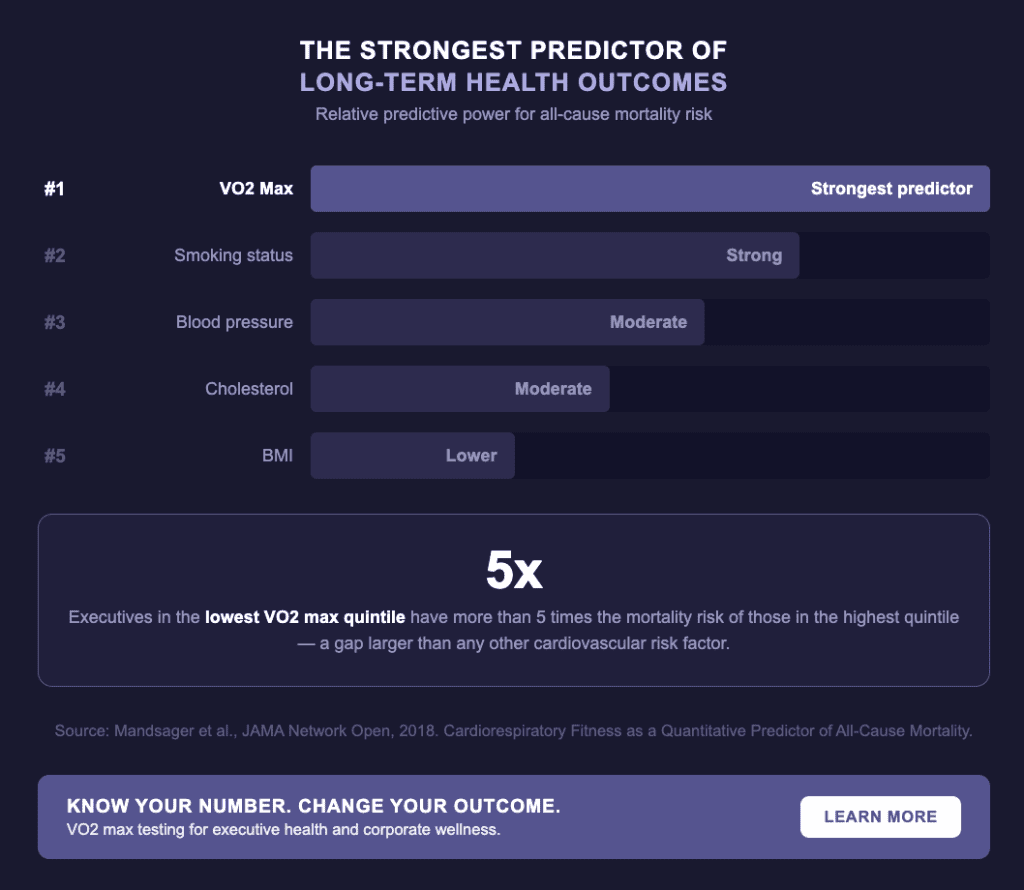
VO2 max measures the maximum rate at which the body can consume oxygen during exercise. It is the single most validated marker of cardiovascular fitness available in a clinical or fitness setting. Research published in JAMA Network Open found that cardiorespiratory fitness is among the strongest predictors of all-cause mortality, rivaling or exceeding the impact of blood pressure, cholesterol, smoking status, and BMI.
For executives and high-net-worth individuals, this framing resonates immediately. These are people accustomed to tracking performance metrics in every area of their professional lives. VO2 max gives them a performance metric for their cardiovascular system, one that is objective, reproducible, and directly tied to the outcomes they care about: longevity, energy, cognitive performance, and disease risk.
A standard VO2 max test takes 8 to 14 minutes on a treadmill or bike ergometer. The result is a single number, expressed in milliliters of oxygen per kilogram of body weight per minute, that tells the practitioner exactly where a client’s aerobic capacity sits relative to age and sex-matched norms.
A better VO2 max test includes in-depth threshold, ventilatory, and metabolic data. On its own, VO2 max describes capacity, not necessarily how that capacity is best trained. With that additional data, VO2 analysis becomes a powerful tool for setting individualized training zones, managing intensity, and ensuring that programming produces the intended results for that individual.
Key Components of VO2 Max Testing in Corporate Wellness Programs
Precision health data for high-performing individuals
Corporate wellness programs serving executives need assessments that go beyond weight and resting heart rate. VO2 max testing measures true aerobic capacity rather than relying on predictive formulas or wearable estimates. For a population that is used to precision in every other area of their work, this matters. Wearable devices estimate VO2 max from heart rate and external workload data. Research finds average errors in the range of 5 to 15 percent, with substantially larger errors possible at the individual level depending on fitness, conditions, and algorithm limitations. A direct metabolic test eliminates that uncertainty.
Personalized training zone prescriptions
Test results enable practitioners to establish accurate heart rate training zones for each individual rather than applying population-based percentages. Zone 2 training, which has become a cornerstone of longevity medicine and executive performance programs, requires precise metabolic data to implement correctly. Without a real VO2 max test, zone prescriptions are approximations. With one, they are individualized to the client’s actual physiology.
Year-over-year performance tracking
One of the most compelling aspects of VO2 max testing for corporate wellness programs is its value as a longitudinal tracking tool. Annual or semi-annual retesting allows organizations to demonstrate measurable cardiovascular improvement across their employee population. That data is the foundation for demonstrating ROI on wellness program investment to HR leadership and C-suite stakeholders. Improved VO2 max scores across a workforce represent reduced cardiovascular disease risk, lower healthcare utilization, and better productivity outcomes.
Disease prevention and early risk identification
VO2 max testing can identify individuals with low cardiorespiratory fitness who are at significantly elevated risk for cardiovascular events, even in the absence of other obvious risk factors. For executive health programs where the goal is proactive rather than reactive medicine, this makes VO2 max testing a meaningful screening tool. A low VO2 max score in an otherwise healthy-appearing executive is a clinically significant finding that warrants follow-up and intervention.
Accessible testing formats for corporate environments
Corporate wellness testing often happens outside of traditional clinical settings, in company fitness centers, at offsite events, or during executive health retreats. The equipment used for VO2 max testing needs to fit those environments without sacrificing accuracy.
The KORR CardioCoach weighs under ten pounds, operates on battery power, and calibrates automatically in 90 seconds without gas tanks or syringes. It moves between rooms, travels to corporate events, and delivers the same mixing chamber accuracy in a conference room as it does in a clinic. For facilities offering corporate wellness testing as a service, this means a single piece of equipment can serve both in-facility clients and on-site corporate accounts.
Benefits of VO2 Max Testing for Corporate Wellness Programs
Measurable ROI for wellness program investment
Corporate wellness directors face increasing pressure to demonstrate return on investment. VO2 max testing provides a measurable, reproducible outcome metric that connects directly to healthcare cost reduction. Organizations with higher average cardiorespiratory fitness scores across their workforce show lower rates of cardiovascular disease, reduced absenteeism, and better cognitive performance outcomes in published research.
Annual retesting creates a longitudinal data set that HR and benefits leadership can present to senior stakeholders as evidence that the wellness program is producing real physiological change, not just participation numbers.
Differentiation for executive health programs
Executive health programs that include VO2 max testing differentiate themselves from generic annual physicals. For organizations competing to attract and retain senior talent, offering a comprehensive executive health assessment that includes cardiorespiratory fitness testing signals a meaningful investment in employee longevity and performance. It positions the wellness benefit as substantive rather than symbolic.
Engagement that sustains behavior change
Generic wellness programs struggle with engagement over time, not because information is unavailable, but because risk feels abstract. A VO2 max result is personal, specific, grounding cardiovascular fitness in a concrete number tied to health outcomes the individual can understand. While no metric guarantees behavior change, individualized data provides clearer context for decision-making than generalized wellness summaries.
The CardioCoach mobile app extends that clarity beyond the test itself. Clients can access their results, build workouts based on their prescribed training zones, and track progress between retesting sessions. For corporate programs that want to drive sustained behavior change rather than one-time participation, that ongoing touchpoint matters.
A revenue opportunity for facilities serving corporate clients
For gyms, wellness centers, physical therapy clinics, and medical practices that serve corporate accounts or want to build them, VO2 max testing creates a premium service offering that corporate wellness budgets are designed to fund.
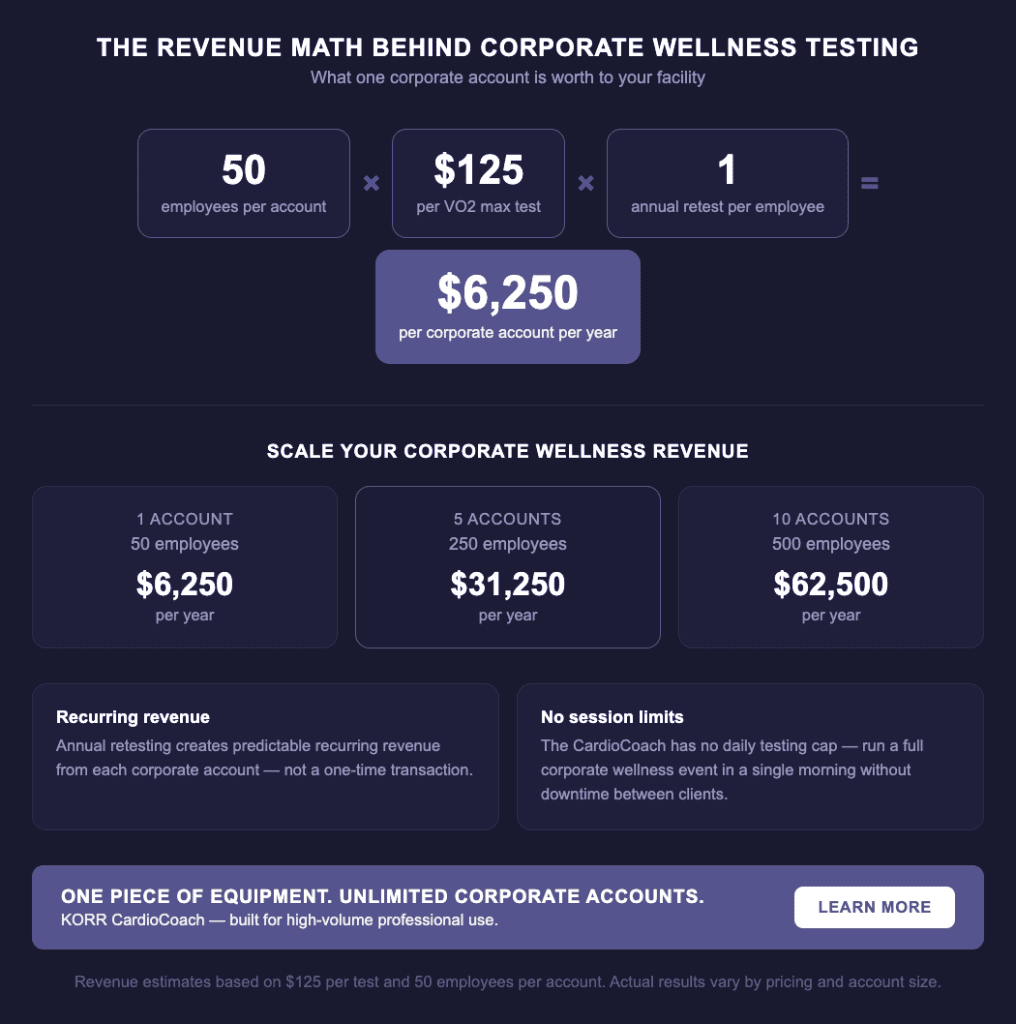
Corporate wellness spending in the United States exceeds $20 billion annually. Organizations are actively looking for evidence-based assessments that go beyond basic screenings. A facility equipped with professional metabolic testing equipment can offer individual executive assessments, group testing events, and annual retesting programs that generate recurring revenue from corporate clients.
The CardioCoach’s no-session-limit design and hands-free calibration make high-volume corporate testing events operationally straightforward. A facility can run ten or fifteen assessments during a half-day corporate wellness event without calibration delays or mandatory cooldown periods between clients.
How to Implement VO2 Max Testing in a Corporate Wellness Program
For corporate wellness directors and HR teams
The most practical path to adding VO2 max testing to a corporate wellness program is partnering with a facility that already operates professional metabolic testing equipment. Use the KORR facility finder to identify CardioCoach-equipped locations near your offices that can offer employee testing on-site or within easy access.
Alternatively, facilities equipped with the CardioCoach can bring testing to corporate environments. The equipment’s portability and simple setup make on-site corporate testing events logistically manageable.
For clinics and fitness facilities building corporate accounts
Corporate wellness contracts represent some of the highest-value recurring revenue available to facilities offering health and performance services. A single corporate account committing to annual VO2 max assessments for 50 employees at $125 to $150 per test represents $6,250 to $7,500 in annual revenue from one client relationship.
To position for corporate accounts, facilities need equipment that can handle volume, travel to client sites when needed, and produce client-facing reports that HR teams can share with employees and present to leadership. The CardioCoach produces customizable, branded reports formatted for client education, making the deliverable appropriate for a corporate health program context.
For executive health clinics and concierge medicine practices
VO2 max testing fits naturally into executive health panels and concierge medicine programs where the goal is comprehensive, personalized health assessment. The 8 to 14 minute test protocol integrates smoothly into a longer assessment appointment and produces data that connects directly to the cardiovascular risk conversations executive health physicians are already having with their patients.
When paired with resting metabolic rate (RMR) testing in the same session, the assessment moves beyond fitness alone. RMR provides an individualized metabolic baseline, how the body uses energy at rest, adding context to conversations around weight management, nutrition, and long-term cardiovascular health.
The Equipment Behind the Service
The quality of a VO2 max testing program is directly tied to the accuracy of the equipment delivering it. For corporate wellness programs where results will be used to guide health decisions, track progress over time, and demonstrate program ROI, measurement precision is not optional.
The KORR CardioCoach uses mixing chamber technology, the gold standard for metabolic gas analysis, to deliver accurate, reproducible results across every test. Unlike breath-by-breath systems that measure instantaneous gas concentrations and correct for biological variation algorithmically, the CardioCoach averages expired gases across multiple breaths before analysis, producing a more stable and clinically reliable measurement. You can review supporting research in KORR’s research article library.
For corporate wellness programs that will use VO2 max data to make health recommendations and demonstrate ROI, that accuracy is the foundation the entire program rests on.
To learn more about adding VO2 max testing to your corporate wellness program or executive health offering, visit korr.com or call 1-801-483-2080 to schedule a demonstration.