


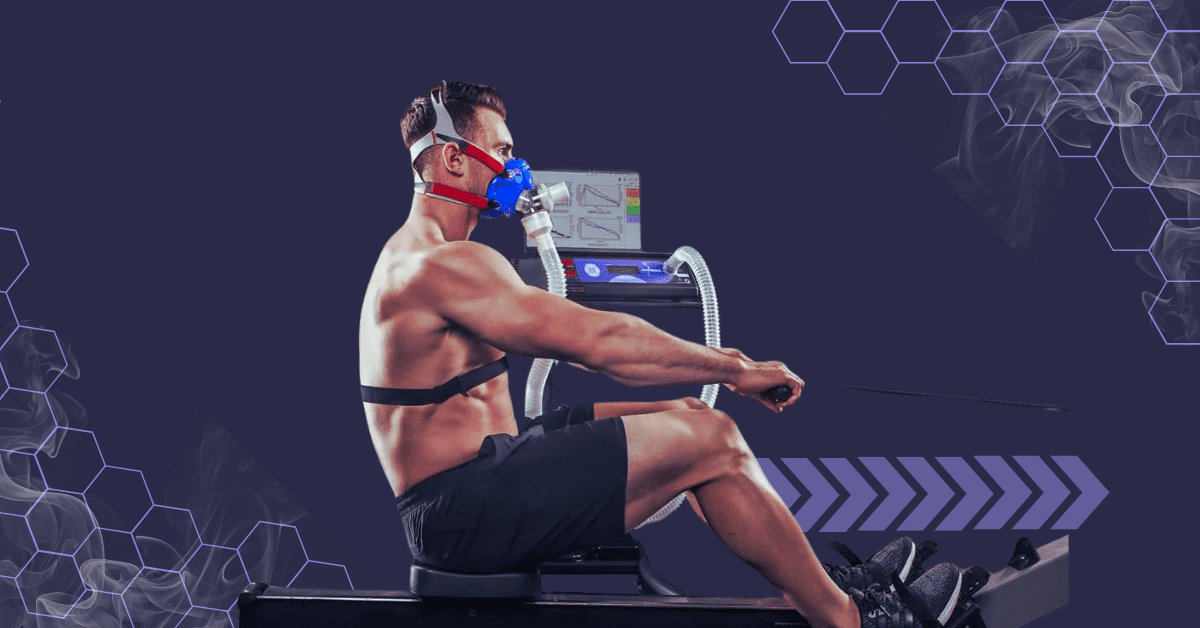
Have you ever wondered why some athletes can maintain their pace for miles while others suddenly “hit the wall” and struggle to continue? The answer lies in understanding your body’s ventilatory thresholds – invisible markers that determine whether you’re running on premium fuel or rapidly burning through your reserves.
Ventilatory thresholds are specific points during exercise where your breathing patterns change dramatically, signaling shifts in how your body produces energy. Think of them as your body’s natural gear changes – moments when your cardiovascular system transitions from one energy pathway to another. These thresholds occur at predictable heart rate zones that are unique to each individual, making them incredibly valuable for optimizing your training approach.
When you understand and train according to your ventilatory thresholds, everything changes. Instead of guessing whether you’re working too hard or not hard enough, you gain insight into which heart rate zones maximize fat burning, build endurance, and develop speed. This knowledge transforms random workouts into strategic training sessions that target specific physiological adaptations. Discovering your ventilatory thresholds is the first step toward unlocking true performance potential.
What Are Ventilatory Thresholds?
As a trainer or coach, you’ve likely observed how your clients’ breathing patterns change as exercise intensity increases. Ventilatory thresholds are the precise points where these breathing changes occur, marking shifts in your client’s metabolic processes. These aren’t arbitrary numbers – they’re physiological landmarks that reveal how your client’s body responds to increasing exercise demands.
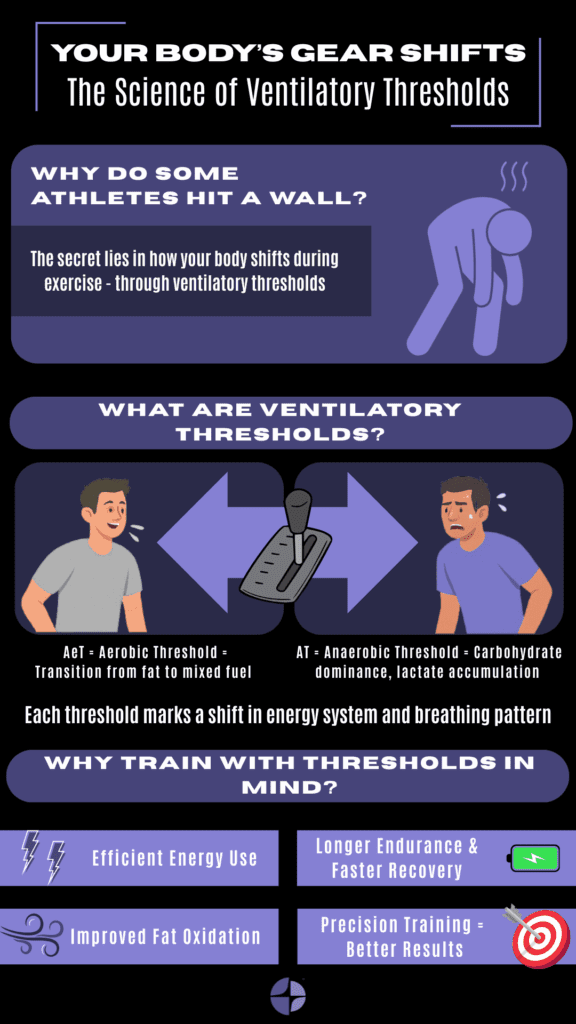
There are two thresholds you need to understand: the Aerobic Threshold (AeT) and the Anaerobic Threshold (AT). The Aerobic Threshold is the point where your client transitions from primarily burning fat to incorporating more carbohydrates for fuel. At this intensity, they can still maintain conversation relatively easily, and their breathing remains controlled and rhythmic. This threshold typically corresponds to what we now recognize as Zone 2 training – the foundation that makes all other training zones more effective.
The Anaerobic Threshold occurs at a higher intensity, marking the point where your client’s body can no longer clear lactate as quickly as it’s being produced. Beyond this threshold, breathing becomes labored, conversation becomes difficult, and the body increasingly relies on carbohydrate metabolism. This is where your client enters the higher-intensity training zones that develop speed and power.
Think of these thresholds as your client’s metabolic gear shifts. Just as a car has optimal RPM ranges for different gears, your client’s body has optimal heart rate ranges for different energy systems. The Aerobic Threshold is like shifting from first to second gear – smooth, efficient, and sustainable. The Anaerobic Threshold is like shifting into high gear – powerful but demanding, requiring careful management to avoid overrevving the engine.
Understanding these thresholds allows you to prescribe training intensities with surgical precision, making sure your clients train in the zones that will produce their desired adaptations most efficiently.
The Science Behind the Thresholds
When you guide your clients through an exercise test, you’re witnessing a fascinating metabolic transformation. At low intensities, their bodies efficiently use oxygen to convert fat and carbohydrates into energy through aerobic metabolism. Their breathing is steady, their heart rate is controlled, and they’re operating well within their physiological comfort zone.
As intensity increases toward the Aerobic Threshold, subtle but important changes begin occurring. Your client’s breathing rate starts to increase proportionally with their heart rate, but they’re still operating mainly within their aerobic system. This is the sweet spot of Zone 2 training – where fat oxidation is maximized while building the aerobic base that supports all other training zones.
The magic happens in understanding how Zone 2 training enhances every other aspect of your client’s fitness. When you develop their aerobic threshold through consistent Zone 2 work, you’re improving their mitochondrial density, capillary development, and fat oxidation capacity. This foundation makes their Zone 3, 4, and 5 efforts more powerful and sustainable because they have a strong aerobic system supporting their higher-intensity work.
At the Anaerobic Threshold, the metabolic landscape shifts. Carbon dioxide production increases disproportionately to oxygen consumption, breathing becomes noticeably more labored, and the body relies on anaerobic pathways that produce lactate. This threshold represents your client’s sustainable race pace for events lasting roughly 30-60 minutes.
The relationship between oxygen uptake and carbon dioxide production during these transitions provides invaluable data. While heart rate zones tell you where your client is training, the metabolic information reveals what fuel they’re burning and how efficiently they’re operating. This distinction between heart rate data and metabolic data is crucial for optimizing training prescriptions.
Understanding the Training Zones
Zone 2 training has revolutionized how coaches approach endurance development, but it’s essential to understand how all five training zones work together to create a comprehensive performance system. Think of your client’s training zones as a pyramid – Zone 2 forms the broad, stable foundation, while the higher zones build specific performance capacities on top of that aerobic base.
Zone 1: Active Recovery and Aerobic Base Building
Heart Rate Range: Below Aerobic Threshold (typically 50-60% of threshold heart rate)
Primary Fuel: Fat (90%+ fat oxidation)
Training Purpose: Recovery, warm-up, cool-down, and gentle aerobic stimulation
Zone 1 is your client’s easiest training intensity – so comfortable they could maintain a conversation without any effort. While it might seem too easy to be valuable, Zone 1 serves crucial functions in a well-designed program. It promotes blood flow for recovery, maintains aerobic stimulation on easy days, and provides a safe intensity for clients returning from injury or building base fitness.
Zone 2: The Metabolic Foundation
Heart Rate Range: At or just below Aerobic Threshold
Primary Fuel: Fat (70-85% fat oxidation)
Training Purpose: Maximizing fat oxidation, building mitochondrial density, enhancing metabolic flexibility
Here’s why Zone 2 is the foundation that transforms all other training: it maximizes fat oxidation while developing mitochondrial efficiency. When your clients can efficiently burn fat for fuel, they preserve their limited carbohydrate stores for when they need them – during high-intensity efforts or competitions. This metabolic flexibility is what separates good athletes from great ones.
Zone 2 training enhances your clients’ ability to clear lactate, which improves their performance in Zones 3, 4, and 5. A well-developed aerobic system acts like a powerful buffer, allowing your clients to work at higher intensities for longer periods before lactate accumulation forces them to slow down.
Zone 3: Aerobic Power Development
Heart Rate Range: Between Aerobic and Anaerobic Thresholds
Primary Fuel: Mixed (50-70% carbohydrate, 30-50% fat)
Training Purpose: Improving aerobic power, race pace for longer events, lactate clearance
Zone 3 is the “tempo” zone where your clients work at a comfortably hard effort. This intensity improves their ability to sustain moderate-to-high workloads while still operating primarily within their aerobic system. For many endurance events lasting 2-6 hours, Zone 3 represents sustainable race pace.
Zone 4: Lactate Threshold and Anaerobic Power
Heart Rate Range: At or slightly above Anaerobic Threshold
Primary Fuel: Carbohydrate (70-85%)
Training Purpose: Improving lactate threshold, sustainable high-intensity pace, anaerobic capacity
Zone 4 is where your clients develop their ability to sustain high-intensity efforts. This zone improves lactate buffering capacity and teaches the body to operate efficiently at or near the anaerobic threshold. For events lasting 30-60 minutes, Zone 4 represents race pace intensity.
Zone 5: Neuromuscular Power and VO2 Max
Heart Rate Range: Above Anaerobic Threshold (often 90-100% of max heart rate)
Primary Fuel: Carbohydrate (85-100%)
Training Purpose: Developing VO2 max, neuromuscular power, speed, anaerobic capacity
Zone 5 is your client’s highest sustainable intensities, usually used in short intervals with substantial recovery. This zone develops maximum oxygen uptake capacity, improves neuromuscular coordination at high speeds, and enhances the body’s ability to tolerate and buffer high lactate levels.
How the Zones Work Together
The magic happens when you understand how these zones interact. A strong Zone 2 foundation makes Zones 3, 4, and 5 more effective because:
- Enhanced fat oxidation preserves carbohydrate stores for high-intensity efforts
- Improved lactate clearance allows for better recovery between intervals
- Greater mitochondrial density supports higher sustainable power outputs
- Better oxygen utilization makes VO2 max efforts more productive
Without adequate Zone 2 development, your clients will struggle to sustain higher intensities and recover effectively between training sessions. Their Zone 4 threshold pace will be limited by poor aerobic support, and their Zone 5 intervals will be compromised by inadequate recovery capacity.
The Importance of Accurate Zone Identification
Generic heart rate formulas can’t accurately identify your client’s training zones. The 180-minus-age formula or percentage-based calculations are rough estimates that can be off by 20-30 beats per minute. For some clients, training at these estimated zones means they’re working too easy to stimulate adaptation. For others, they’re working too hard and missing the metabolic benefits that make each zone effective.
The only way to accurately determine your client’s complete zone profile is through precise metabolic testing that measures both their heart rate response and their actual fuel utilization at each intensity. This is where the science of ventilatory thresholds becomes practical coaching gold – giving you the exact heart rate ranges and metabolic insights needed to optimize every training session.
Why Accurate Testing Matters
As a coach, you understand that training prescription is art and science. While your experience and intuition guide much of your coaching, having precise physiological data eliminates the guesswork and accelerates your clients’ progress. This is particularly crucial when it comes to identifying ventilatory thresholds and establishing accurate training zones.
Generic formulas and age-based calculations fall short because they ignore individual physiological differences. Two clients of the same age and fitness level can have dramatically different threshold heart rates based on factors like genetics, training history, and metabolic efficiency. When you rely on estimated zones, you’re essentially asking your clients to train blindfolded.
Accurate threshold testing provides you with three vital pieces of information: your client’s precise heart rate zones, their fat-burning efficiency at different intensities, and their metabolic profile across the exercise spectrum. This data transforms how you design training programs because you can target adaptations with confidence.
Modern mixing chamber technology offers advantages for obtaining precise data. Unlike breath-by-breath systems that can be affected by environmental factors and produce noisy data requiring extensive algorithms to interpret, mixing chamber technology provides reliable measurements that reflect your client’s true metabolic response.
The metabolic information – specifically the fat versus carbohydrate burn data – is where this testing becomes invaluable for coaching. While heart rate zones tell you where your client should train, metabolic data tells you what adaptations they’re stimulating. This insight allows you to fine-tune training intensities and help clients understand not just how hard to work, but why they’re working at specific intensities.
Practical Applications for Coaches
Understanding ventilatory thresholds transforms how you approach program design and client education. Instead of prescribing generic training zones, you can create individualized programs that target physiological adaptations based on your client’s threshold profile.
For endurance athletes, knowing their precise Aerobic Threshold allows you to prescribe Zone 2 sessions that maximize fat oxidation and aerobic development without crossing into higher intensities that would compromise the intended adaptation. You can confidently program long, steady efforts knowing your client is working in the best range for building their aerobic base.
The Anaerobic Threshold becomes your guide for tempo and threshold training sessions. This intensity shows your client’s sustainable race pace for middle-distance events and provides an anchor point for designing interval training that improves their lactate clearance capacity and sustainable power output.
For clients with body composition goals, understanding their fat-burning zones allows you to optimize their training for metabolic efficiency. You can show them exactly which heart rate ranges maximize fat oxidation, helping them understand why lower-intensity, longer-duration sessions are more effective for fat loss than exhausting high-intensity workouts.
The real coaching advantage comes from being able to explain the “why” behind your training prescriptions. When clients understand that their Zone 2 work is building the foundation that makes their higher-intensity training more effective, they’re more likely to embrace those seemingly easy sessions and trust the process.
The Coaching Advantage
Ventilatory thresholds highlight the intersection of exercise science and practical coaching application. By understanding these physiological landmarks and how they translate into training zones, you gain the ability to prescribe exercise with precision rather than approximation.
The coaching advantage is clear: When your clients train in their accurately identified zones – especially Zone 2 as the foundation – every other aspect of their fitness improves. Their threshold pace becomes faster, their VO2 max efforts become more sustainable, and their recovery between sessions accelerates dramatically.
But here’s what separates exceptional coaches from the rest: access to technology that delivers both speed and precision. KORR’s mixing chamber technology auto-calibrates in 90 seconds without syringes or gas tanks, providing metabolic data that reveals exactly how your clients burn fuel at every intensity. No noisy breath-by-breath data requiring complex algorithms – just reliable results you can trust.
What this means for your coaching practice:
- Move beyond guesswork to scientifically-backed training prescriptions
- Show clients their exact fat-burning zones with metabolic data
- Explain the “why” behind every workout with confidence
- Deliver measurable results that keep clients engaged and progressing
Your clients deserve more than estimated zones based on outdated formulas. They deserve the precision that comes from understanding their metabolic profile and training accordingly.
Ready to transform your coaching impact? KORR’s VO2 Max testing technology provides the insights that turn good coaches into game-changers. Discover how accurate threshold identification can revolutionize your programs and unlock each client’s true potential – because the future of personalized fitness starts with precise data, and that future is available today.