


Metabolic testing has become a valuable tool for clinical practices, fitness centers, and performance facilities looking to provide data-driven insights for their clients.
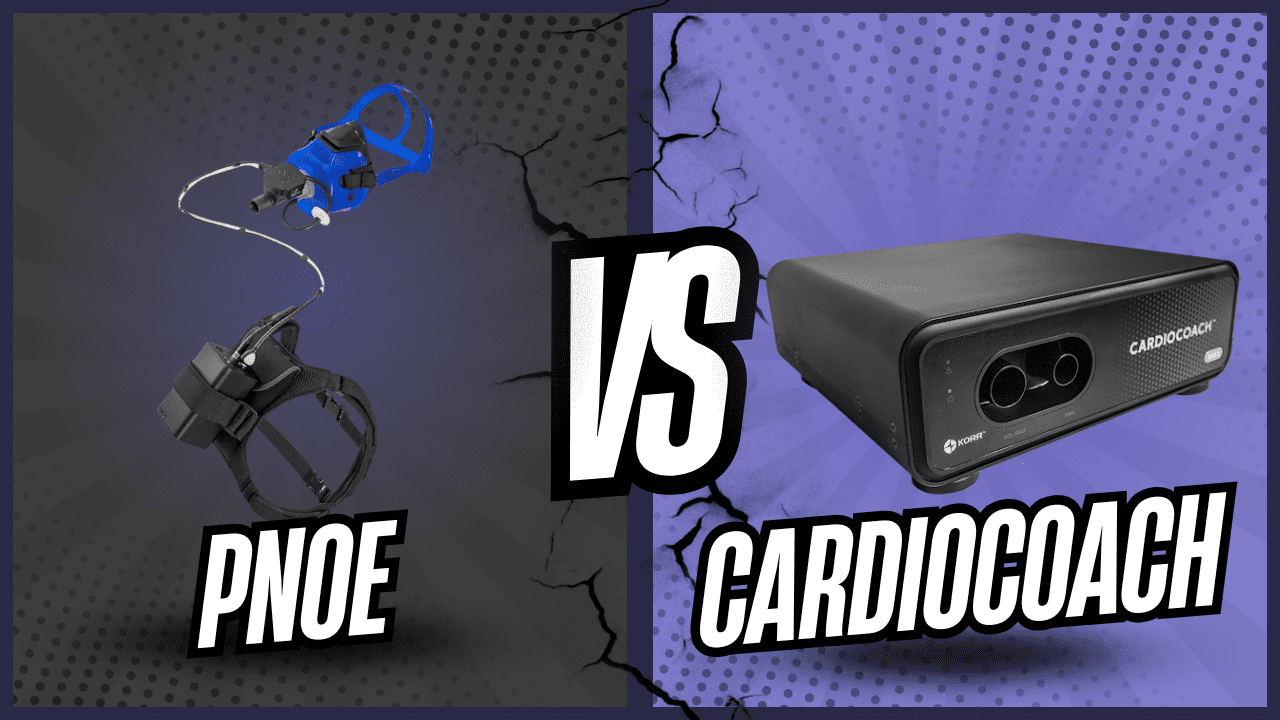
Two systems have emerged in the market with different approaches: the KORR CardioCoach, a clinic-focused stationary system, and PNOE, a portable wearable analyzer.
While both measure metabolic parameters, they differ significantly in technology, design philosophy, and total cost of ownership. This comparison examines these differences to help you determine which system best fits your practice needs.
Primary Technology
The CardioCoach and PNOE represent two distinct philosophies in metabolic analysis. The CardioCoach uses mixing chamber technology, collecting expired air from multiple breaths into a chamber where gases stabilize before measurement. PNOE uses breath-by-breath technology, measuring oxygen and carbon dioxide instantaneously with each respiratory cycle through a wearable device.
Neither approach is wrong. But each comes with tradeoffs that matter depending on where and how you conduct testing.
The CardioCoach Approach: Mixing Chamber Technology
The CardioCoach uses mixing chamber technology, the gold standard for precise gas sampling. As clients breathe during testing, expired air flows through a one-way valve into a chamber where gases from multiple breaths combine into a homogeneous sample. Sensors then analyze this stabilized mixture.
Why does this matter? Human breathing isn’t mechanically consistent. Your tidal volume fluctuates. Your respiratory rate shifts. Gas concentrations vary from one breath to the next. By mixing expired air before analysis, the CardioCoach smooths these biological variations through physics rather than relying on algorithms to correct for them afterward.
Published research confirms that mixing chamber systems produce smaller errors in both VO₂ and VCO₂ measurements. For those identifying ventilatory thresholds or fat-burning zones—transitions occurring across narrow heart rate ranges, this precision matters enormously.
The PNOE Approach: Breath-by-Breath Technology
PNOE employs breath-by-breath technology, measuring instantaneous oxygen, carbon dioxide, and airflow with each respiratory cycle. This enables its primary selling point: a compact, wireless, wearable form factor weighing around 800 grams.
However, the engineering tradeoffs are substantial. Breath-by-breath systems must capture and synchronize three rapidly changing data streams in real time. When these signals multiply to calculate VO₂, errors compound rather than cancel. Small percentage errors in oxygen measurement can amplify into VO₂ errors.
Dual Flow Sensor Technology
KORR uses two different flow sensors to ensure low flow rates (during RMR testing) and high flow rates (during high-intensity VO₂ Max testing) are measured accurately. The CardioCoach offers two ports, a smaller port for RMR and a larger port for VO₂ Max, but these aren’t just different port sizes. Each port leads to a different flow sensor with different tolerances, ensuring accurate measurement across the full range of breathing rates.
All other devices, including PNOE, use only one flow sensor, making them susceptible to error at both low and high flow rates. Some systems try to use adapters to focus air movement, but this doesn’t address the fundamental limitation of having only one flow sensor. Most single-sensor systems offer only one size port/intake, making them neither optimized for the low flow rates associated with RMR testing nor the high flow rates associated with VO₂ Max testing.
Calibration and Maintenance
Hands-Free Calibration
The CardioCoach features hands-free auto-calibration. Adjustments for barometric pressure, temperature, and humidity are critical to accurate VO₂ measurement. The CardioCoach measures these parameters during each routine calibration cycle, then automatically compensates to standard (STPD) conditions. No training or certification is necessary, and there’s no need for syringe calibration or calibration tanks—procedures that have historically made metabolic testing cumbersome.
PNOE’s calibration process, while eliminating the 3-liter syringe requirement, involves several time-consuming steps according to the PNOE operations manual. The flow sensor must warm up for 10 minutes before each test. Calibration must be performed outdoors or next to an open window or open doorway to ensure access to fresh air. The device requires two consecutive calibrations before each test can begin. Once calibrated, the calibration only remains accurate for 15 minutes before the device needs to be recalibrated. These requirements add significant time and labor to each testing session.
For busy clinical practices conducting multiple tests per day, the need to perform outdoor calibration twice before each test, combined with the 10-minute warm-up period and 15-minute calibration window, can substantially impact patient throughput and workflow efficiency.
Oxygen Sensor Replacement
For the CardioCoach, routine replacement of the oxygen sensor is required, but can be performed on-site by your own staff. The user-replaceable design means no tools or recalibration are needed when replacing the sensor. The factory-calibrated cartridge system maintains accuracy without requiring the device to be sent away for service.
PNOE requires that the unit be sent to a PNOE service center every two years for comprehensive maintenance. According to PNOE’s terms and conditions, the service includes: (i) oxygen sensor replacement, (ii) internal device battery replacement, and (iii) SD card replacement. This service is free for users with an active PNOE GROW subscription package, provided all subscription fees are paid on time. For users outside the warranty period or without an active subscription, PNOE charges USA residents $2,500 for the service package, which includes additional costs such as shipment, customs, and insurance. The device must be sent to Greece for this maintenance, creating downtime during the service period.
Design Philosophy & Practical Use
Zoning Methodology
KORR offers multiple zoning method options, unlike competitors. The CardioCoach provides:
- % VO₂ Max
- % of HR Max
- % HR at AT
- Anaerobic threshold
- Manual zoning methods.
For the percentage-based methods, users can even change the percentages. For the anaerobic threshold method, KORR offers both metabolic and ventilatory options. This flexibility allows clinicians to select the specific method that’s best for each individual test and client.
PNOE and other competitors do not allow for multiple zoning methods. Users can only utilize whatever zones are defaulted into their system, and the methodology is not disclosed. This one-size-fits-all approach limits the ability to customize programs for individual client needs.
RMR Analysis Methods
KORR allows you to select the best analysis method for RMR testing, including:
- Best 5 minutes
- Last five minutes
- Douglas Bag method.
Without this ability, you cannot select the best part of each individual RMR to analyze and therefore, may end up with faulty outputs. KORR offers the ability to change the method for each test, giving you the flexibility to select the section of the test that best represents their resting metabolic rate.
PNOE and other competitors do not offer the option to choose analysis methods, potentially affecting the accuracy of their RMR assessments.
Form Factor & Portability
The CardioCoach measures 15″ x 15″ x 4″ and weighs 7 pounds 14 ounces (3.5 kg). It comes in a steel casing, making it durable enough to withstand normal use without breaking or incurring damage. The system is designed specifically for clinic use, built to move patients through efficiently with robust equipment and minimal downtime. It produces outputs that aid patient education, making it practical for daily clinical operations, while portable enough to move from location to location.
PNOE takes the opposite approach. It’s worn in a vest and designed for extreme portability, which makes sense for coaches or researchers who need to test athletes in the field. The portability addresses a longstanding limitation of traditional metabolic testing: the inability to test athletes in their natural training environments. That being said, the inability to standardize data against normative data significantly limits its usability and validity.
The difference comes down to priorities. CardioCoach is optimized for accuracy, reliability, speed, and profitability in everyday clinical practice. PNOE is optimized for mobility and sport-specific testing.
Hygiene and Disease Prevention
CardioCoach:
Metabolic testing requires breathing through shared equipment during exertion. How an analyzer manages disease transmission risk affects safety and client’s willingness to participate.
KORR has several options for masks, valves, and mouthpieces, giving test administrators flexibility based on their hygiene requirements and operational preferences.
For exercise testing, the CardioCoach uses the Hans Rudolph 2-way non-rebreathing valve, which can be paired with either:
- A reusable mask that must be thoroughly cleaned between clients. This valve does not rely on filters and has no small moving parts that can trap particulates, making thorough cleaning straightforward.
- A single patient use mask, which eliminates any cross-contamination between masks entirely.
KORR also manufactures a completely disposable neoprene mask and disposable 2-way non-rebreathing valve for exercise testing. While there is a modest cost-per-test (less than $10), the time saved in cleaning and the peace of mind in infection control is worth it to many practitioners.
For RMR testing, KORR manufactures a completely disposable mouthpiece and hose to eliminate any concern of cross-contamination between clients and to allow for rapid testing in busy clinics.
The key to the CardioCoach’s hygiene advantage is the 2-way non-rebreathing valve system. This valve physically prevents re-breathing of exhaled air and contaminants. Clients inhale ambient air through one port and exhale through a completely separate channel. This is a mechanical barrier eliminating the contamination pathway entirely.
PNOE
PNOE utilizes filter discs within the airflow pathway, replaced according to testing frequency. The mask system is reusable with proper cleaning. While adequate when procedures are followed, filter-based protection depends on consistent execution, different from the CardioCoach’s engineered contamination barrier provided by the non-rebreathing valve.
For multi-client facilities where dozens of individuals cycle through testing weekly, the non-rebreathing valve combined with disposable mask options provides peace of mind that procedural compliance alone cannot match.
Total Cost of Ownership
Ongoing Operating Costs
CardioCoach has no hidden charges for software, reports, analysis, or service contracts. The KORR product warranty is 2 years and does not vary by product. The primary ongoing cost is oxygen sensor replacement every 12-18 months. MetaBreather mouthpieces cost $725 per 100-pack. There are no software fees, no report generation charges, and the app is completely free with all features available to both clinician and end user.
PNOE’s cost structure extends well beyond the initial equipment purchase. The system does not provide customers with immediate access to the data collected during testing. Instead, data must be sent to PNOE for analysis, and customers are required to enter into contracts to access that data, along with exercise prescriptions and nutrition prescriptions.
These subscription contracts are tier-based, starting at $300 per month and ranging up to $500 and $1,000 per month depending on the service level. Contract terms average four years in length. Over a four-year contract period, even the entry-level $300/month subscription adds $14,400 in ongoing costs, significantly more than the initial equipment purchase price. The mid-tier subscription at $500/month totals $24,000 over four years, while the top-tier $1,000/month option reaches $48,000 over the contract term.
Additionally, PNOE requires that units be sent to a service center every two years for oxygen sensor replacement, battery replacement, and SD card replacement. This service is free for users with an active PNOE GROW subscription (with fees paid current), but costs $2,500 for those outside warranty or without subscription coverage.
In contrast, CardioCoach’s model allows practices to own their data immediately with no subscription requirements, no mandatory analysis fees, and no contractual obligations for accessing test results or creating client programs.
Revenue Constraints
PNOE’s Operational Limitations
PNOE’s calibration and warm-up requirements create a hard ceiling on revenue potential that busy facilities must consider.
Each PNOE test requires:
- 10-minute sensor warm-up period
- Two consecutive calibrations (performed outdoors or at an open window)
- 15-minute calibration validity window
This means between each client, staff must:
- Complete the previous test
- Begin 10-minute warm-up for next test
- Perform two outdoor/window calibrations
- Start next test within 15 minutes or recalibrate
At best, this creates 15-20 minute mandatory gaps between tests. For a facility operating 8 hours per day, these constraints limit maximum daily capacity to approximately 8-10 tests, regardless of demand.
At $100-150 per test:
- 8 tests per day = $800-1,200 daily revenue
- Limited ability to scale during peak demand
- Staff downtime between tests that cannot be eliminated
CardioCoach’s Unlimited Throughput
The CardioCoach operates without session limits, mandatory downtime, or duration restrictions. At $100–150 per test, the difference between eight maximum daily tests and twelve or fifteen achievable tests represents $400–1,000+ in daily revenue potential.
Key advantages:
- No warm-up period between clients
- Auto-calibration happens during routine operation
- Immediate start capability after a disposable component swap
- Staff can conduct back-to-back tests during busy periods
This flexibility means:
- 12-15 tests achievable during peak days
- $1,200-2,250 daily revenue potential
- Ability to accommodate walk-ins and high-demand events
- Revenue scales with facility marketing efforts, not equipment constraints
Clinical Workflow and Throughput
KORR designed the CardioCoach for environments where efficiency matters: busy gyms, PT clinics, wellness centers conducting multiple daily assessments.
No Downtime Between Tests: When one client finishes, the next begins immediately. Staff swap disposable components and proceed directly. There are no mandatory warm-up periods, no outdoor calibration requirements, no 15-minute validity windows to manage. The system is ready when you are.
No Session Limits: Whether three tests on a slow Tuesday or fifteen during a wellness event, the CardioCoach operates continuously. The only limit is your schedule, not the equipment’s operational constraints.
Intuitive Interface: The software guides any user through testing with on-screen prompts. New staff can conduct assessments after brief training—no specialized certification required. Any current employee can perform a VO₂ Max test.
For practitioners who want to expand their knowledge of metabolic testing beyond basic operation, KORR offers optional advanced certification programs through industry professionals. These certifications provide deeper understanding of metabolic physiology and testing applications but are not required to successfully operate the equipment or deliver results to clients.
Client-Facing Results: Reports are formatted for client education with customizable branding. Mobile app integration and Garmin Connect IQ compatibility extend engagement beyond the testing session. Clients receive clear, actionable results they can immediately apply to their training.
Limited Connectivity Issues: Unlike PNOE, the CardioCoach has the ability to connect by either Bluetooth or hardwire to prevent connection issues. This redundancy ensures reliable operation even in environments with wireless interference.
PNOE’s Workflow Constraints
PNOE’s model works differently. Because PNOE does not provide immediate access to test data, requiring it be sent to PNOE for analysis, the interpretation barrier is built into the system rather than being optional. Users must rely on PNOE’s contracted analysis services to access their data and generate client recommendations.
The PNOE’s constraints suit individual athlete coaching but restrict commercial facility throughput. The mandatory warm-up periods, outdoor calibration requirements, and limited calibration validity windows make it challenging to conduct more than 8-10 tests per day, regardless of staffing or demand.
Comprehensive Comparison Table
| Feature | Clinical Significance | CardioCoach PRO | PNOE |
| Mixing Chamber Technology | Gold standard for precise gas sampling, decreasing algorithm errors | Yes | No |
| Hands-Free Calibration | Auto-calibrates without syringe, calibration tanks, or manual processes | ✓ | ✗ |
| Simple O₂ Sensor Replacement | No tools or calibration required for routine oxygen sensor replacement | ✓ | ✗ |
| Minimal Disease Transmission Risk | One-way valve prevents re-breathing of contaminants | ✓ | ✗ |
| No Ongoing Fees | No hidden charges for software, reports, analysis, or service contracts | ✓ | ✗ |
| Intuitive UX Design | User interface designed for minimal staff training and easy data management | ✓ | ✓ |
| Lightweight, Portable | Less than 10 lbs with battery power options | ✓ | ✓ |
| Training Included | Free training by credentialed personnel with each purchase | ✓ | ✗ |
| Designed for Clinic Use | Designed to move patients through efficiently with robust equipment and little downtime; outputs that aid patient education | ✓ | ✗ |
| Priced Below $18K | Price of full setup: cart, operating system, and accessories | ✓ | ✓ |
Choosing the Right Metabolic Testing Platform
KORR CardioCoach and PNOE serve different markets in the metabolic testing arena. The CardioCoach features mixing chamber technology for precise gas sampling, reducing errors. Its design emphasizes patient throughput and durability, while the transparent pricing has no hidden fees. Additionally, it offers a user-replaceable oxygen sensor and hands-free calibration to simplify operations.
PNOE’s wearable design opens possibilities for short duration field testing, despite potential inaccuracies.
For clinical practices, fitness centers, and weight loss programs prioritizing operational efficiency, staff ease-of-use, and predictable costs, the CardioCoach delivers proven technology in a practical package. With multiple models available at price points below $18,000, practices can select only the features they need while maintaining the core benefits of accurate, reliable metabolic testing.
When choosing metabolic testing equipment, consider not just the measurements obtained but the total operational picture: How will staff be trained? What are the ongoing costs? How does the equipment fit your physical space and workflow? How will clients interact with their results?
The CardioCoach answers these questions with a straightforward, clinic-focused approach that has served thousands of facilities worldwide.
Ready to explore metabolic testing for your practice? Contact KORR Medical Technologies at korr.com or call 1-801-483-2080 to schedule a demonstration and discuss which CardioCoach configuration fits your needs.