



Adding metabolic testing to your facility is one of the more defensible revenue decisions a gym owner can make right now. Clients want data. The longevity conversation has moved VO2 max from niche sports science into mainstream health awareness. And a testing service differentiates your facility from every big-box gym in your market that is still selling memberships based on equipment count and group class schedules.
But VO2 max testing equipment is a significant purchase. The category ranges from consumer wearables under $600 to clinical-grade laboratory systems above $30,000. In between sits a range of professional devices with meaningfully different technology, operational requirements, and total costs. Making the wrong choice does not just cost money upfront. It creates ongoing friction in your operation and puts a ceiling on the revenue the service can generate.
1. How Many Clients Can I Realistically Test Per Day?
This is the first question most facility operators do not think to ask, and it is one of the most important.
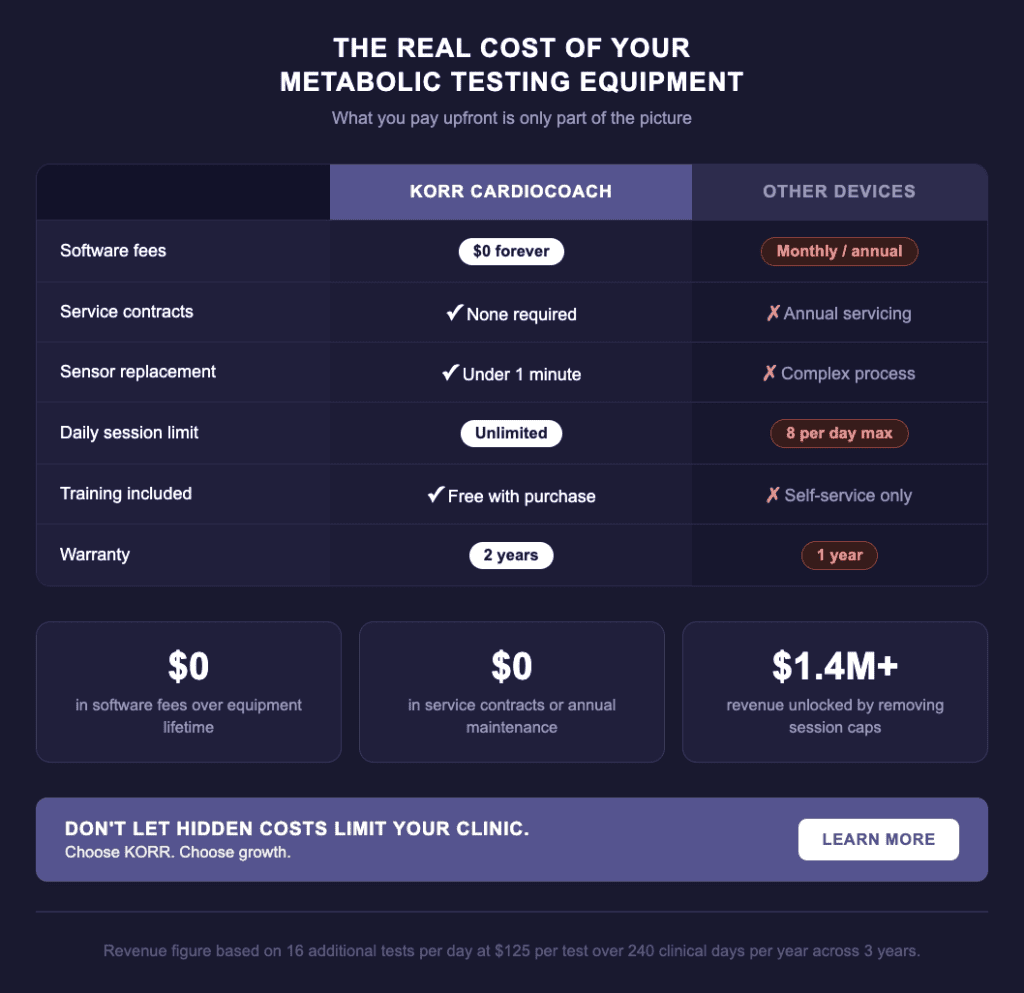
Some metabolic analyzers have documented session limits. Certain breath-by-breath devices cap daily testing at eight sessions and require mandatory cooldown periods between clients, sometimes up to an hour, to allow internal sensors to dry and reset. For a facility hoping to run morning testing blocks or offer multiple appointments throughout the day, that kind of restriction is a hard ceiling on revenue.
Before purchasing any VO2 max testing equipment, ask the manufacturer directly: is there a maximum number of sessions per day? Is there required downtime between sessions? What happens to accuracy if those limits are exceeded?
The financial impact of throughput limits compounds quickly. At $125 per test, the difference between 8 and 24 tests per day is $2,000 in daily revenue. Over 20 clinical days that is $40,000 per month. Equipment engineered for high-volume clinic use does not just pay for itself faster. It changes the ceiling on what your testing service can earn.
Equipment designed for commercial facility use should not impose scheduling constraints that limit your ability to serve clients. The KORR CardioCoach has no documented session limits and no mandatory cooldown between tests. When one client finishes, the next begins. For a facility charging $100 to $150 per test, the difference between eight and fifteen daily sessions is significant daily revenue.

2. What Does This Actually Cost Over Three Years, Not Just at Purchase?
The purchase price of VO2 max testing equipment is the starting point, not the full picture. The more relevant number is total cost of ownership over the life of the equipment.
Ask about ongoing software fees. Some systems charge monthly or annual subscription fees for the software platform, reporting tools, or cloud storage. Those fees add up quickly and compress the margin on every test you run.
Ask about service contracts. Some manufacturers require annual servicing that creates both direct costs and operational downtime while the equipment is out of your facility.
Ask about consumables. Certain devices require assessment kits or specialized components that need replacement every fifty tests or at fixed intervals. At volume, consumable costs become a meaningful line item.
Ask about sensor replacement. All metabolic analyzers use oxygen sensors that degrade over time. The difference is how complex and costly replacement is. The CardioCoach uses a user-replaceable oxygen sensor cartridge that requires no tools and no recalibration. Staff can replace it in under a minute. The new cartridge arrives factory calibrated and ready to use.
KORR charges no ongoing fees for software, reports, or analysis. The equipment you purchase is the system you own. For facility operators building a testing service with predictable margins, that matters.
3. How Much Staff Training Does This Require, and What Happens When Staff Turns Over?
Metabolic testing equipment that requires specialized certification or extensive training creates operational risk. If the one staff member who knows how to run the system leaves, your testing service shuts down until someone else is trained.
Ask how long it takes a new employee to learn to perform a test competently. Ask whether the manufacturer provides training and what that training costs. Ask whether the software guides users through the testing process or assumes prior knowledge.
The best VO2 max testing equipment for gym and facility use is designed so that any trained staff member can conduct a test after a brief onboarding session. KORR includes free training by credentialed personnel with every CardioCoach purchase. The software interface guides users through the testing process with on-screen prompts, which means new staff can conduct assessments after minimal training without a specialist present.
This matters more than it seems when you are building a service that needs to run reliably across different staff schedules.
4. What Does the Calibration Process Look Like in Daily Practice?
Calibration is one of the least glamorous topics in equipment evaluation and one of the most operationally significant.
Some metabolic analyzers require calibration procedures involving gas tanks, syringes, and multi-step protocols that take fifteen minutes or more. In a facility testing multiple clients throughout the day, that time adds up. It also introduces the possibility of human error. If a staff member skips a calibration step under time pressure, the accuracy of the next several tests is compromised without anyone knowing.
Ask how long calibration takes. Ask what equipment or consumables calibration requires. Ask whether the process is automated or manual. Ask what happens to test accuracy if calibration is performed incorrectly.
The CardioCoach auto-calibrates in approximately ninety seconds using ambient room air. No gas tanks. No syringes. No steps that can be performed incorrectly. The system measures barometric pressure, temperature, and humidity automatically and adjusts to standard conditions. Staff do not have to manage the calibration process. It happens, it takes ninety seconds, and testing begins.
For a busy facility, hands-free calibration is not a minor convenience. It is a meaningful operational advantage.
5. What Outputs Does the Equipment Produce, and How Do Clients Receive Their Results?
A VO2 max test is only as valuable as what the client walks away with. If the report is a spreadsheet of raw numbers without context or explanation, most clients will not know what to do with it. That limits the perceived value of the service and reduces the likelihood they return for follow-up testing.
Ask what the client-facing report looks like. Ask whether results can be customized with your facility’s branding. Ask whether clients can access their data between sessions to stay engaged with their training. Ask whether the software produces training zone prescriptions based on test results, and whether those zones can be customized based on different methodologies.
The CardioCoach produces reports formatted for client education with clear data visualization and customizable recommendations. The free CardioCoach mobile app gives clients access to their results and allows them to build and track workouts based on their test data between sessions. That ongoing engagement between testing appointments increases client retention and creates natural touchpoints for upselling follow-up tests.
Multiple zoning methodologies are available, including percentage of VO2 max, percentage of heart rate max, anaerobic threshold-based zones, and manual selection. Practitioners can select the methodology that best fits each individual client rather than applying a one-size-fits-all output.
One More Thing Worth Considering
Beyond these five questions, it is worth thinking about who you are buying from.
Metabolic testing equipment is not a commodity purchase. The manufacturer relationship matters. Training quality, customer support responsiveness, software updates, and the company’s long-term commitment to the product category all affect how the equipment performs in your facility over time.
KORR Medical Technologies has been manufacturing metabolic testing equipment for professional facilities for over two decades. The CardioCoach is in use at more than 1,000 locations worldwide, across gyms, wellness centers, physical therapy clinics, universities, and medical practices. Use our facility finder to see where CardioCoach is already being used near you. That track record reflects equipment that works in real commercial environments, not just controlled laboratory conditions.
If you are evaluating VO2 max testing equipment for your facility, the right next step is seeing the system in action. Contact KORR at korr.com or call 1-801-483-2080 to schedule a demonstration and discuss which CardioCoach configuration fits your operation.