



If you’re looking for a game-changer in how you approach client training, consider focusing on VO₂ Max. While tracking weight, measurements, and strength gains provides useful data, VO₂ Max takes it a step further. This powerful metric of cardiorespiratory fitness helps you design more effective programs and gives clear evidence of your clients’ progress.
When clients come to you frustrated that they’re not seeing results from their current fitness routine, having objective data about their cardiovascular fitness can be a game-changer. VO₂ Max testing offers precisely that – a scientifically validated measurement of how efficiently their body utilizes oxygen during exercise. This insight allows you to move beyond generic workout plans and create personalized training strategies.
Age is a crucial factor in interpreting VO₂ Max results for your clients. While the average person experiences a decline of approximately 10% per decade after age 30, this knowledge presents an opportunity. By understanding where your clients stand relative to their age group, you can set realistic goals and demonstrate progress even as they get older. This becomes a powerful tool for client retention – showing them that age doesn’t have to mean declining fitness when working with a knowledgeable trainer.
Knowing your clients’ VO₂ Max numbers transforms how you approach program design. Rather than relying on perceived exertion or general age-based formulas, you can create training protocols based on accurate data. This is valuable for establishing proper training zones, especially Zone 2 training, which has become recognized for its role in building endurance and metabolic efficiency. Understanding where a client’s VO₂ Max stands relative to their age can be a crucial part of this process, so let’s explore what that means and how it impacts training strategies.
Understanding VO₂ Max
What Exactly is VO₂ Max? As a fitness professional, you need to be able to explain complex concepts in simple terms. When discussing VO₂ Max with clients, think of it as the maximum amount of oxygen their body can utilize during intense exercise. More specifically, it’s the measurement of how many milliliters of oxygen their body can use per kilogram of body weight per minute at their peak performance. VO₂ Max encompasses the entire oxygen transport system, from breathing efficiency to how effectively the muscles use the oxygen delivered.
The Gold Standard of Fitness Measurement
There’s a reason why VO₂ Max testing is considered the gold standard for assessing cardiorespiratory fitness. Unlike subjective measures or estimates based on formulas, VO₂ Max testing provides precise data about your client’s cardiovascular fitness. This technology captures the difference between inhaled and exhaled oxygen, offering unparalleled accuracy in determining their maximal oxygen consumption.
When discussing the value of VO₂ Max testing with clients, emphasize these points:
- It provides a comprehensive assessment of their entire cardiorespiratory system
- Results can’t be artificially inflated – it’s an objective measure of their current fitness
- Testing establishes clear, personalized training zones for the best results
- Regular retesting offers concrete evidence of improvement
Testing establishes clear, personalized training zones for optimal results, allowing you to precisely target different aspects of their cardiovascular development. Through regular retesting, you can offer concrete evidence of improvement, helping maintain client motivation and demonstrating the value of your training programs.
Factors Influencing Your Clients’ VO₂ Max
Understanding what impacts VO₂ Max helps you explain potential results and set realistic expectations for your clients. Here are the primary factors to consider:
Training Status
- Current fitness level significantly affects VO₂ Max potential – clients who have been sedentary will typically see rapid initial improvements, while those with an athletic background may have already developed their baseline capacity
- Sedentary clients typically have more room for improvement, often seeing gains of 15-20% in VO₂ Max within the first few months of structured training
- Well-trained clients may see smaller but still meaningful gains, typically in the range of 5-10% with proper programming
Genetic Factors
Individual genetic makeup plays a role in baseline VO₂ Max and potential for improvement. Some clients may have naturally higher or lower baselines, which can affect their starting point and ultimate potential. While genetic predisposition influences potential improvement ranges, it’s important to emphasize that all clients can make meaningful progress with proper training.
Age and Gender
The relationship between age, gender, and VO₂ Max is well-documented. VO₂ Max typically peaks in the early 20s, followed by a gradual decline that can be minimized through proper training. Male clients generally have higher values due to physiological differences like greater muscle mass and higher hemoglobin levels, but this shouldn’t impact individual goal-setting and progress tracking.
Training Specificity
Understanding how different types of training affect VO₂ Max development is crucial for program design. Zone 2 training plays a vital role in improvement, because it targets the aerobic system most effectively. Proper intensity distribution across all training zones is key for the best results, with research showing that a polarized approach often yields the best outcomes1.
Environmental Factors
- Altitude affects testing results and training adaptations, with performance typically decreasing by about 2% for every 1,000 feet above sea level
- Temperature and humidity can impact performance by affecting the body’s ability to regulate heat and oxygen delivery to working muscles
- Training environment should be considered when interpreting results and designing programs, especially for clients who train outdoors or at varying elevations
By understanding these fundamentals, you can better communicate the value of VO₂ Max testing to your clients and use the results to create more effective training programs. This knowledge positions you as an expert who uses scientific data to drive results, setting you apart from trainers who rely solely on subjective measures.
Understanding Age-Related VO₂ Max Variations
Understanding age-related VO₂ Max trends helps you set appropriate expectations and goals for your clients. While individual variation exists, research has established clear patterns in how VO₂ Max typically changes across the lifespan2.
The natural progression of VO₂ Max follows a predictable pattern throughout life. Peak values typically occur in the early to mid-20s, followed by a gradual decline. Research shows that after age 30, VO₂ Max tends to decrease by approximately 10% per decade in sedentary individuals. This decline can be reduced through proper training, particularly through well-structured training programs.
When discussing VO₂ Max with clients, it’s key to understand typical ranges based on age and gender. These ranges serve as benchmarks for initial assessment and goal setting. It’s important to note that these are general guidelines rather than strict rules, and clients may fall outside these ranges while still making meaningful progress in their fitness journey.
Males (ml/kg/min):
- 20-29 years: While poor scores fall below 33, superior scores exceed 52. The good range for moderately active individuals falls between 42-46, providing a realistic target for many clients beginning their fitness journey
- 30-39 years: Performance expectations adjust slightly downward, with superior scores now starting at 49. This age group often sees the most dramatic improvements with proper training intervention
- 40-49 years: The good range shifts to 39-44, reflecting natural age-related decline. Dedicated training can help clients maintain higher ranges despite their age
- 50+ years: While average scores decrease, exceptional performers can still maintain excellent (41-45) or superior (>45) scores through consistent training
Females (ml/kg/min):
- 20-29 years: Superior performance starts at 41, with most recreational athletes falling in the good range of 33-37. This provides an excellent baseline for setting initial client goals
- 30-39 years: The excellent range spans 35-40, demonstrating that high performance is still very achievable in this age group with proper training
- 40-49 years: Good scores range from 33-37, but many clients can exceed these benchmarks through consistent, well-designed training programs
- 50+ years: While average scores naturally decrease, dedicated training can help maintain scores in the good (27-31) or excellent (31-36) ranges, far exceeding age-related expectations
The Importance of Age-Group Comparisons
Setting expectations and goals requires careful consideration of age-related norms. This context helps create more meaningful training experiences for your clients. By understanding these benchmarks, you can demonstrate how their performance compares to peers while still emphasizing personal progress as the main metric of success.
Individual Variation
Training history plays a role in determining a client’s VO₂ Max potential and response to training:
- Previous athletic experience can impact baseline measurements, with former endurance athletes often retaining higher values even after periods of inactivity
- The type and intensity of past training influences adaptation potential, with clients who have never engaged in structured cardiorespiratory training often seeing the most dramatic initial improvements
- Training consistency over the past 3-5 years provides valuable context for setting realistic progression targets
Genetic factors and current health status play a role in determining baseline VO₂ Max and the potential for improvement. For example, the distribution of muscle fiber types can affect how an individual responds to training, with a predominance of Type I fibers often linked to a higher VO₂ Max potential3. Cardiovascular health markers like resting heart rate and blood pressure can influence training capacity and adaptation rates. It’s also important to consider any medications or underlying health conditions when interpreting VO₂ Max results and designing personalized training programs.
Lifestyle factors also play a key role in training outcomes. Daily activity patterns, including occupation and commuting habits, can impact how well someone adapts to training. Sleep quality and quantity also affect the outcome, as 7-9 hours of sleep are recommended for recovery and adaptation. Nutritional status and dietary habits further influence testing performance and training results, particularly in terms of energy availability and recovery. These lifestyle factors should be considered when designing training programs to create the best possible outcomes for your clients.
Signs Your Clients’ VO₂ Max May Need Improvement
Identifying potential VO₂ Max deficiencies before testing helps you communicate the value of assessment to your clients. Understanding these signs allows you to make informed recommendations and highlight the importance of cardiorespiratory fitness in athletic performance and daily life.
Observable Daily Life Indicators
When consulting with new clients, their daily life experiences often reveal valuable insights about their cardiovascular fitness. Many clients may not realize that their everyday challenges stem from limited VO₂ Max capacity. By helping them connect these dots, you can better illustrate the benefits of improved fitness.
Work Capacity Signs:
- Clients reporting excessive fatigue during routine activities often indicate poor oxygen utilization efficiency – watch for specific mentions of struggling with stairs, feeling winded while carrying groceries, or needing to rest during basic household chores that shouldn’t be challenging
- Difficulty maintaining focus or energy levels throughout the workday, particularly noting an afternoon energy crash that may signal their cardiovascular system isn’t efficiently delivering oxygen to their brain and body
- Struggling with consecutive days of physical activity or basic tasks may indicate poor aerobic foundation, especially if they need full rest days between moderate activities that shouldn’t require recovery
Exercise-Related Performance Indicators
The way clients respond to exercise provides solid information about their current VO₂ Max status. These are practical observations you can make during training sessions:
Early Session Performance:
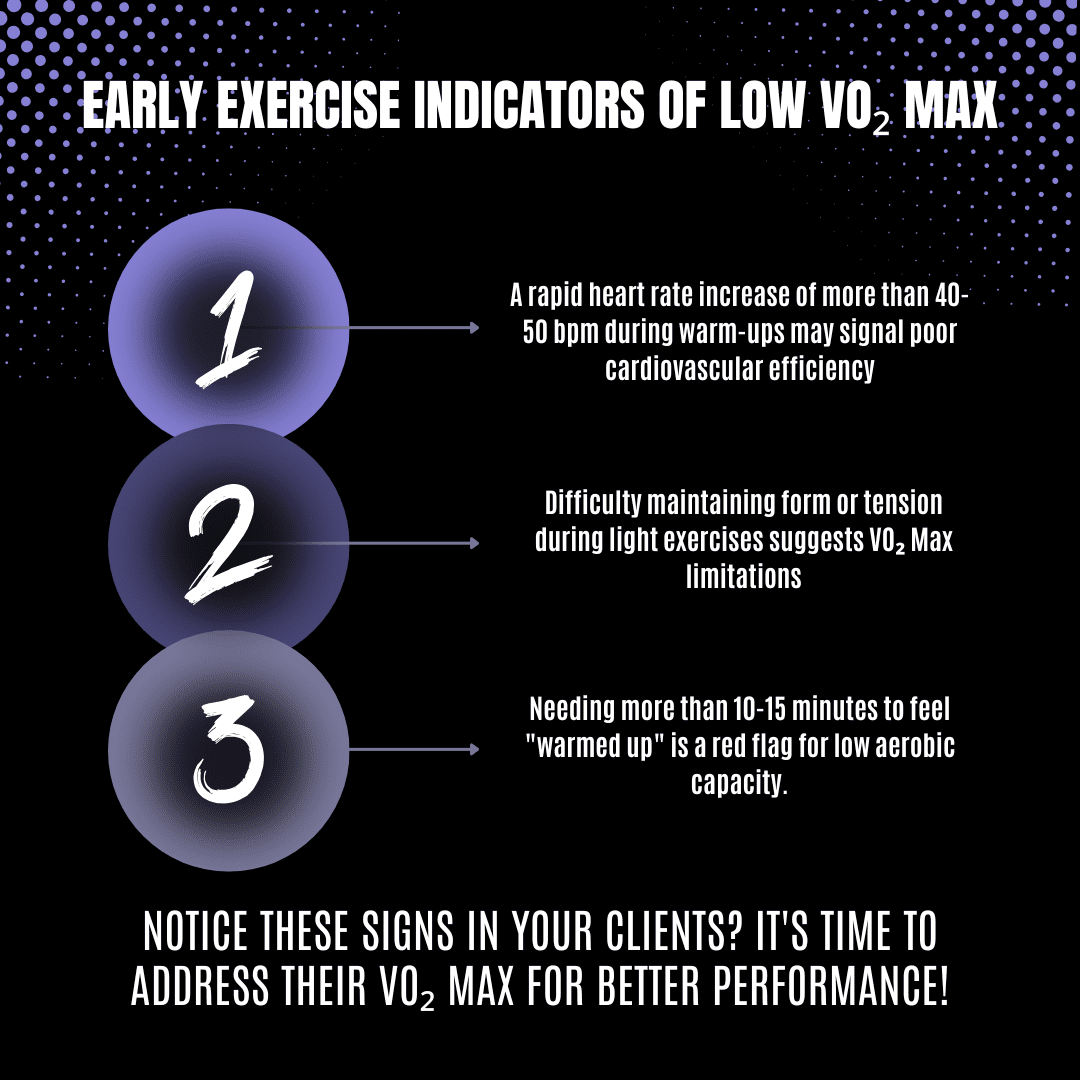
- Rapid heart rate elevation during basic warm-up activities, noting when heart rate jumps more than 40-50 beats per minute above resting with simple movements like walking or light jogging
- Difficulty maintaining proper form early in cardiovascular exercises, especially observing postural changes, increased upper body tension, or irregular breathing patterns within the first few minutes of activity
- Extended time needed to feel “warmed up” and ready for main workout components, watching for clients who require more than 10-15 minutes to feel prepared for moderate intensity work
During-Session Markers:
- Inconsistent heart rate responses to steady-state work, noting dramatic fluctuations during activities that should maintain stable heart rates
- Inability to maintain target heart rates in Zone 2 without significant strain, especially watching for clients who struggle to stay in lower intensity zones without slipping into higher heart rate ranges
- Excessive perceived exertion during moderate-intensity activities, specifically when clients rate activities as “hard” or “very hard” that should feel sustainable and moderate
Recovery Pattern Insights
Understanding recovery patterns has become more pivotal in identifying fitness limitations. Poor recovery often indicates suboptimal VO₂ Max and provides clear indicators for when testing would be beneficial:
Between-Session Recovery:
Immediate recovery indicators can provide valuable insights into a client’s fitness and recovery capacity. For example, if a client’s heart rate remains elevated for an extended period after exercise, especially when it takes more than 3-5 minutes to return within 20 beats of pre-exercise levels, it may signal recovery issues. Difficulty transitioning between exercises without extended rest is another indicator, especially when clients need more than 2-3 minutes between moderate intensity sets. Excessive breathlessness that continues after moderate activity, where clients cannot return to conversational breathing within 1-2 minutes of completing exercise, also suggests a need for improvement in recovery. These signs can help guide adjustments to training programs for better outcomes.
The key to successfully implementing VO₂ Max testing lies in clear communication with your clients about its value. Focus on connecting their current challenges with the solutions that accurate testing provides. Emphasize how testing removes guesswork from their training and allows for personalized program design.
Translating Observable Indicators into Action
Being able to recognize these signs of suboptimal VO₂ Max positions you to have meaningful conversations with clients about their fitness needs. While these indicators help identify who might benefit most from testing, remember that they serve as discussion points rather than diagnostic tools. The only way to truly determine a client’s VO₂ Max is through proper testing.
When you observe multiple indicators in a client, use these observations to build a compelling case for VO₂ Max testing. By connecting their daily challenges and training limitations to concrete solutions that testing provides, you demonstrate your expertise while offering a clear path to improvement. This approach helps clients understand the value of testing and sets the foundation for more effective training programs.
Taking Action
As a fitness professional, your role extends beyond testing – translating those results into effective training programs helps your clients achieve their goals.
The Foundation: Zone 2 Training
Zone 2 training serves as the cornerstone of VO₂ Max improvement, and understanding its importance is crucial for program design. This often-overlooked training zone offers unique benefits that make it essential for cardiovascular development.
Zone 2 training improves mitochondrial density and efficiency, enhancing your clients’ ability to utilize oxygen at the cellular level. This adaptation is crucial because it creates lasting improvements in endurance capacity that benefit all other training zones. Unlike high-intensity work, Zone 2 training can be performed frequently without overtraining risks, allowing for consistent progress through regular training sessions. The relatively low intensity makes it accessible for clients of all fitness levels while still providing cardiovascular benefits.
The impact of Zone 2 training extends beyond its specific intensity range. It enhances recovery capacity between high-intensity sessions while building the aerobic foundation necessary for improved performance in Zones 3-5. Furthermore, it develops fat oxidation efficiency, improving metabolic flexibility, and creates sustainable progress with lower injury risk. This makes it an essential component of any well-designed training program aimed at improving VO₂ Max.
Implementing Improvement Strategies
Creating effective VO₂ Max improvement programs requires a systematic approach through distinct phases:
Initial Phase (Weeks 1-4): The first month focuses on establishing proper Zone 2 training form and pacing, with emphasis on maintaining steady-state effort within the prescribed heart rate range. Begin with 20-30 minute sessions at Zone 2 intensity, performed 2-3 times per week. This period is vital for introducing basic heart rate monitoring skills and teaching clients to recognize proper training intensity. The main focus should be on building consistency and proper mechanics before increasing duration.
Development Phase (Weeks 5-12): As clients adapt to initial training, gradually increase Zone 2 session duration by 5-10 minutes every 1-2 weeks. This phase introduces one higher-intensity session per week to complement Zone 2 training while carefully monitoring recovery patterns to ensure appropriate progression. Begin tracking performance metrics beyond heart rate, including pace, power, and perceived effort, to provide a more complete picture of client adaptation.
Optimization Phase (Weeks 13+): The advanced phase introduces polarized training approaches combining Zone 2 with targeted high-intensity work. Regular testing becomes crucial for tracking progress and adjusting training zones. This phase requires fine-tuning the balance between various training intensities based on client response and adjusting programs based on objective performance data.
The Value of Regular Testing
Implementing a structured testing schedule proves invaluable for both trainer and client. Baseline testing establishes starting points, while retesting every 8-12 weeks measures improvements and allows for training zone adjustments. This data validates training approaches and demonstrates program effectiveness while tracking long-term trends to ensure continued progress.
Program optimization becomes more precise with regular testing. Rather than relying on historical data, you can adjust training zones based on current fitness levels and identify plateaus early. This objective evidence of improvement maintains client motivation while allowing you to fine-tune the balance between different training intensities for the best results.
Age-Specific Considerations
While the basic principles remain consistent, age-specific modifications help optimize results for different client populations. Younger clients in their 20s and 30s should focus on building proper training habits and fundamental skills while taking advantage of their higher recovery capacity for more frequent training sessions. The emphasis should be on developing strong cardiovascular fitness for long-term health benefits.
Middle-aged clients require a more nuanced approach that balances improvement goals with recovery needs. Special attention must be paid to proper progression to prevent overtraining, and consistency should be emphasized over intensity. This helps maintain steady progress while minimizing the risk of setbacks.
For older clients, the focus shifts to maintaining functionality and independence through improved fitness. Training sessions should prioritize form and safety, with longer adaptation periods between intensity increases. This approach creates continued progress while respecting the body’s changing recovery needs.
Your Role as a Trainer
As fitness professionals, we have the unique opportunity to transform our clients’ lives through improved cardiovascular fitness. The science is clear: VO₂ Max improvement is achievable at any age, and with proper assessment and programming, we can help our clients surpass what they believed possible for their fitness level.
The foundation of successful VO₂ Max improvement lies in precise testing using mixing chamber technology. This gold-standard approach eliminates guesswork and provides the detailed data needed to create truly personalized training programs. Unlike estimated measurements or generic formulas, professional testing reveals exactly where your clients stand and how to move them forward effectively.
Modern mixing chamber technology offers unprecedented accuracy in determining training zones, particularly the Zone 2 range where major cardiovascular development occurs. This precision allows you to design programs that maximize results while minimizing unnecessary strain or undertraining.
Taking Action Now
The time to integrate professional VO₂ Max testing into your practice is now. Your clients are seeking measurable results and reliable guidance in their fitness journey. By offering precise, technology-backed assessment and programming, you position yourself as a cutting-edge professional who delivers evidence-based results.
Every client who walks through your door represents an opportunity to transform their cardiovascular fitness and, by extension, their quality of life. Professional VO₂ Max testing provides the roadmap for that transformation, allowing you to create programs that deliver consistent, measurable improvements regardless of your clients’ starting points or age.
Your expertise, combined with accurate testing and thoughtful programming, can help clients achieve levels of cardiovascular fitness they never thought possible. Take the step toward becoming a leader in evidence-based fitness programming by incorporating professional VO₂ Max testing into your practice today.
References:
- Seiler S. What is best practice for training intensity and duration distribution in endurance athletes? Int J Sports Physiol Perform. 2010;5(3):276-91. doi: 10.1123/ijspp.5.3.276. PubMed PMID: 20861519.
- Strasser B, Burtscher M. Survival of the fittest: VO2max, a key predictor of longevity? Front Biosci (Landmark Ed). 2018;23(8):1505-16. doi: 10.2741/4657. PubMed PMID: 29293447.
- Mujika IE. Endurance Training: Science and Practice. Second ed: Iñigo Mujika S.L.U.; 2023.